3D Printing Quality Control for Industrial Applications
In industrial manufacturing, 3D printing quality control is the bridge between a digital design and a functional, reliable component. At RapidPrintParts, we prioritize consistency and performance for machinery OEMs, robotics integrators, and industrial hardware developers. Because our parts are built to be used—ranging from jigs and fixtures to low-volume end-use components—our quality processes validate that every component satisfies its intended engineering requirements.
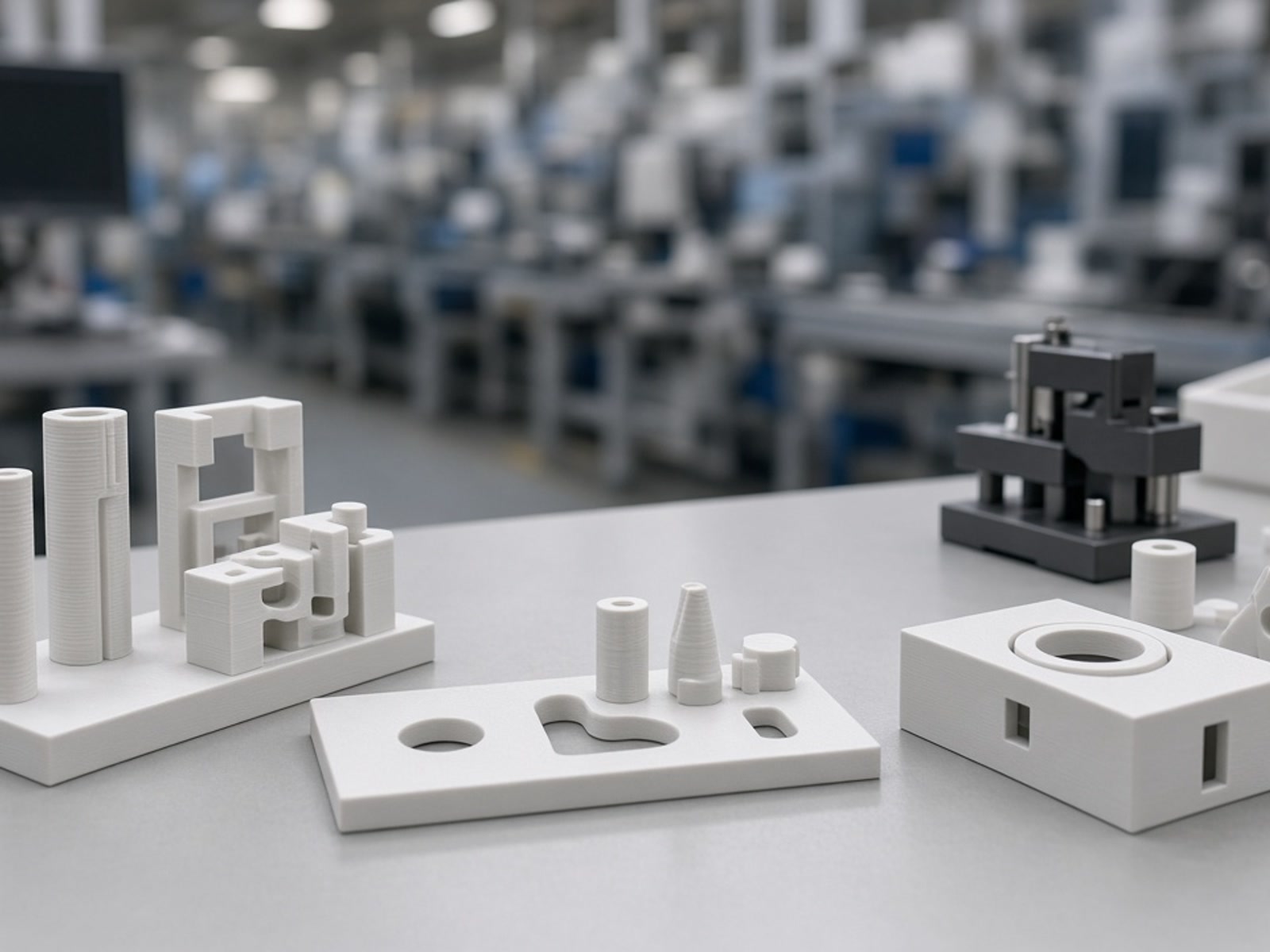
Systematic validation: CAD-to-part compliance for functional polymer assemblies.
Our Approach to Quality Assurance
Quality control in additive manufacturing requires a combination of process monitoring, post-build verification, and clear communication regarding expectations. We support our clients by aligning production parameters directly with the specific operating environment of the part.
Our engineering and quality team, consisting of approximately 12 dedicated professionals, oversees the production flow to ensure that material selection, print orientation, and post-processing steps are executed precisely to specification.
Process Monitoring
Continuous observation of thermal, layer deposition, and ambient environmental parameters during manufacturing.
Build Orientation
Strategic placement to optimize layer shear strength, critical fit surfaces, and minimal support mark impact.
Dedicated Oversight
A specialized team of 12 engineering and quality specialists auditing production steps before dispatch.
Post-Build Checks
Systematic verification of cleanout, finishing, insert retention, and geometric surface readiness.
Dimensional Accuracy and Tolerances
Additive manufacturing processes possess inherent variance dictated by thermal physics and polymer crystallization. Understanding these nominal reference ranges is critical for successful assembly and fit in industrial applications.
FDM / FFF
Fused Deposition Modeling for durable structural components and functional tooling.
SLA
Stereolithography for high-resolution visual masters and fine-pitch assembly checks.
SLS
Selective Laser Sintering for isotropic nylon housings, brackets, and complex ducts.
MJF
Multi Jet Fusion for dense, consistent end-use polymer components at production scale.
Engineering Review Requirement: These values represent typical references across standard geometries. Guaranteed tolerances for specific part profiles require upfront evaluation. During our review, we examine the critical dimensions of your CAD model (STEP/STP) to confirm if the requested tolerance envelope is achievable with the specified material, wall thickness, and thermal profile.
Documentation and Inspection Services
For B2B projects requiring supply chain traceability or performance validation, we offer structured quality support. These services are agreed upon during the quoting phase so that our quality team can seamlessly integrate inspection checkpoints into the manufacturing cycle.
First Article Inspection (FAI)
Validation of the initial production piece against supplied engineering drawings to verify toolpaths, shrinkage compensation, and critical dimensions prior to full batch execution.
Dimensional Inspection Reports
Direct measurement and verification records targeting the critical-to-quality features and clearance interfaces identified on your 2D engineering prints.
Material Documentation
Provision of relevant polymer technical data sheets (TDS) or certificates of conformity where applicable to verify raw resin or filament compliance.
Shipment Reports
Comprehensive summaries detailing lot production checks, visual verification, packaging protocols, and post-finishing steps completed before dispatch.
Selection Factors for Consistent Quality
Quality control is most effective when technical expectations are aligned during initial discovery. We encourage engineering teams to outline four critical operational factors when submitting project files:
Application Environment
Exposure factors such as operating temperature extremes, chemical agents, solvents, UV radiation, or recurring mechanical loads.
Critical Interfaces
Pinpointing exact datum planes, mating surfaces, bore diameters, or sliding fits that require prioritized tolerance control.
Post-Processing Needs
Secondary operations including precision CNC machining, threaded heat-set inserts, bead blasting, or vapor smoothing.
Functional Requirements
Compliance demands including electrostatic discharge (ESD) dissipation, flame retardancy ratings, or structural load-bearing limits.
Engineering Review for Critical Parts
Not every part requires the same level of inspection, but every functional part requires an engineering review. By submitting your CAD files, 2D drawings, and a clear description of the part’s application, our team can identify potential manufacturing challenges early. This proactive approach helps us recommend the optimal process—whether FDM, SLA, SLS, or MJF—to meet your functional requirements while maintaining strict quality standards.
Start Your Project Review
Contact our team today to discuss your project requirements and initiate an engineering review for your next industrial component.
Contact RapidPrintParts
Get in Touch
We are here to answer your questions about industrial additive manufacturing and functional 3D printed parts. Reach out to us through the following methods:
Email: [email protected]
Address: No. 17-1, Guanlan Avenue, Longhua District, Shenzhen, Guangdong Province, Shenzhen 3D Printing Industrial Park