316L Stainless Steel 3D Printing: An Overview
316L stainless steel is a widely utilized material in industrial additive manufacturing, known primarily for its exceptional corrosion resistance, high ductility, and weldability. Often referred to as "marine grade" stainless steel, the low-carbon "L" designation prevents carbide precipitation during thermal laser melting and sintering cycles.
Alloy Standard: UNS S31603 / 1.4404
Austenitic chromium-nickel-molybdenum stainless steel
Characteristics of 316L Stainless Steel
In an industrial context, 316L is favored for applications where aggressive environmental exposure is a factor. Its specific chemical formulation provides elevated defense against pitting and crevice corrosion in chloride-rich and chemically hostile environments.
Corrosion Resistance
The molybdenum content delivers superior protection against pitting in marine, saline, acid, and chemical-heavy process streams compared to standard 304 alloys.
Mechanical Strength
Preserves structural integrity and tensile strength across elevated operational ranges while maintaining stable performance at cryogenic temperatures.
Ductility & Toughness
Demonstrates high elongation at break and toughness, providing resistance against sudden brittle failure under sustained mechanical stress and cyclic loads.
Industrial Applications
316L is frequently specified for mission-critical components where longevity, media containment, and operational safety dictate material selection.
Fluid Handling Components
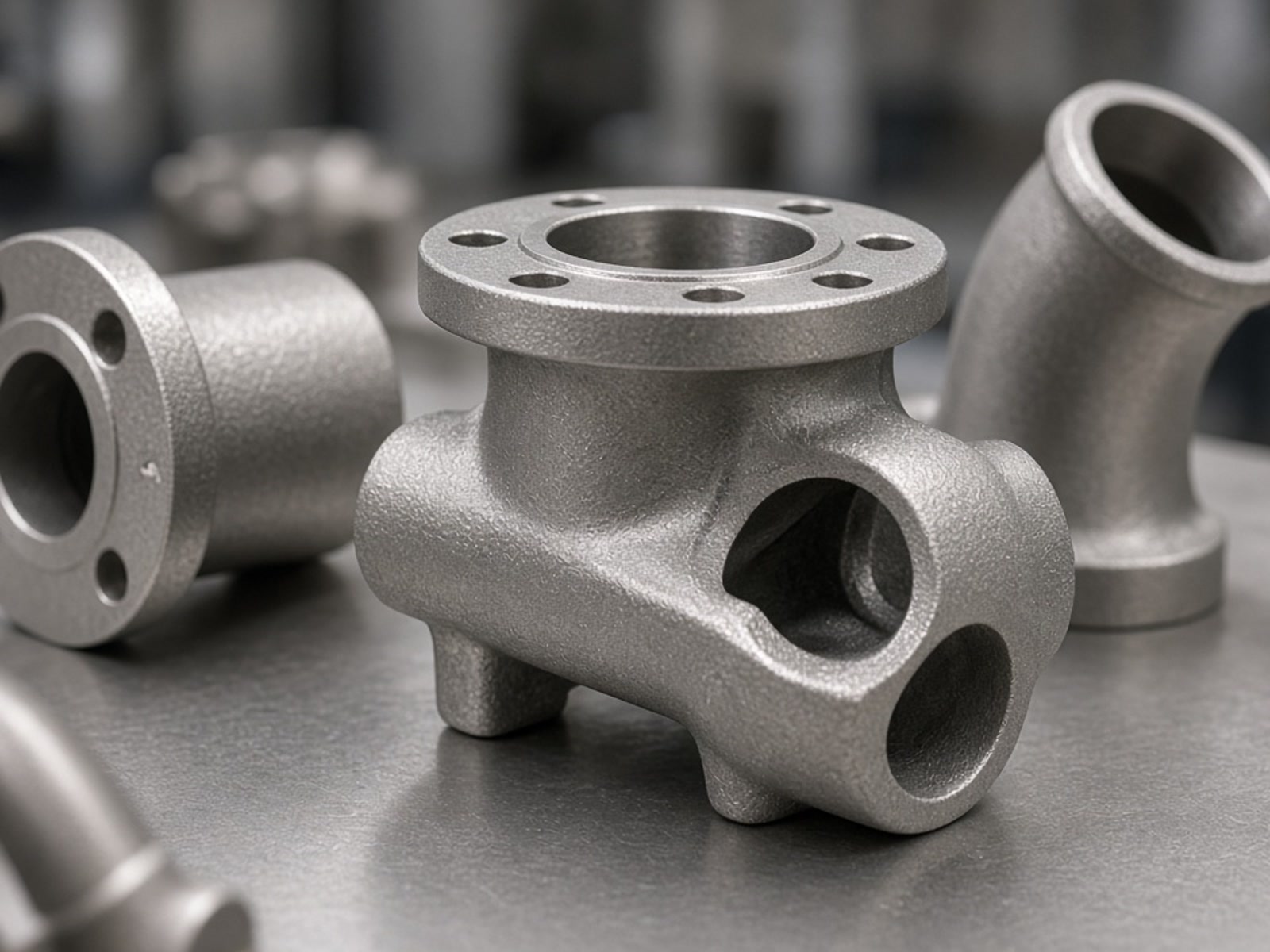
Custom impellers, valve bodies, manifolds, and specialized chemical flow fittings requiring internal conformal channels and leak-free resistance to aggressive working fluids.
Marine Hardware
Subsea connectors, sensor housings, and brackets engineered to withstand continuous immersion in harsh saltwater environments without surface breakdown.
Industrial Fixtures
Assembly jigs, end-effectors, and wear tooling deployed inside production cells where common tooling plastics or carbon steels degrade prematurely from cleaning solvents.
Design Considerations for Metal Additive Manufacturing
Designing for metal additive processes requires accounting for extreme localized thermal gradients. High-energy laser melting introduces residual stresses that affect part geometry and post-processing steps.
Wall Thickness & Geometry
Careful balance of thin and thick sections is essential. Unbalanced thermal masses can trigger internal stresses or localized warping during layer consolidation and cool-down cycles.
Support Structures
Supports in metal additive serve both as mechanical anchors to the build plate and as thermal conduits to dissipate heat. Critical design planning minimizes support placement on hard-to-access internal faces.
Surface Finish & Post-Processing
As-printed metal surfaces feature micro-roughness derived from powder particles. Mating flanges, O-ring grooves, and precision bearing fits require secondary CNC machining or polishing operations.
Selecting the Right Process & Material
While 316L stainless steel is an established baseline in metal additive manufacturing, the optimal production method is always defined by specific operational envelopes, functional tolerances, and batch volumes.
At RapidPrintParts, we specialize in high-performance functional polymers and engineering resins. When your project demands structural rigidity, temperature endurance, or chemical inertness, our engineering team assesses your exact application parameters—such as mechanical load, continuous operating temperature, and corrosive exposure—to identify whether advanced polymers (including PEEK, PEKK, or carbon-fiber reinforced nylon) or conventional metal fabrication processes represent the most cost-effective path forward.
Consult With an EngineerEngineering Feasibility & Material Assessment
Selecting the ideal material is critical to predictable component life. Our technical team is available to review your design drawings, evaluate environmental constraints, and help you determine the optimal manufacturing trajectory.
Detailed examination of mechanical stresses, operating fluid exposure, and thermal cycles.
Cross-material comparison between engineering polymers and traditional metals.
Design guidance to optimize build orientation, tolerances, and post-machining viability.
Submit Technical Specifications
Provide part parameters or CAD files to initiate engineering review.
Contact RapidPrintParts
Get in Touch
We are here to answer your questions about industrial additive manufacturing and functional 3D printed parts. Reach out to us through the following methods:
Email: [email protected]
Address: No. 17-1, Guanlan Avenue, Longhua District, Shenzhen, Guangdong Province, Shenzhen 3D Printing Industrial Park