Machinery 3D Printing
RapidPrintParts supplies functional parts produced by additive manufacturing for machinery and automation applications. Parts are evaluated against operating requirements including material, load, temperature, tolerance, finish, quantity, and lead time before a process is recommended.
- FDM/FFF, SLA, SLS, and MJF systems operated in-house
- Engineering review before any process is recommended
- Supports new builds, line upgrades, customization, and spares
Suitable Processes for Machinery Parts
RapidPrintParts operates FDM/FFF, SLA, SLS, and MJF systems in-house. These polymer processes address different machinery needs.
FDM / FFF
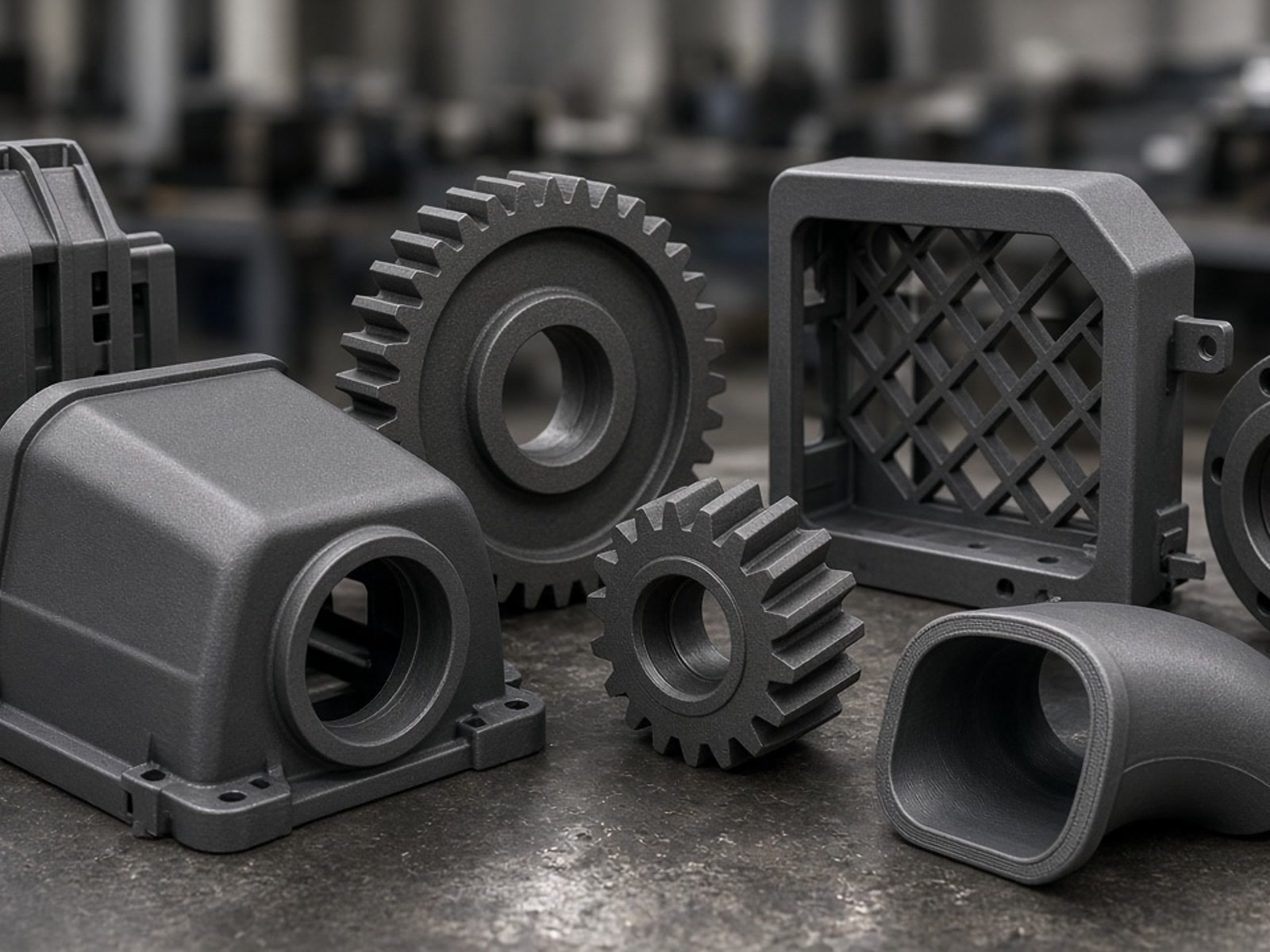
Used for larger fixtures, equipment housings, ducts, and structural components where build envelopes reach approximately 1,000 × 600 × 600 mm.
SLS / MJF
Produce complex, durable nylon parts such as guards, brackets, and low-volume end-use components without support structures.
SLA
Supports high-detail prototypes and fit-validation parts when fine features or smooth surfaces are required.
Typical Materials
ABS, ASA, PC, PA, PA-CF, PETG, TPU, and engineering resins. PEEK, PEKK, and PEI/ULTEM are available for higher-performance applications.
Typical Machinery Applications
Machinery and automation customers commonly request the following part types.
- Jigs, fixtures, robot EOAT, and assembly aids
- Guards, ducts, brackets, and mechanical housings
- Functional prototypes for engineering validation
- Replacement parts and bridge-production components before tooling
Where These Parts Fit
These parts are produced for new machine builds, line upgrades, customization projects, and maintenance spares.
New Machine Builds
Line Upgrades
Customization Projects
Maintenance Spares
Selection Factors and Design Inputs
Process and material choice depends on the following inputs.
Application Environment
Mechanical loads and operating environment.
Quantity
Volume and repeat-order potential.
Tolerances
Required tolerances and critical dimensions.
Exposure
Temperature, chemical, or flame exposure.
Finish
Surface finish and post-processing needs.
Lead Time
Target lead time for the project.
Typical Tolerance References
Guaranteed tolerances require engineering review.
Post-Processing Options
Available finishing steps may include:
Limitations and Engineering Review
Additive manufacturing is best suited for complex geometry, low-to-medium volumes, or parts that are slow or uneconomical with traditional methods. Very high volumes or simple geometries may be better addressed by other processes.
All projects begin with a review of the supplied application details, CAD data, and performance requirements.
Well Suited For
- Complex geometry
- Low-to-medium volumes
- Parts that are slow or uneconomical with traditional methods
Very high volumes or simple geometries may be better addressed by other processes.
Submit Your Part Information
Submit your part information for an engineering review to determine suitable processes, materials, and lead-time options.
Email: [email protected]
Address: No. 17-1, Guanlan Avenue, Longhua District, Shenzhen, Guangdong Province, Shenzhen 3D Printing Industrial Park
Contact RapidPrintParts
Get in Touch
We are here to answer your questions about industrial additive manufacturing and functional 3D printed parts. Reach out to us through the following methods:
Email: [email protected]
Address: No. 17-1, Guanlan Avenue, Longhua District, Shenzhen, Guangdong Province, Shenzhen 3D Printing Industrial Park