3D Printed End-of-Arm Tooling for Robotics and Automation
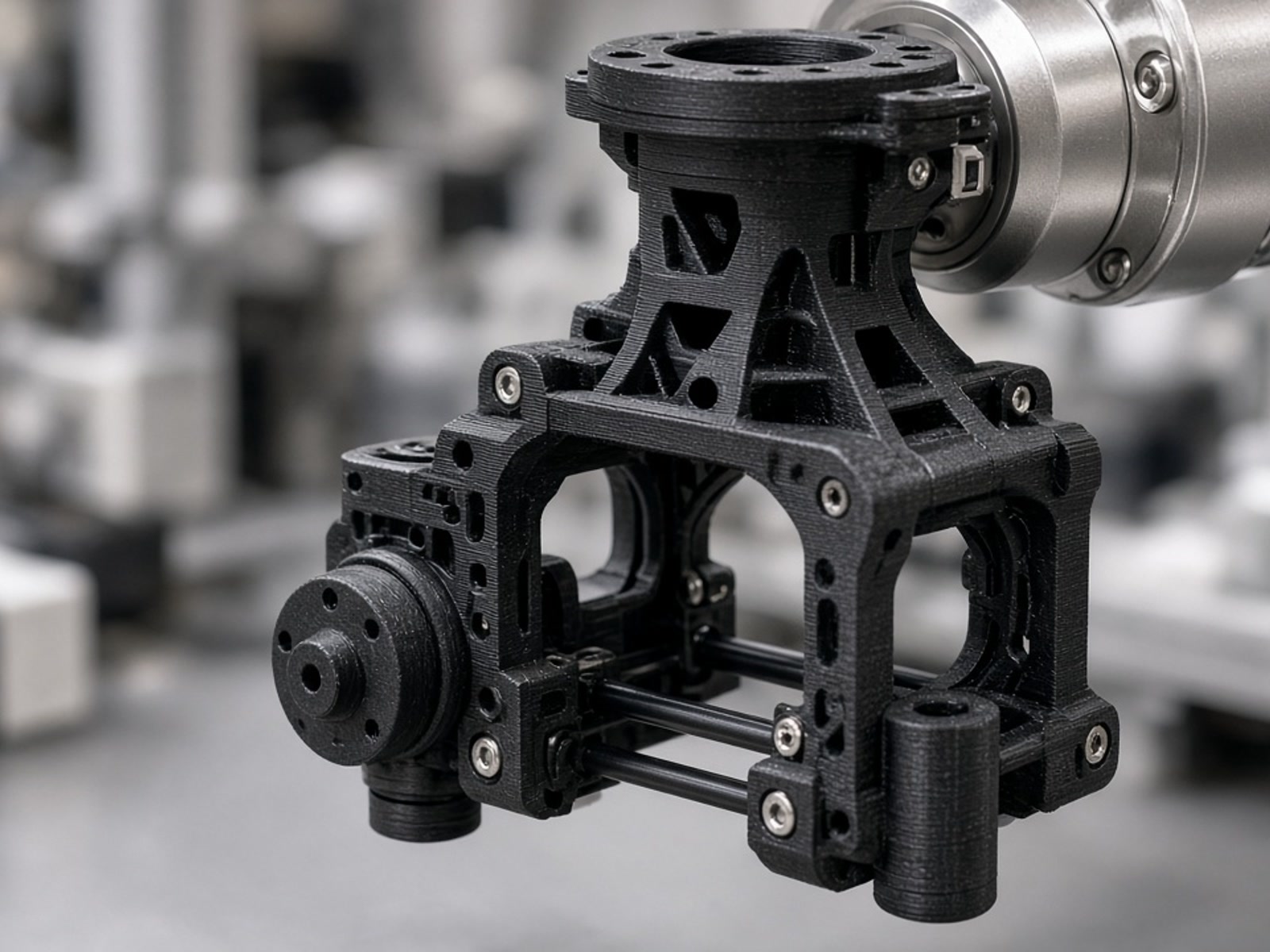
RapidPrintParts produces functional 3D printed end-of-arm tooling (EOAT) using polymer additive manufacturing processes. These parts serve robotics integrators and automation OEMs that require custom grippers, brackets, and lightweight structures for line upgrades or customer projects.
- Processes
- FDM · SLA · SLS · MJF
- Focus
- Low-Volume Functional Parts
- Inputs
- STEP / STP · 2D Drawing
Suitable Applications in Industrial Settings
End-of-arm tooling includes grippers, sensor mounts, vacuum manifolds, and lightweight adapters. These components support repetitive handling tasks where traditional machined parts add unnecessary weight or lead time. RapidPrintParts evaluates each request against operating requirements such as material, load, temperature, and quantity before recommending a process.
Grippers
Custom end effectors for repetitive handling tasks.
Sensor Mounts
Positioning and mounting components for automation cells.
Vacuum Manifolds
Integrated channels enabled by additive geometry.
Lightweight Adapters
Weight reduction where machined parts add mass.
In-House Polymer Processes for EOAT
RapidPrintParts uses four polymer processes for EOAT components. These processes align with the needs of robotics teams that require low-volume functional parts without tooling.
FDM / FFF
Large StructuresSuits larger structures and equipment parts with materials including ABS, ASA, PC, PA, PA-CF, PETG, TPU, and PEEK.
Build envelopes reach approximately 1,000 × 600 × 600 mm.
SLA
High DetailProduces high-detail prototypes and fit-validation parts using engineering resins.
Typical envelopes are approximately 600 × 600 × 400 mm.
SLS
Durable NylonDelivers complex, durable nylon parts in PA12, PA11, PA12 GF, and TPU.
Envelopes are approximately 380 × 380 × 600 mm.
MJF
Complex GeometryDelivers complex, durable nylon parts in PA12, PA11, PA12 GF, and TPU.
Envelopes are approximately 380 × 284 × 380 mm.
Practical Selection Factors
Engineers should provide the following inputs for accurate process and material recommendations.
- Application and operating environment
- Expected load, temperature, and chemical exposure
- Critical dimensions and tolerance requirements
- Quantity and repeat-order potential
- Target lead time
Tolerance References
Guaranteed tolerances require engineering review.
| Process | Tolerance Reference |
|---|---|
| FDM & MJF | ±0.2 mm or ±0.3% |
| SLA | ±0.1 mm or ±0.2% |
| SLS | ±0.3 mm or ±0.3% |
Post-Processing Options
Design and Performance Limitations
Additive manufacturing enables complex internal channels and weight reduction, yet part performance depends on material selection and build orientation. Not every geometry or load case is suitable for every process. Parts intended for high-cycle or safety-critical use must undergo engineering evaluation before production.
Engineering evaluation is required before production for high-cycle or safety-critical parts.
Next Step: Engineering Review
Provide STEP/STP files, a 2D drawing, or a description of the operating conditions. RapidPrintParts reviews application requirements, material options, and process fit before quoting.
- STEP / STP files or a 2D drawing
- A description of the operating conditions
- Application requirements, material options, and process fit reviewed before quoting
Request an EOAT Engineering Review
Share your application details and RapidPrintParts will review process fit before quoting.
Contact RapidPrintParts
Get in Touch
We are here to answer your questions about industrial additive manufacturing and functional 3D printed parts. Reach out to us through the following methods:
Email: [email protected]
Address: No. 17-1, Guanlan Avenue, Longhua District, Shenzhen, Guangdong Province, Shenzhen 3D Printing Industrial Park