Industrial 3D Printed Prototypes for Functional Engineering Validation
In industrial product development, 3D printed prototypes serve as critical milestones between initial design and full-scale production. Moving beyond simple appearance models, functional prototypes allow engineering teams to validate mechanical assemblies, test material performance under load, and verify fitment within complex machinery.
RapidPrintParts specializes in producing industrial-grade prototypes that meet the rigorous demands of Machinery OEMs, robotics integrators, and product developers. Utilizing professional additive manufacturing processes, we help bridge the gap between EVT (Engineering Validation Testing) and final production.
Selecting the Right Process for Your Prototype
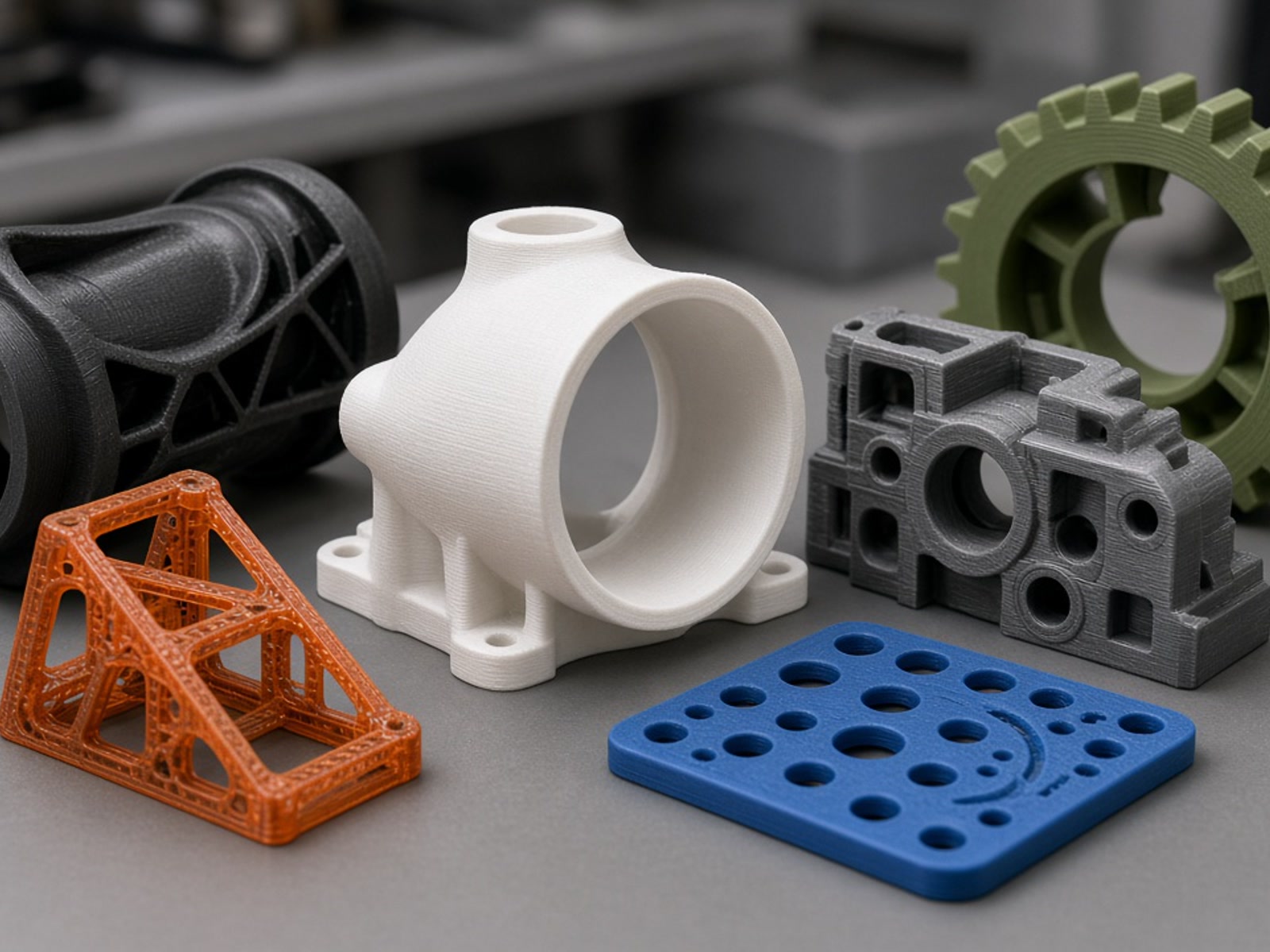
The choice of 3D printing technology depends on the prototype's intended application, operating environment, and required mechanical properties. We offer four core in-house processes to meet diverse engineering needs.
FDM (Fused Deposition Modeling)
Large EnvelopeIdeal for large-scale structures and rugged equipment parts. Features an expansive build envelope of up to 1,000 × 600 × 600 mm, supporting industrial-grade and high-performance thermoplastics.
SLA (Stereolithography)
High PrecisionWhen high surface finish and fine detail are the priority, SLA is the preferred method for fit and appearance validation with tight reference tolerances.
SLS (Selective Laser Sintering)
Isotropic DurabilityProduces durable, isotropic parts without requiring support structures, allowing for highly complex internal geometries and rugged structural testing.
MJF (Multi Jet Fusion)
Production GradeOptimized for functional nylon components and low-volume bridge production, offering exceptional feature resolution and consistent mechanical properties throughout the build volume.
Engineering Selection Factors
To ensure an additive manufactured prototype matches real-world operating conditions, our engineering team thoroughly reviews design inputs before initiating production.
Drawing Requirement: For guaranteed tolerances on mating faces or press-fit features, please provide a 2D drawing highlighting critical dimensions alongside the native 3D file.
Mechanical Load
Evaluating whether the part will operate under constant tension, cyclic bending, compression, or high torque to determine the optimal build orientation and infill structure.
Operating Environment
Assessing exposure to continuous thermal stress, UV radiation, cleaning solvents, hydraulic fluids, or industrial chemical agents to select appropriate polymers.
Critical Tolerances
Applying baseline process references while establishing formal engineering reviews of your 2D drawings for critical mating interfaces and assembly pinholes.
Post-Processing Needs
Accommodating secondary operations such as heat-set threaded inserts, precision CNC boring, vapor smoothing for airtight sealing, or specialized painting.
Transitioning from Prototype to Production
3D printed prototypes frequently serve as bridge production components, enabling OEMs to begin assembly validation and field testing while waiting for traditional tooling.
Tooling Lead-Time Mitigation
Eliminate delays associated with multi-week mold making or casting tooling by deploying functional additive parts directly onto assembly trial lines.
High-Performance Materials
Components fabricated from PA12, PEEK, and carbon-fiber-reinforced filaments provide mechanical durability suitable for end-use automation components.
Engineering Iteration
Identify assembly conflicts, weight optimization possibilities, and stress concentrations before committing capital to permanent production tooling.
Technical Capabilities & Quality Support
RapidPrintParts operates a 2,600 m² production facility staffed by a dedicated engineering and quality team of approximately 12 specialists focused on industrial-grade additive manufacturing.
For all engineering prototypes, we recommend submitting a STEP/STP file accompanied by a 2D engineering drawing identifying all critical fit surfaces and dimensional parameters.
Quality Verification Services
- First Article Inspection (FAI): Detailed verification of initial production runs prior to completing batch orders.
- Dimensional Inspection Reports: Calibration reports verifying adherence to critical dimensional drawings.
- Material Documentation: Certificates of conformity confirming base polymer specifications and integrity.
- Standardized Shipment Reports: Complete documentation package packaged with dispatch goods.
Request an Engineering Review
Contact our engineering team to review your CAD data and receive a technical assessment for your functional 3D printed prototypes.
STEP / STP for 3D model geometry; PDF / DWG for 2D technical drawings with critical inspection dimensions.
2,600 m² additive manufacturing plant with 12-person engineering and quality team.
Submit Prototype Specifications
Fill out the form below to receive a formal technical assessment and pricing evaluation.
Contact RapidPrintParts
Get in Touch
We are here to answer your questions about industrial additive manufacturing and functional 3D printed parts. Reach out to us through the following methods:
Email: [email protected]
Address: No. 17-1, Guanlan Avenue, Longhua District, Shenzhen, Guangdong Province, Shenzhen 3D Printing Industrial Park