
Aerospace 3D Printing: High-Performance Polymers & Industrial Tooling
Aerospace additive manufacturing drives critical weight reduction, assembly consolidation, and rapid production of specialized tooling. RapidPrintParts delivers engineering-led polymer 3D printing for functional prototypes, shop-floor assembly aids, and low-volume end-use components tailored to demanding operating environments.
In-House Production
High-Performance Polymer Processes for Aerospace Support
For interior fixtures, environmental ducting, and ground support equipment, advanced polymers deliver significant weight and cost advantages over conventional metals while satisfying stringent mechanical requirements.
FDM / FFF Manufacturing
Optimized for large-format structures, rugged brackets, and high-temp production fixtures requiring certified functional properties.
- • PEI (ULTEM™) & PEEK: High heat deflection and intrinsic flame-retardant performance.
- • PA-CF: Carbon fiber-reinforced nylon delivering exceptional stiffness-to-weight.
- • ASA & PC: Environmental durability, UV stability, and high impact resistance for covers.
SLS & MJF Technologies
Support-free processing enables highly complex, consolidated geometries, fluid-handling channels, and robust low-volume production.
- • PA12 & PA11: Isotropic mechanical integrity, chemical resistance, and air-handling durability.
- • Glass-Filled Nylon (PA12 GF): Enhanced thermal stability and stiffness under sustained mechanical load.
- • Consolidated Assemblies: Eliminate fasteners by designing complete monolithic duct systems.
Industrial SLA Resin
Engineered for high-resolution visual prototypes, aerodynamic wind-tunnel visualization, and precise pre-production fit testing.
- • Engineering Resins: Simulated ABS and durable formulations for design validation.
- • High Detail: Crisp edge definitions and smooth surfaces for ergonomic inspection.
- • Fit & Function: Rapid clearance verification prior to releasing hard production tooling.
Metal 3D Printing in Aerospace
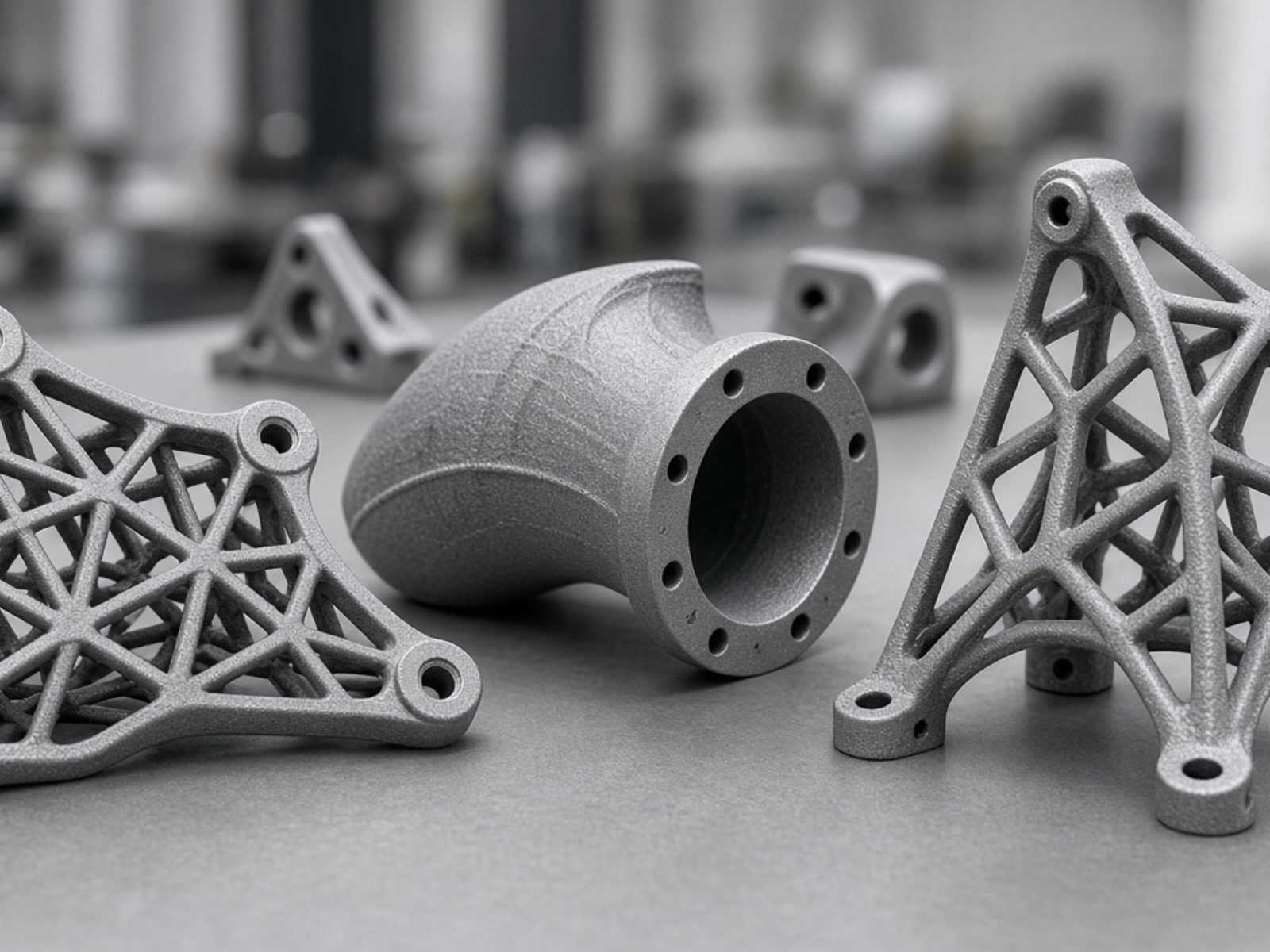
In the wider aerospace domain, metal additive manufacturing is utilized primarily for flight-critical propulsion components, high-pressure conduits, and airframe brackets. Key alloys commonly deployed across the industry include:
Exceptional strength-to-weight ratio and corrosion resistance for structural airframe fittings.
Maintains structural yield at extreme temperatures; widely selected for turbine and exhaust ducting.
Thermal conductivity and low mass for thermal exchangers and lightweight avionics housings.
Wear resistance and high tensile strength for ground infrastructure and heavy-load hardware.
Practical Implementation
Functional Polymer Applications in Aerospace Support
While flight-critical airframe hardware involves long-horizon regulatory qualification, industrial 3D printing is deployed every day across assembly plants, MRO facilities, and testing lines.
Jigs, Fixtures & Templates
Custom drill guides, trimming fixtures, and positioning templates produced in carbon-fiber reinforced nylon to prevent marring critical composite or aluminum panels.
Ducting & Fluid Manifolds
Complex internal contours and weight-optimized environmental control ducting built via SLS/MJF PA12, complete with vapor smoothing for airtight performance.
Robotic End-of-Arm Tooling
Lightweight grippers and vacuum end-effectors that reduce mechanical inertia on automated manufacturing and composite lay-up cells.
Validation Prototypes (EVT/DVT/PVT)
Form, fit, and assembly validation components to confirm mating clearances and ergonomics before investing in high-tonnage production molds.
Protective Housings & Ground Enclosures
Ruggedized, UV-stable ASA or flame-resistant ULTEM enclosures protecting avionics ground-support units, diagnostic equipment, and sensor harnesses.
Have a Custom Technical Requirement?
Submit your 3D models (STEP/STP) and functional constraints for a thorough manufacturability evaluation.
Engineering Framework
Design Parameters & Tolerancing
Successful adoption of additive manufacturing in demanding aerospace support tasks requires strict control over mechanical properties, thermal boundaries, and finishing operations.
Reference Tolerances
General reference tolerances for polymer processes typically range from ±0.1 mm to ±0.3 mm, depending on part scale, geometry, and process selection (SLA, FDM, SLS, or MJF). Guaranteed precision limits require a 2D engineering drawing review.
Thermal & Chemical Environment
Parts exposed to high ambient heat or chemical solvents require specialized polymers such as PEEK or PEI (ULTEM™). We verify continuous operating temperatures against required heat deflection metrics.
Post-Processing Capabilities
Enhance base polymer components with media blasting for uniform matte finishes, chemical vapor smoothing to ensure airtight duct sealing, and ultrasonic brass threaded inserts for reliable mechanical assembly.
Quality Assurance & Verification
RapidPrintParts supports industrial additive projects with a dedicated team of 12 engineering and quality professionals. Every project is reviewed for mechanical feasibility, build orientation, and interface tolerances.
Request an Engineering Review
Send us your component files for a thorough DFM (Design for Additive Manufacturing) evaluation. Our engineering team will review geometry, recommend high-performance polymers, and verify manufacturing feasibility.
Required Technical Inputs
- 1. CAD Geometry: 3D models in standard STEP (.stp) or native formats.
- 2. 2D Drawings: PDF prints identifying critical interface tolerances or inserts.
- 3. Operating Context: Thermal bounds, mechanical loads, or chemical exposure conditions.
- 4. Quantity: Low-volume runs, pre-production validation batches, or one-off fixtures.
Submit Aerospace Polymer Inquiries
Fill out the project specifications below to connect directly with our engineering department.
Contact RapidPrintParts
Get in Touch
We are here to answer your questions about industrial additive manufacturing and functional 3D printed parts. Reach out to us through the following methods:
Email: [email protected]
Address: No. 17-1, Guanlan Avenue, Longhua District, Shenzhen, Guangdong Province, Shenzhen 3D Printing Industrial Park