
3D Printed End-Use Parts
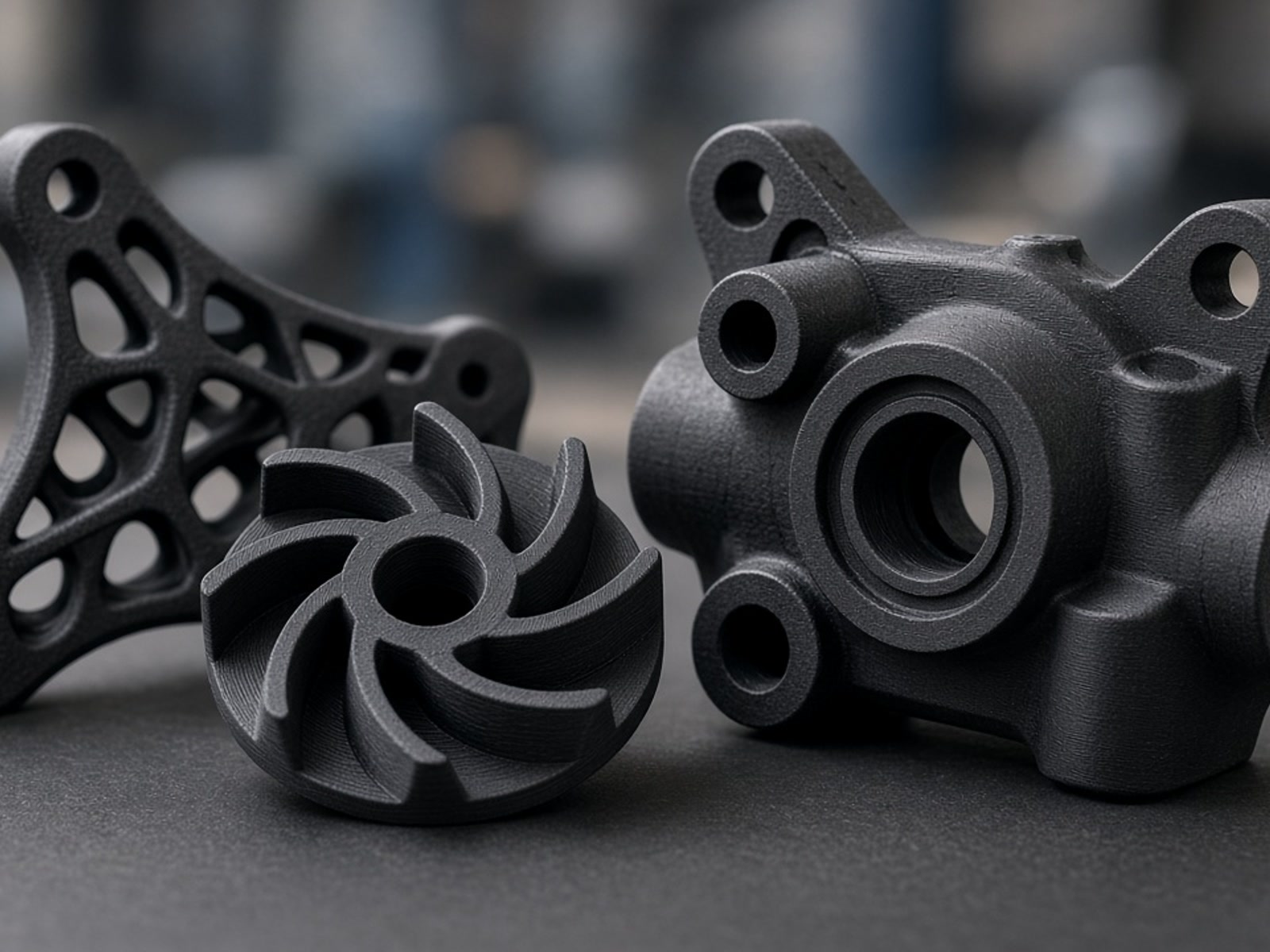
RapidPrintParts produces functional 3D printed end-use parts for demanding industrial environments where traditional tooling is uneconomical or lead times are too long. We deliver production-grade polymer components built for defined load capacity, temperature resistance, chemical resistance, and repeatable mechanical performance.
Industrial Scope
Typical Applications & Production Deployments
Additive components serve functional roles across machinery, automation, robotics, and maintenance operations where small-to-mid volumes or frequent engineering revisions make fixed tooling impractical.
Machinery & Automation OEMs
Structural mounts, custom sensor housings, cable management tracks, and complex manifold ducts integrated directly into automated production assemblies.
Robotics & End-of-Arm Tooling
Lightweight structural brackets, pneumatic routing channels, and customized vacuum grippers designed to minimize payload inertia and accelerate system cycles.
Bridge Production & Part Families
Pre-tooling pilot batches and low-volume commercial production runs that preserve design flexibility without upfront injection mold capital expenses.
Industrial Enclosures & Covers
Durable protective covers, control-panel bezels, and specialized environmental enclosures featuring integrated fastener standoffs and sealing gaskets.
MRO & Legacy Equipment Support
On-demand replacement components, obsolescence management, and custom retrofit brackets produced directly from 3D CAD files to reduce machine downtime.
Functional Prototypes to Production
End-use validation under genuine operating conditions, ensuring fluid dynamics, thermal resistance, and mechanical loading meet design criteria prior to scaling.
Manufacturing Systems
In-House Polymer Additive Technologies
RapidPrintParts evaluates operational stresses, chemical contact, thermal requirements, and tolerances to assign the correct manufacturing technology for each part.
FDM / FFF
Optimized for large structural elements, production fixtures, and durable internal housings requiring high-performance engineering thermoplastics.
Standard Materials:
ABS, ASA, PC, PA, PA-CF, PETG, TPU, PEEK
Multi Jet Fusion (MJF)
Delivers balanced mechanical properties, dense isotropic behavior, and repeatable geometry for low-volume functional parts without support scaffolding.
Standard Materials:
PA12, PA11, PA12 Glass Bead (GF), TPU
SLS
Suited for highly complex internal channels, thin-walled ducts, and durable mechanical assemblies requiring chemical and impact resistance.
Standard Materials:
PA12, PA11, Elastomeric TPU
SLA
High-detail resin curing for precise fit checks, micro-fluidic prototyping, and master patterns requiring smooth surface definitions.
Standard Materials:
Engineering Resins, Tough, High-Temp Resins
Integrated Secondary Operations & Surface Finishing
Components can be post-processed to meet operational specifications: bead blasting, technical sanding, polishing, chemical vapor smoothing, black dyeing, protective painting, part marking, threaded brass inserts installation, drilling, tapping, and secondary precision CNC machining.
Engineering Evaluation
Practical Selection Inputs
A successful additive manufacturing deployment balances operational exposure against mechanical constraints and total cost of supply. Our team reviews eight fundamental project parameters:
01. Operational Environment
Continuous and peak operating temperatures, UV exposure, and outdoor weathering.
02. Demand & Frequency
Initial order volume, projected annual usage, and planned revision cadences.
03. Material Class
Target polymers: PA12, PEEK, carbon-reinforced composites, or elastomeric grades.
04. Critical Dimensions
Identification of critical fit interfaces, mating features, and datums requiring review.
05. Environmental Resistance
Hydrocarbon contact, acid exposure, flammability rating (UL94), and ESD protection.
06. Surface Requirements
As-printed texture, dyed finish, smoothed fluid path, or painted exterior appearance.
07. Production Timeline
Target delivery date for pre-production verification versus regular scheduled batches.
08. Digital Engineering Data
Clean 3D STEP/STP files coupled with 2D drawings indicating tolerances and inserts.
Process Boundaries
Design Realities & Suitability
Industrial additive manufacturing provides geometric freedom and rapid iteration, but proper engineering rigor requires understanding its technical boundaries.
Geometry-Dependent Tolerancing
Standard build tolerances vary across technologies and polymer shrink rates. Guaranteed tolerances depend heavily on wall thickness, overall volume, and cooling profiles; tight interfaces must be reviewed before commitment.
Volume & Geometry Economics
Additive excels at complex internal channels, consolidated assemblies, and small-to-medium runs. Extremely high-volume runs of simple shapes often achieve lower unit economics through conventional injection molding or extrusion.
B2B Industrial Focus
RapidPrintParts focuses strictly on functional, end-use industrial and mechanical parts. Consumer novelties, aesthetic desktop prints, and cosmetic decorative pieces fall outside our core manufacturing profile.
Submit Your Project Requirements
Our engineering and quality team reviews your STEP/STP files, application parameters, mechanical loads, thermal limits, and target delivery schedule before confirming manufacturing feasibility and quotation.
DFAM Assessment: Evaluation of wall thickness, hole orientation, thermal dissipation, and support structures.
Material Fit: Selection across industrial polymers, carbon composites, and elastomeric compounds.
Secondary Specification: Detailed options for inserts, machining, vapor smoothing, and technical finishes.
Contact RapidPrintParts
Get in Touch
We are here to answer your questions about industrial additive manufacturing and functional 3D printed parts. Reach out to us through the following methods:
Email: [email protected]
Address: No. 17-1, Guanlan Avenue, Longhua District, Shenzhen, Guangdong Province, Shenzhen 3D Printing Industrial Park