
3D Printed Enclosures for Functional Industrial Applications
RapidPrintParts manufactures production-grade polymer enclosures for machinery, automation, robotics, and industrial hardware. Engineered for applications where conventional tooling is uneconomical, iterations are rapid, or schedule demands eliminate machining lead times.
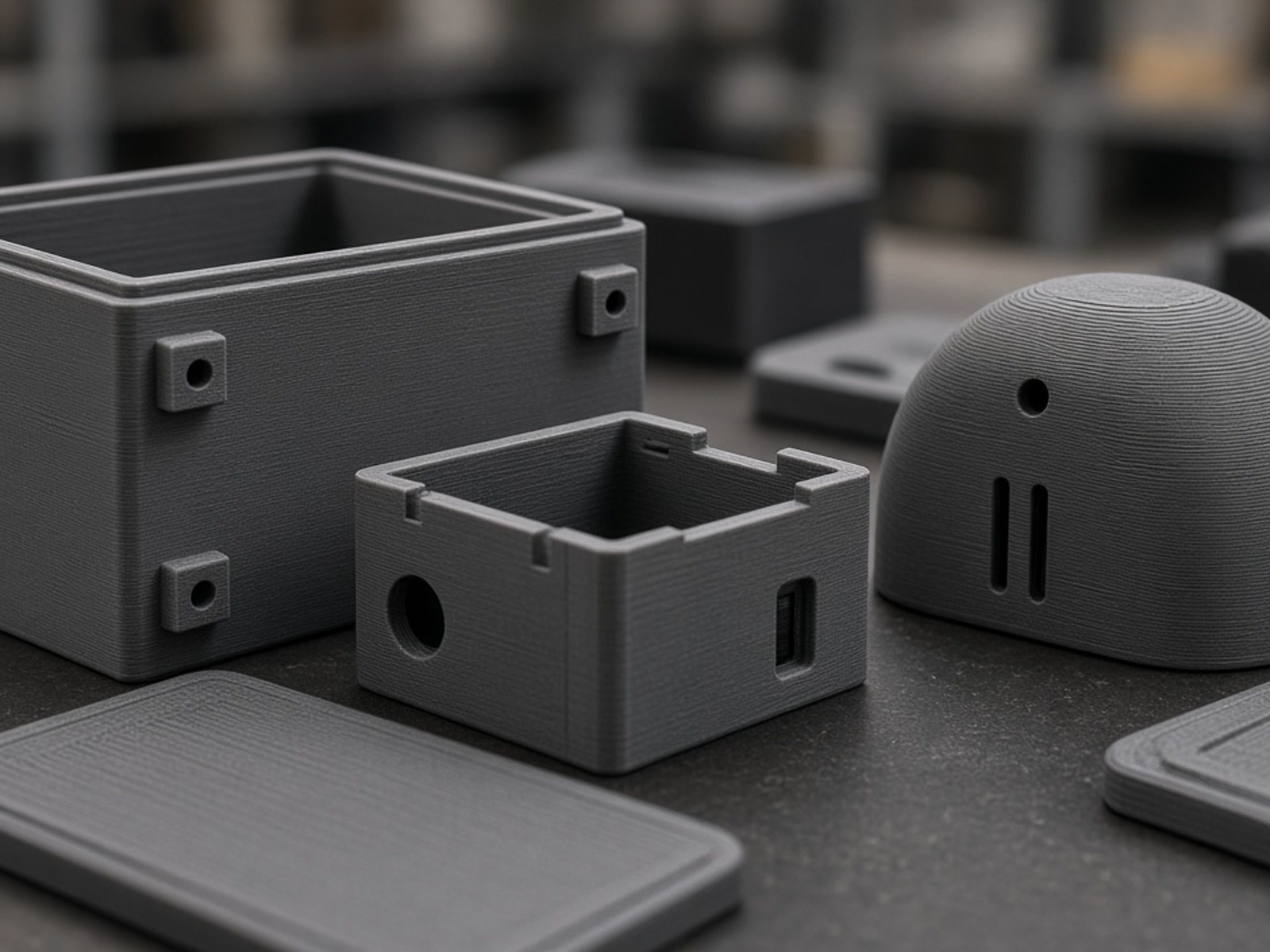
Engineered for Demanding Operational Environments
Additive enclosures provide direct production solutions across automation infrastructure, low-volume equipment builds, and high-wear mechanical interfaces. Every project undergoes technical evaluation for operating temperature, load paths, and environmental contact.
Automation & Sensor Housings
Mounting enclosures, sensor brackets, and distribution covers integrated directly onto active automated assembly lines and conveying machinery.
Robotics & EOAT Protective Covers
Lightweight, high-durability covers designed for robotic end-of-arm tooling, protecting pneumatic channels, wiring harnesses, and payload electronics.
Pre-Series Product Enclosures
Pilot-run and low-volume mechanical housings for functional engineering evaluation, eliminating initial injection mold capital investments.
Legacy Machine Parts Replacement
Direct reproduction of out-of-production or discontinued machinery housings, terminal enclosures, and protective shrouds from CAD or scan data.
Bridge-to-Production Manufacturing
Interim enclosure manufacturing to fulfill hardware deployment schedules while long-lead conventional tooling is fabricated and qualified.
Custom Air Ducts & Flow Channels
Integrated airflow management shrouds and complex venting housings designed directly into outer protective enclosures for thermal control.
Polymer Process Selection Matrix
RapidPrintParts configures four core industrial polymer technologies. Process assignment is determined by overall physical scale, resolution demands, mechanical loads, and unit quantities.
Large-Scale Structural
Engineered for large build volumes, structural durability, and custom mounting fixtures using industrial thermoplastics.
- Build Envelope: Up to ~1,000 × 600 × 600 mm
- Tolerance Reference: ±0.2 mm or ±0.3 %
- Primary Polymers: ABS, ASA, PC, PA-CF
High-Detail Verification
Optimized for intricate features, smooth surface requirements, tight snap-fits, and detailed fit-check validation.
- Build Envelope: Up to ~600 × 600 × 400 mm
- Tolerance Reference: Geometry-dependent
- Primary Polymers: Photopolymer resins
Complex Powder Bed
Produces self-supporting, complex mechanical geometries with balanced isotropic properties in production nylon.
- Build Envelope: Up to ~380 × 380 × 600 mm
- Tolerance Reference: ±0.3 mm or ±0.3 %
- Primary Polymers: PA12, PA6, composite nylons
Dense Industrial Nylon
Yields high-density, airtight parts with balanced mechanical strength, suitable for end-use functional assemblies.
- Build Envelope: Up to ~380 × 284 × 380 mm
- Tolerance Reference: ±0.2 mm or ±0.3 %
- Primary Polymers: PA12, PA11, TPU
Industrial Thermoplastics & Polymers
Selecting the appropriate enclosure material depends directly on operating temperatures, environmental exposure, chemical contact, and mechanical stresses.
Standard Engineering Thermoplastics
ABS, ASA, PETG: Suited for standard structural housings, UV-exposed exterior automation, and non-aggressive indoor industrial enclosures.
High-Durability & Reinforced Nylons
PA6, PA12, Glass-Filled & Carbon-Filled Nylons (PA-CF): Exceptional rigidity, chemical resistance, high impact strength, and wear endurance for demanding mechanical assemblies.
Specialty & High-Performance Polymers
PC, TPU, and PEEK: Polycarbonate for impact and clarity demands; TPU for flexible seals and gaskets; PEEK for severe continuous heat, aggressive chemical exposure, or flame retardancy requirements.
Post-Processing & Hardware Integration
As-printed enclosure surfaces vary by technology. A selection of secondary treatments is available to achieve the desired tactile, sealing, or mechanical properties.
Media Blasting
Homogenizes powder-bed surfaces and removes loose media for a uniform, matte tactile finish.
Vapor Smoothing
Chemically seals polymer porosity, improving fluid resistance, washable hygiene, and surface sheen.
Sanding & Painting
Prepares surfaces for color matching, clear coats, UV barriers, or corporate aesthetic requirements.
Dyeing (Black/Color)
Permeates nylon components with deep pigment without altering critical mating dimensions.
Threaded Inserts & Fastener Hardware
Heat-set or ultrasonic brass and stainless steel inserts installed for high-cycle assembly and disassembly.
Required Design & Operational Inputs
To provide an accurate technical assessment, our engineering team reviews your CAD package against practical application criteria. Providing the following inputs ensures optimal process assignment and realistic tolerance allocation:
Practical Scope & Production Limits
Additive manufacturing is optimal for complex geometries, consolidated assemblies, low-to-medium quantities, and accelerated tooling bypass.
- • High Volumes: Very large production runs (e.g., tens of thousands of units) with simple geometries generally remain more cost-effective via conventional injection molding.
- • High-Precision Fits: Features requiring sub-tenth-millimeter repeatability across extensive quantities may require targeted CNC post-machining or bonded bushings.
- • Raw Finish: As-printed surfaces feature microscopic layering or powder texture; applications demanding high-gloss or mirror finishes require defined post-processing.
Request an Enclosure Engineering Review
Submit your STEP/STP 3D CAD files alongside 2D engineering drawings and operational requirements. Our technical team evaluates part manufacturability, suggests appropriate polymer processes, and delivers a detailed quotation.
Contact RapidPrintParts
Get in Touch
We are here to answer your questions about industrial additive manufacturing and functional 3D printed parts. Reach out to us through the following methods:
Email: [email protected]
Address: No. 17-1, Guanlan Avenue, Longhua District, Shenzhen, Guangdong Province, Shenzhen 3D Printing Industrial Park