
Understanding CuCrZr 3D Printing and Material Selection
In industrial additive manufacturing, Copper Chromium Zirconium (CuCrZr) is recognized for its pairing of elevated thermal conductivity with mechanical durability. Explore the technical trade-offs of copper-based alloys and discover when advanced engineering polymers provide an efficient, functional alternative.
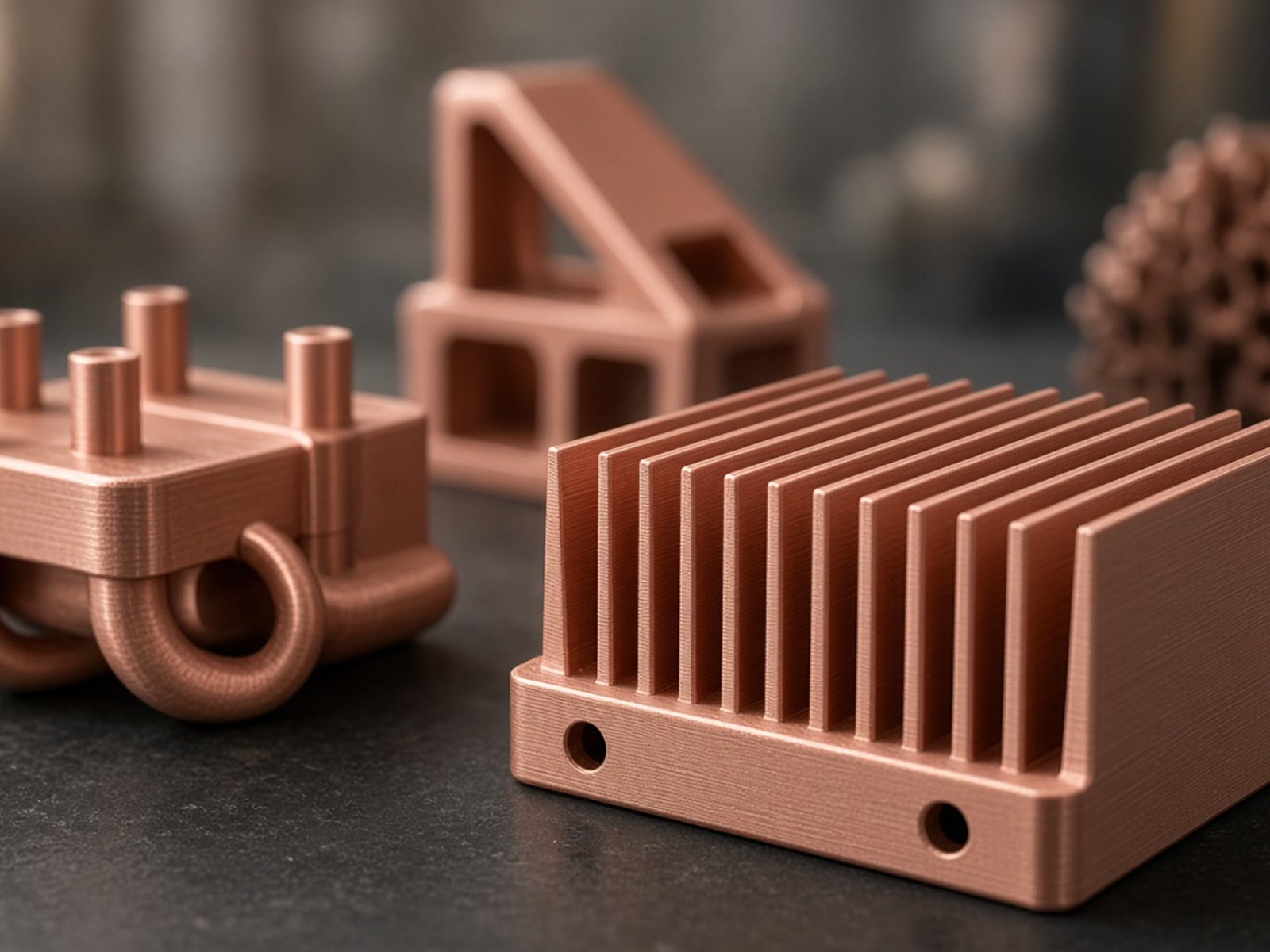
Material Characteristics of CuCrZr
CuCrZr is a precipitation-hardening copper alloy developed to balance heat transfer and structural resistance. Unlike unalloyed copper, the integration of chromium and zirconium preserves yield strength under elevated operating temperatures, suiting components under thermal and physical stresses.
High Thermal Conductivity
Essential for cooling channels, thermal exchangers, and conduction management assemblies where rapid heat extraction prevents hot spots and mechanical degradation.
Mechanical Hardness
Demonstrates increased yield strength and wear resistance over pure copper grades, mitigating creep and plastic deformation when exposed to continuous mechanical loads.
Electrical Conductivity
Maintains solid conductivity suitable for specialized parts requiring concurrent current handling and dissipation, offering stable electrical connectivity under heat.
Engineering Considerations for Copper Alloys & Polymers
Producing CuCrZr components typically relies on specialized Laser Powder Bed Fusion (LPBF) systems calibrated for reflective, high-absorption metal powders. This specialized equipment requires precise inert gas controls and post-processing protocols.
At RapidPrintParts, our production focus is on polymer-based additive manufacturing processes, including FDM/FFF, SLA, SLS, and MJF. While we do not operate metal 3D printing equipment in-house, we help engineering teams analyze operational envelopes to determine whether metallic alloys are truly mandatory or if functional polymers meet design criteria.
When designs require structural stability, chemical resilience, or thermal endurance without the heavy weight and cost of copper alloys, engineering polymers such as PEEK, PEKK, or Carbon-Fiber reinforced Nylons (PA-CF) can provide a high-performance alternative.
Material & Capability Alignment
-
•
Metallic CuCrZr (LPBF): Selected when maximum bulk thermal or electrical conductivity is non-negotiable within dense metal geometries.
-
•
High-Performance Polymers (SLS / FDM / MJF): Ideal for tooling, functional housings, and fluid handling where weight savings, chemical inertness, and structural rigidity take precedence.
-
•
Engineering Review: We review your CAD geometry, loads, and thermal boundaries to help determine the most practical manufacturing route before committing to production.
Selecting the Right Material and Process
Thoroughly assessing functional requirements before finalizing production tooling or alloy orders prevents over-engineering and minimizes cycle times.
Thermal vs. Structural
Determine whether your component requires active thermal dissipation or basic thermal stability. If structural stiffness and fluid isolation are primary, high-performance polymers (PEEK, PA-CF) often provide faster, lighter solutions.
Mechanical Boundaries
Evaluate maximum continuous operating temperatures alongside static and dynamic stresses. Comparing yield curves helps define whether metal or reinforced plastics are required.
Internal Complexity
Complex internal channels, fluid manifolds, or lightweight lattices favor additive methods. Evaluate print orientation and support removal constraints during CAD layout.
Project Velocity
Weigh the lead times of complex metal powder sourcing and sintering cycles against rapid polymer build times for prototypes, bridge manufacturing, and low-volume production.
Functional Applications for Industrial Parts
At RapidPrintParts, we prioritize end-use factory hardware and functional assemblies. We assess each CAD model across key production metrics: raw material suitability, directional load resistance, temperature thresholds, dimensional tolerances, and surface finish.
Robot EOAT
Lightweight end effectors and grippers optimized for high-speed automated lines.
Jigs & Fixtures
Durable assembly nests, inspection gauges, and manufacturing alignment guides.
Housings
Protective enclosures, sensor mounts, and fluid conduits with custom geometries.
Transitioning from Metal to Advanced Polymers
Many industrial components traditionally machined or printed from metals can be redesigned in carbon-fiber filled or high-temperature polymers. This transition often achieves significant weight savings and eliminates lead-time bottlenecks without compromising assembly integrity.
- ✓ Substantial mass reduction for moving automation equipment
- ✓ Shorter production turnaround for tooling and low-volume runs
- ✓ Direct evaluation of tolerances, finishes, and functional fit
Request an Engineering Evaluation
Whether you are exploring CuCrZr material trade-offs or seeking to produce robust parts using industrial polymer additive manufacturing, we are here to review your application requirements.
Information to Include:
- • 3D CAD models in STEP / STP file format
- • Target quantities and delivery expectations
- • Operating environments: thermal limits, chemical exposure, and mechanical load
- • Key dimensional tolerances and surface finish specifications
Contact RapidPrintParts
Get in Touch
We are here to answer your questions about industrial additive manufacturing and functional 3D printed parts. Reach out to us through the following methods:
Email: [email protected]
Address: No. 17-1, Guanlan Avenue, Longhua District, Shenzhen, Guangdong Province, Shenzhen 3D Printing Industrial Park