Understanding Titanium 3D Printing for Industrial Applications
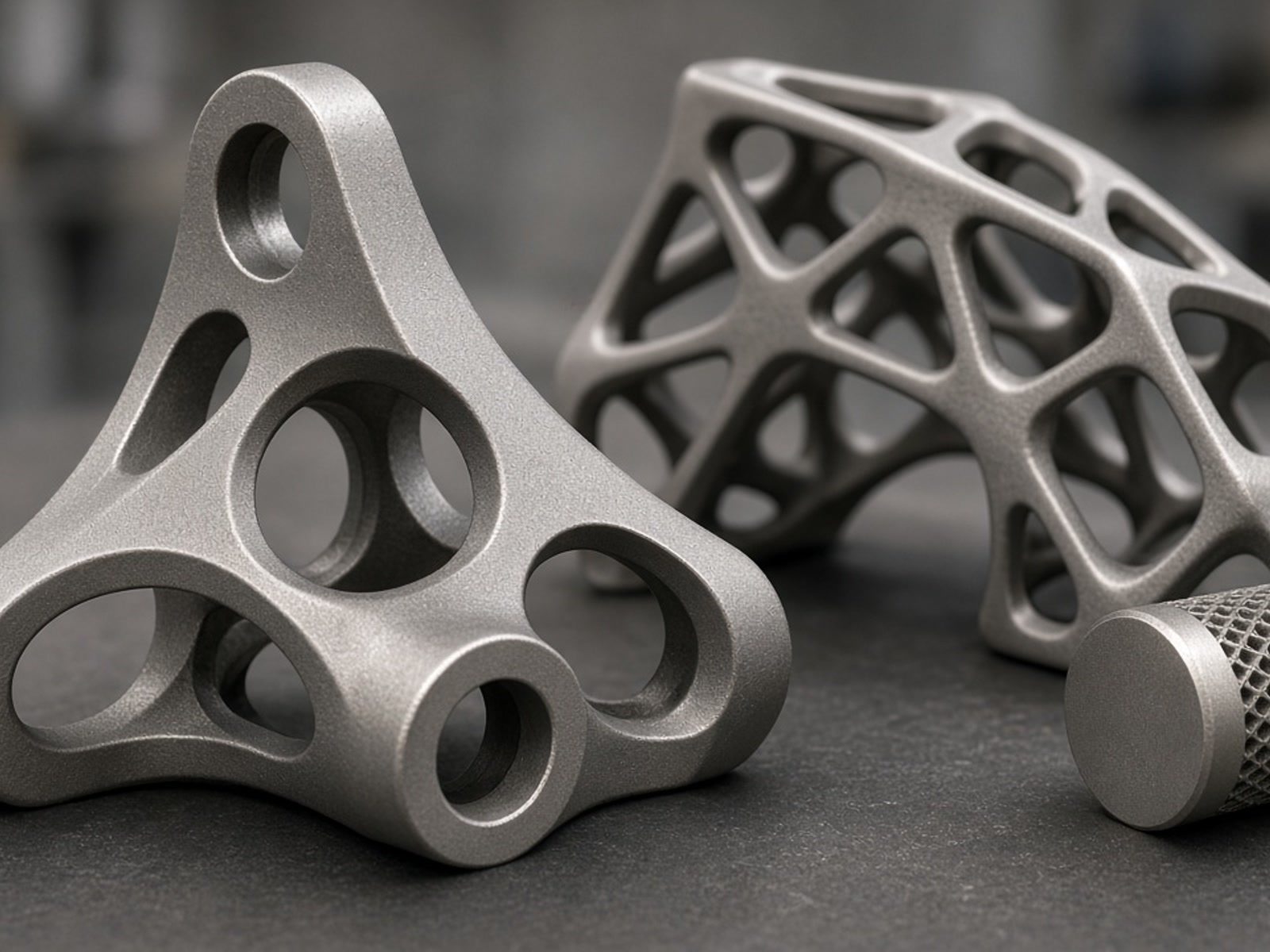
Titanium 3D printing, primarily utilizing Direct Metal Laser Sintering (DMLS) or Selective Laser Melting (SLM), is a specialized additive manufacturing process used to produce high-strength, lightweight functional components. In industrial sectors, titanium is often selected for its exceptional strength-to-weight ratio and resistance to harsh environments.
This educational overview outlines the characteristics of titanium alloys in additive manufacturing and how they compare to high-performance polymers used in industrial 3D printing.
Common Titanium Alloys in Additive Manufacturing
While several grades of titanium exist, the additive manufacturing industry focuses on a few specific alloys that balance processability with mechanical performance.
Ti6Al4V (Grade 5)
The most widely used titanium alloy. It offers high strength, excellent corrosion resistance, and is heat-treatable. It is a typical reference for structural components in robotics and high-stress mechanical assemblies.
Ti6Al4V ELI (Grade 23)
An "Extra Low Interstitials" version of Grade 5, providing higher ductility and better fracture toughness.
Commercially Pure Titanium (Grades 1 & 2)
Used primarily where maximum corrosion resistance is required rather than high mechanical strength.
Key Benefits of Titanium for Functional Parts
Industrial applications often require titanium when traditional metals like aluminum or steel cannot meet specific performance thresholds.
Strength-to-Weight Ratio
Titanium provides mechanical strength comparable to many steels while being approximately 40% lighter. This makes it a critical material for end-of-arm tooling (EOAT), mobile robotics, and components where reducing inertia is vital for performance.
Corrosion and Chemical Resistance
Titanium naturally forms a stable oxide layer, providing superior resistance to saltwater, acids, and industrial chemicals. This is often a primary requirement for parts used in marine environments or chemical processing equipment.
Thermal Stability
Titanium maintains its mechanical properties at significantly higher temperatures than aluminum. For components such as ducts, brackets, or housings exposed to elevated operating temperatures, titanium provides a stable and durable solution.
Design and Engineering Considerations
Designing for metal additive manufacturing requires a different approach than traditional CNC machining or polymer 3D printing. The following factors shape how a titanium part is specified and reviewed.
Typical Tolerances
While metal 3D printing is precise, critical dimensions often require an engineering review to determine if the as-printed tolerance (typically ±0.1 mm to ±0.2 mm depending on geometry) is sufficient or if secondary machining is necessary.
-
1
Support Structures
Metal 3D printing requires robust support structures to anchor the part to the build plate and dissipate heat during the laser melting process. These supports must be mechanically removed during post-processing.
-
2
Thermal Stress
The rapid heating and cooling inherent in the process can introduce internal stresses. Parts may require stress-relief heat treatment to ensure dimensional stability.
-
3
Surface Finish
As-printed titanium parts typically have a matte, slightly grainy surface texture. For functional interfaces, secondary CNC machining, grinding, or polishing may be required to meet specific tolerance or finish requirements.
Titanium vs. High-Performance Polymers
For many industrial applications, high-performance polymers and composites can serve as effective alternatives to titanium, often with shorter lead times and lower costs. At RapidPrintParts, we evaluate functional requirements to determine if advanced polymers can meet the application's needs.
PA-CF (Carbon Fiber Reinforced Nylon)
Offers high stiffness and low weight, making it a suitable alternative for jigs, fixtures, and brackets that do not require the extreme temperature resistance of metal.
PEEK and PEI (ULTEM™)
These high-performance thermoplastics offer excellent chemical resistance and high continuous-use temperatures, often replacing metal in manifolds, housings, and specialized industrial equipment.
Weight Considerations
While titanium is light for a metal, polymers like PA12 (processed via SLS or MJF) or PEEK are significantly lighter, which may be preferable for high-speed automation components.
Selecting the Right Process for Functional Parts
The choice between titanium 3D printing and high-performance polymer printing depends on the specific operating environment. Key design inputs for engineering review include:
Start an Engineering ReviewMechanical Load
The peak and continuous stress the part must withstand.
Operating Temperature
The maximum and minimum temperatures of the environment.
Chemical Exposure
Contact with oils, solvents, or corrosive agents.
Dimensional Accuracy
Critical tolerances and fitment requirements.
For projects requiring functional industrial parts, an engineering review of the CAD data and application requirements is essential. This ensures the selected material and process—whether a high-performance polymer like PEEK or a reinforced composite—aligns with the part's intended use and performance life.
Request a Quote or Engineering Review
Share your CAD data and application requirements to determine whether a high-performance polymer or reinforced composite fits your part's operating environment and performance life.
- Email: [email protected]
- Address: No. 17-1, Guanlan Avenue, Longhua District, Shenzhen, Guangdong Province, Shenzhen 3D Printing Industrial Park
Contact RapidPrintParts
Get in Touch
We are here to answer your questions about industrial additive manufacturing and functional 3D printed parts. Reach out to us through the following methods:
Email: [email protected]
Address: No. 17-1, Guanlan Avenue, Longhua District, Shenzhen, Guangdong Province, Shenzhen 3D Printing Industrial Park