
Metal Inserts for 3D Printed Parts
Transform lightweight polymer components into industrial-grade assemblies. RapidPrintParts integrates precision brass, stainless steel, and aluminum threaded inserts into functional 3D printed parts across FDM, SLS, MJF, and SLA processes for demanding high-torque and repeated-use environments.
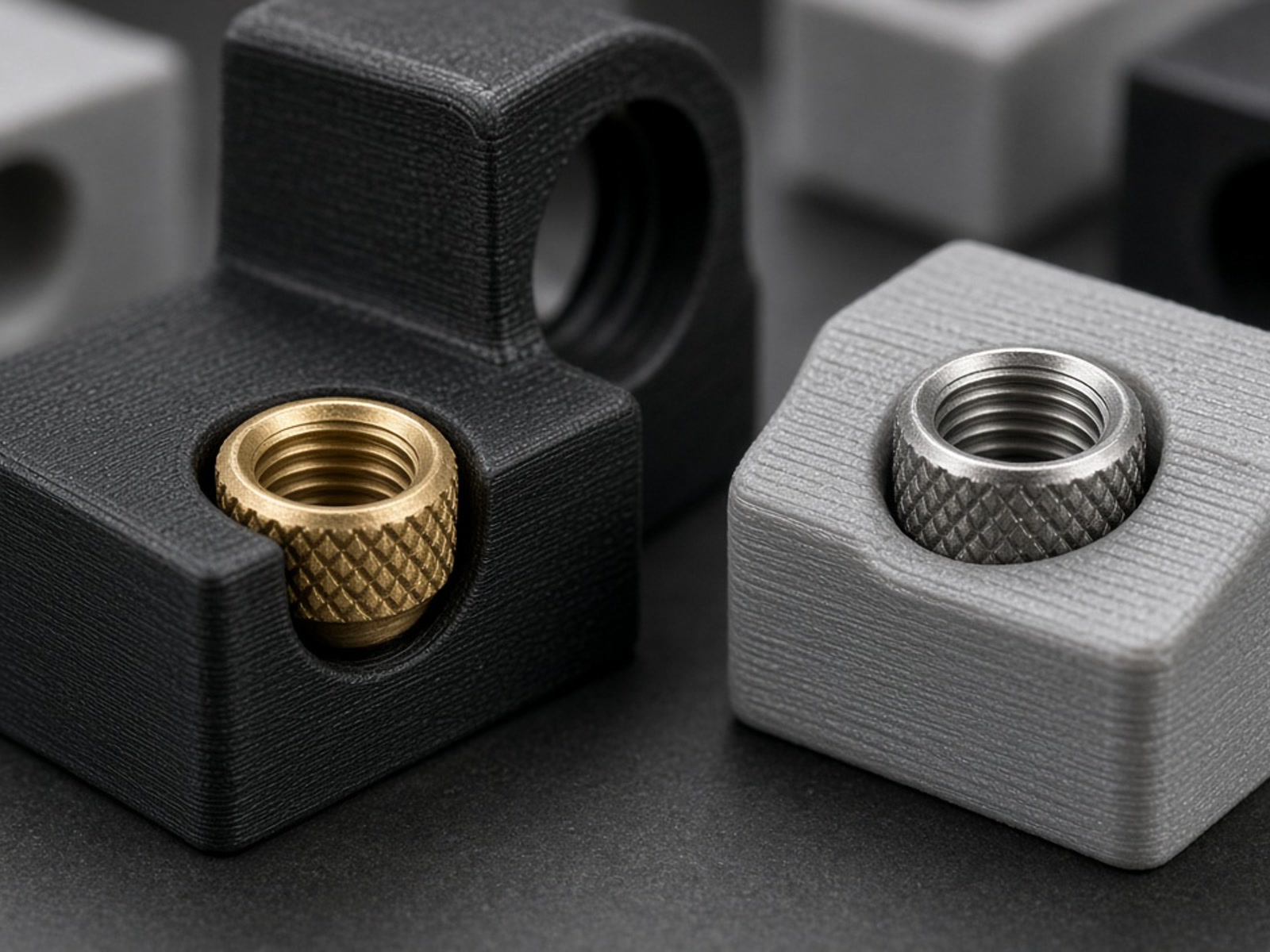
Why Integrate Metal Inserts into Additive Components?
Directly printed or tapped plastic threads often degrade under cyclic loading, mechanical vibration, or regular maintenance. Integrating engineered metal hardware provides machine-grade reliability while retaining complex additive geometries.
High Pull-out Resistance
Inserts distribute axial tensile forces across a broadened contact area within the thermoplastic matrix, preventing fastener pull-out under heavy operational stress.
Repeated Durability
Eliminates thread stripping and cross-threading during routine assembly, field servicing, and teardown cycles common in industrial tooling.
Precision Threads
Provides standard, high-tolerance internal metric (M3, M4, M5, M6) or imperial (1/4-20) interfaces that integrate smoothly with off-the-shelf industrial hardware.
Broad Material Coverage
Applicable across standard prototyping filaments (ABS, PETG), powder-bed polymers (PA12, PA11), and high-performance engineering grades (PEEK, PA-CF).
Integration Methods for Industrial 3D Printing
The installation approach depends directly on the polymer matrix, thermal properties, and structural wall constraints of your additive component.
Heat-Set Threaded Inserts
The benchmark method for thermoplastics including ABS, ASA, PC, and PA12. A calibrated thermal tool transfers localized heat to the brass or stainless insert, gently melting adjacent polymer as it is driven into a pilot hole. The melted polymer reflows into opposing diagonal knurls, forming a rigid mechanical lock upon cooling.
Press-Fit & Expansion Inserts
Used on thermosets and highly cross-linked engineering photopolymers that char or fracture rather than reflow under heat. Inserts utilize mechanical interference or expansion slots that bite securely into the cured hole walls as the mating fastener engages, minimizing hoop stress.
Secondary CNC Machining & Tapping
For mission-critical alignments, multi-axis fixtures, or tight-tolerance hole patterns, RapidPrintParts utilizes secondary CNC milling to ream precise pilot holes or tap preliminary threads before insert seating. This guarantees axial squareness and removes layer-line irregularities.
CAD Design Rules for Engineering Review
Incorporating metal inserts requires accounting for material displacement and wall stresses during the 3D modeling stage. RapidPrintParts conducts thorough DFM checks on your 3D geometry before manufacturing.
Maintain adequate boss wall thickness (generally 2x to 3x the insert hole diameter) to prevent radial hoop stress from cracking the thermoplastic during thermal insertion.
Ensure pilot hole depth exceeds the insert length by at least 15–20% to collect displaced polymer flash and prevent bottoming out against the exterior part skin.
Specify a slight 8° included taper for standard heat-set inserts to self-center the hardware, or parallel straight bores when using specialized symmetrical press-fits.
Glass-filled (PA12 GF) or high-temperature matrices (PEI/ULTEM) require tailored thermal cycles and specialized knurl profiles to ensure complete mechanical interlock.
Industrial Manufacturing Applications
RapidPrintParts applies metal threaded inserts across demanding custom end-use hardware, assembly aids, and functional production fixtures.
Jigs & Assembly Fixtures
Wear-resistant mounting points for inspection brackets, clamp guides, and locating pins requiring high holding force on factory floors.
Robot EOAT & Grippers
Lightweight carbon-fiber or nylon end effectors fitted with reliable metal threads for pneumatic fittings, suction cups, and sensor brackets.
Mechanical Enclosures
Durable internal chassis standoffs and exterior lid fasteners for electronic enclosures, power electronics prototypes, and field devices.
Legacy Hardware Repair
Replacement components matching obsolete OEM dimensions, with accurate internal thread pitches to integrate seamlessly into existing assemblies.
Request an Engineering Review & Quote
Every functional assembly has unique requirements for tension, shear, operating temperature, and chemical exposure. RapidPrintParts evaluates your CAD models to determine the optimal insert type, pilot hole specifications, and polymer selection.
Contact RapidPrintParts
Get in Touch
We are here to answer your questions about industrial additive manufacturing and functional 3D printed parts. Reach out to us through the following methods:
Email: [email protected]
Address: No. 17-1, Guanlan Avenue, Longhua District, Shenzhen, Guangdong Province, Shenzhen 3D Printing Industrial Park