Automation 3D Printing: Custom Industrial Solutions
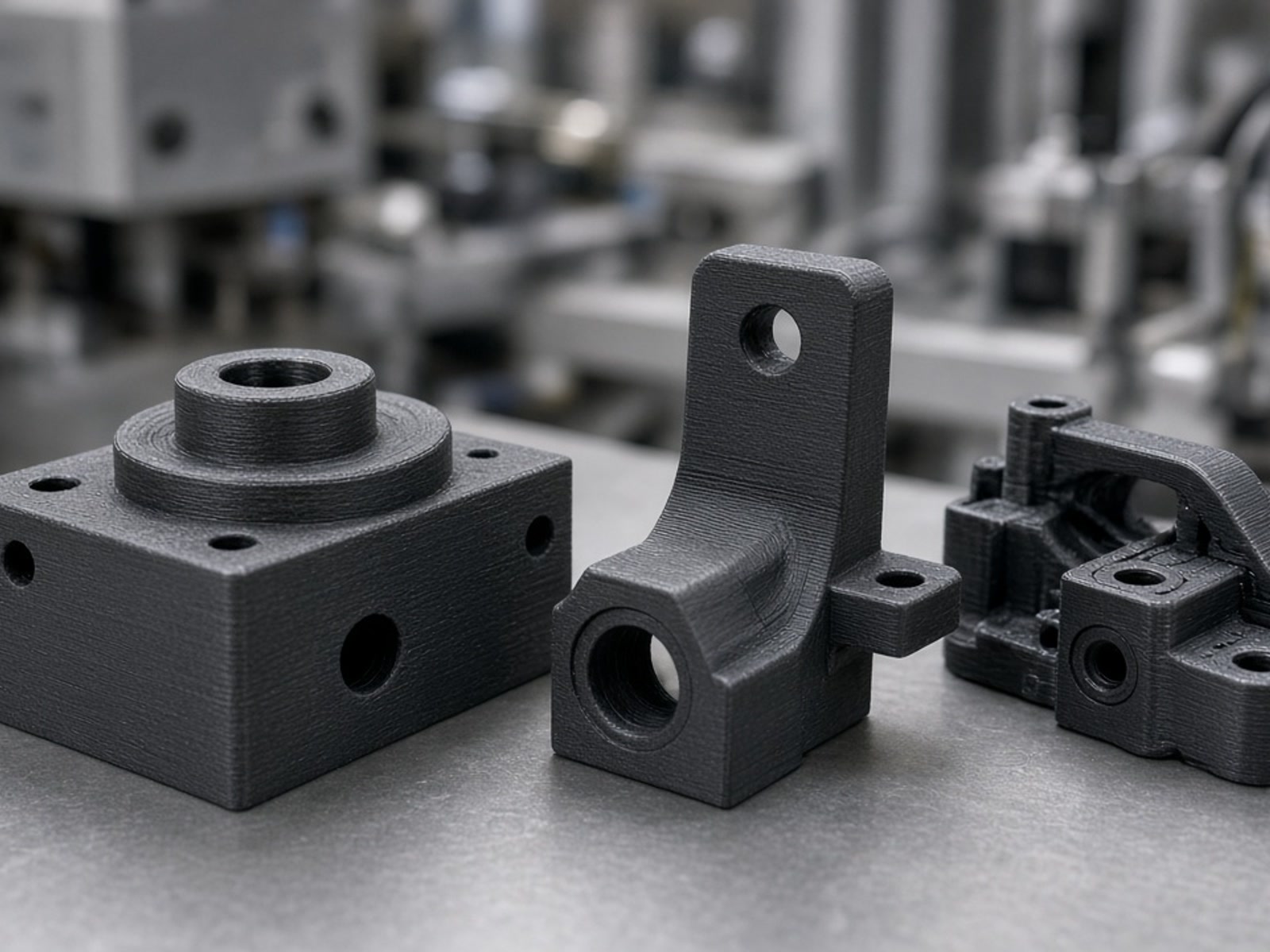
In modern industrial environments, automation 3D printing serves as a critical bridge between design and deployment. By utilizing additive manufacturing, machinery OEMs and robotics integrators can produce complex, lightweight, and functional components that are often slow or uneconomical to manufacture through traditional methods.
RapidPrintParts specializes in producing industrial-grade parts for the automation sector, focusing on durability, mechanical performance, and application-specific material selection.
Key Applications in Industrial Automation
Additive manufacturing allows for the rapid iteration and production of parts that interface directly with automated systems. Typical applications include:
End-of-Arm Tooling (EOAT)
Custom grippers, vacuum manifolds, and specialized brackets designed to reduce the payload on robotic arms.
Jigs and Fixtures
Assembly aids, alignment tools, and nesting fixtures that improve the repeatability of automated lines.
Sensor Brackets and Mounts
Precisely positioned mounts for sensors, cameras, and limit switches that require custom geometries to fit existing machine frames.
Cable Management
Custom clips, ducts, and guides that prevent cable wear in high-cycle motion environments.
Replacement and MRO Parts
Rapid production of discontinued or obsolete mechanical components to minimize machine downtime.
Process Selection for Automation Components
Choosing the right process depends on the mechanical load, environmental conditions, and required tolerances of the automation system.
FDM / FFF
Fused Deposition Modeling
Best suited for large structures, equipment guards, and heavy-duty fixtures.
- Materials
- ABS, ASA, PC, PEEK, and Carbon Fiber reinforced Nylon (PA-CF).
- Advantages
- High strength-to-weight ratio and availability of high-performance polymers for demanding environments.
SLS and MJF
Powder Bed Fusion
Ideal for complex, durable nylon parts and low-volume production of end-use components.
- Materials
- PA12, PA11, and Glass-Filled Nylon (PA12 GF).
- Advantages
- Isotropic mechanical properties and the ability to print complex internal geometries without support structures, such as integrated air channels for pneumatic grippers.
SLA
Stereolithography
Used for high-detail prototypes and fit validation.
- Materials
- Engineering-grade resins.
- Advantages
- Superior surface finish and dimensional accuracy for intricate components that require precise fitment.
Material Performance for the Factory Floor
Automation environments often require materials that can withstand more than just static loads. We evaluate material selection based on four performance criteria.
-
1
Mechanical Strength
PA-CF or PEEK for high-stress brackets and structural mounts.
-
2
Impact Resistance
TPU or specialized Nylon for grippers and bumpers that must absorb energy.
-
3
Thermal Stability
PC or PEEK for components located near heat-generating motors or in processing heat zones.
-
4
Chemical Resistance
Selection of materials like PP or specialized resins for environments exposed to oils, coolants, or cleaning agents.
Technical Capabilities and Tolerances
Successful integration of 3D printed parts into automation systems requires adherence to predictable tolerances. Typical reference tolerances for our processes include:
FDM
±0.2 mm
or ±0.3%
SLA
±0.1 mm
or ±0.2%
SLS
±0.3 mm
or ±0.3%
MJF
±0.2 mm
or ±0.3%
Note: Guaranteed tolerances are subject to geometry and require an engineering review of the specific CAD data.
For parts requiring high-precision interfaces, such as bearing seats or mating surfaces with tight tolerances, we offer secondary CNC machining, tapping, and the installation of threaded inserts.
Engineering Review and Quality Support
At RapidPrintParts, we prioritize the functional requirements of the part. Our engineering team reviews eight critical inputs before production: application environment, quantity, material requirements, critical tolerances, load/temperature needs, finish, lead time, and technical drawings.
To ensure the performance of your automation components, our team evaluates the operating requirements to recommend the most reliable process and material combination for your specific project.
Quality support for automation projects may include:
- First Article Inspection (FAI)
- Dimensional inspection reports
- Material documentation and Certificates of Conformity (CoC)
- Functional post-processing (vapor smoothing, dyeing, or painting)
Request a Quote for Your Automation Components
Share your application environment, critical tolerances, and technical drawings. Our engineering team will review your requirements and recommend the most reliable process and material combination.
Email: [email protected]
Address: No. 17-1, Guanlan Avenue, Longhua District, Shenzhen, Guangdong Province, Shenzhen 3D Printing Industrial Park
Contact RapidPrintParts
Get in Touch
We are here to answer your questions about industrial additive manufacturing and functional 3D printed parts. Reach out to us through the following methods:
Email: [email protected]
Address: No. 17-1, Guanlan Avenue, Longhua District, Shenzhen, Guangdong Province, Shenzhen 3D Printing Industrial Park