
3D Printed Brackets for Industrial and Mechanical Applications
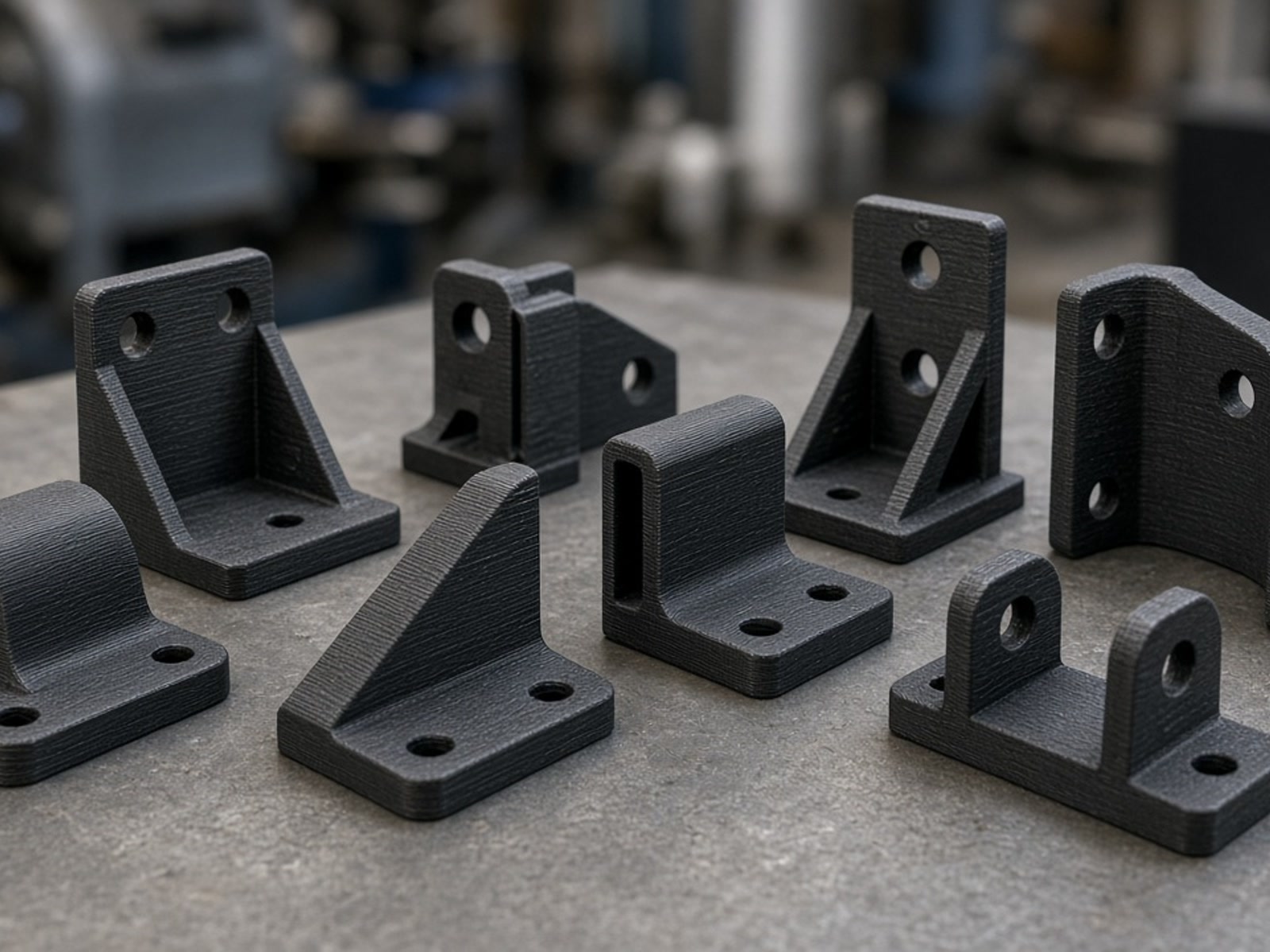
Brackets support, align, and secure assemblies. Traditional CNC machining or sheet metal stamping carries high setup costs and material waste, especially for complex geometries or low-volume runs. 3D printed brackets give machinery OEMs, robotics integrators, and MRO specialists a functional path to rapid iteration and specialized performance.
At RapidPrintParts, we produce industrial-grade brackets using polymer additive manufacturing. By evaluating load, temperature, and environmental requirements, we help engineering teams transition from prototypes to bridge production and end-use mechanical components.
Why Use Additive Manufacturing for Industrial Brackets?
3D printing enables brackets that are difficult or impossible to manufacture through subtractive methods.
Complexity Without Cost Penalties
Internal reinforcement ribs, specialized cable routing channels, and topology-optimized shapes can be integrated without increasing the price of the part.
Tooling Avoidance
For low-volume production (1 to 500 units), 3D printing eliminates the lead time and capital expenditure associated with injection mold tooling or specialized stamping dies.
Weight Reduction
High-performance polymers and carbon-filled materials allow for lightweighting in robotics and end-of-arm tooling (EOAT) applications where reducing mass is critical for cycle times.
Consolidated Assemblies
Multiple components—such as a bracket, a sensor mount, and a cable clip—can often be redesigned into a single 3D printed part, reducing assembly labor and BOM complexity.
Core Processes for Bracket Production
Selecting the right process depends on the mechanical requirements and the operating environment. RapidPrintParts utilizes four primary in-house processes for functional brackets.
FDM / FFF (Fused Deposition Modeling)
Best for large-scale brackets and rugged equipment parts. With a build envelope of up to 1,000 × 600 × 600 mm, FDM is ideal for structural components.
- Typical Materials:
- ABS, ASA, PC, and PA-CF (Carbon Fiber Reinforced Nylon)
- Typical Tolerance:
- ±0.2 mm or ±0.3%
SLS (Selective Laser Sintering)
SLS produces durable, isotropic nylon parts without the need for support structures, allowing for highly complex nested geometries.
- Typical Materials:
- PA12 and PA11
- Typical Tolerance:
- ±0.3 mm or ±0.3%
MJF (Multi Jet Fusion)
MJF is a high-speed process that produces dense, functional nylon parts suitable for end-use brackets requiring consistent mechanical properties.
- Typical Materials:
- PA12, PA11, and PA12 GF (Glass Filled)
- Typical Tolerance:
- ±0.2 mm or ±0.3%
SLA (Stereolithography)
Used primarily for high-detail prototypes and fit validation where surface finish and dimensional accuracy are the highest priorities.
- Typical Materials:
- Engineering-grade resins
- Typical Tolerance:
- ±0.1 mm or ±0.2%
Material Selection Factors
When designing 3D printed brackets, the choice of material is driven by the application's stress profile. Matching the polymer to the load case, environment, and chemical exposure keeps the bracket performing over its service life.
Not sure which polymer fits your bracket? Share your CAD data and operating conditions, and our engineering team will review the application.
-
1
Structural Strength
For high-load applications, PA-CF (Carbon Fiber Reinforced) or PA12 GF (Glass Filled) provide increased stiffness and dimensional stability under load.
-
2
Environmental Resistance
ASA is a typical reference for outdoor brackets due to its UV resistance, while PEEK or PEI (ULTEM) may be required for high-temperature environments.
-
3
Impact and Flexibility
TPU is utilized for brackets that require vibration dampening or impact absorption.
-
4
Chemical Exposure
Industrial environments may require materials resistant to oils, greases, or specific cleaning agents; PA12 is a common choice for its chemical resilience.
Design and Post-Processing for Functional Brackets
To ensure a 3D printed bracket performs reliably in a mechanical assembly, several design and finishing factors must be considered.
Load Orientation
In FDM printing, the Z-axis (layer adhesion) is typically the weakest point. Brackets should be oriented during printing so that the primary loads do not act to "peel" the layers apart.
Fasteners and Inserts
While 3D printed plastics can be tapped, for high-cycle or high-torque applications, we recommend the use of heat-set or ultrasonic threaded inserts.
Secondary Machining
For critical mating surfaces or high-tolerance holes, RapidPrintParts can provide CNC secondary machining, drilling, and tapping to meet specific engineering requirements.
Surface Finishing
Functional finishes may include bead blasting for a uniform matte appearance, vapor smoothing for sealed surfaces, or dyeing and painting for color-coding and aesthetics.
Engineering Review and Quality Support
Every industrial bracket project requires a clear understanding of its operating context. Before production, our engineering team reviews CAD data (STEP/STP) and 2D drawings to verify that the chosen process and material meet the intended performance targets.
For complex or high-load 3D printed brackets, guaranteed tolerances and specific mechanical performance require a formal engineering review of the application and operating environment.
Quality support may include
- First Article Inspection (FAI)
- Dimensional inspection reports
- Material documents and Certificates of Conformity (CoC)
- Shipment reports
Start Your Bracket Project
Send your CAD data (STEP/STP) and 2D drawings along with your load, temperature, and environmental requirements. Our engineering team will review the application and recommend a process and material for your 3D printed brackets.
Email: [email protected]
Address: No. 17-1, Guanlan Avenue, Longhua District, Shenzhen, Guangdong Province, Shenzhen 3D Printing Industrial Park
Contact RapidPrintParts
Get in Touch
We are here to answer your questions about industrial additive manufacturing and functional 3D printed parts. Reach out to us through the following methods:
Email: [email protected]
Address: No. 17-1, Guanlan Avenue, Longhua District, Shenzhen, Guangdong Province, Shenzhen 3D Printing Industrial Park