
Stainless Steel 3D Printing: Process Overview and Industrial Considerations
Stainless steel 3D printing refers to additive manufacturing methods that produce metal components from stainless steel alloys. These techniques serve industrial contexts demanding high strength, corrosion resistance, or elevated-temperature performance, yet they introduce process complexities and application constraints that require rigorous evaluation.
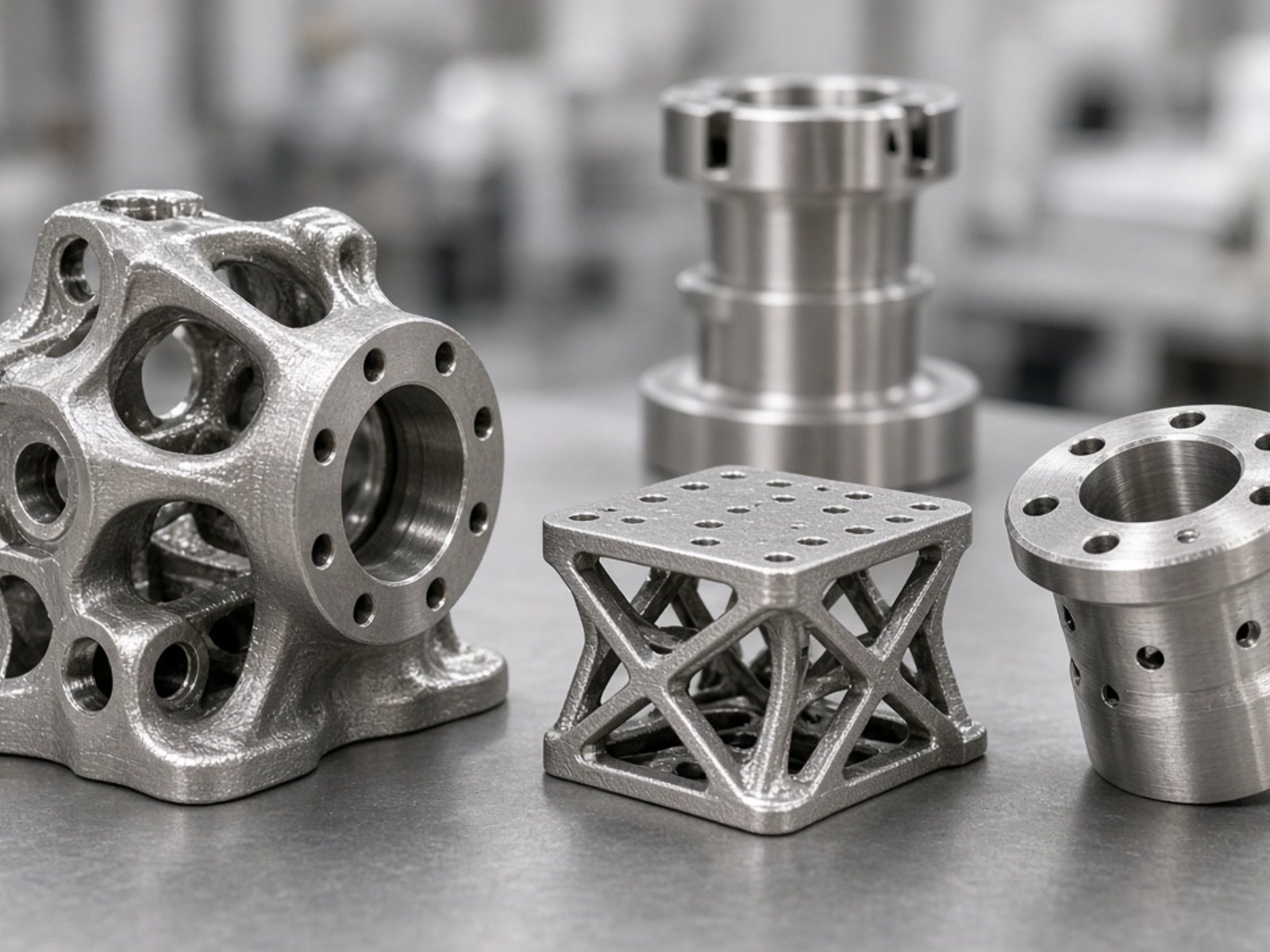
Process Mechanics
Metal Additive Methods and Material Behavior
Building dense metal components requires specialized infrastructure, controlled protective atmospheres, and multi-stage post-processing regimens.
Common Approaches to Stainless Steel Printing
Several metal additive processes can process stainless steel grades. Each method builds parts layer by layer from powder or wire feedstock and typically requires post-processing such as heat treatment, support removal, and surface finishing. Because these processes operate at high temperatures and involve metal powders, they demand specialized equipment, controlled atmospheres, and extensive safety protocols.
Material Behavior & Typical Requirements
Stainless steel printed parts may exhibit mechanical properties influenced by build orientation, layer adhesion, and subsequent thermal processing. Common considerations include tensile strength, ductility, hardness, and corrosion resistance in the final condition. Operating environments involving load, temperature cycling, chemical exposure, or wear dictate whether a printed part meets functional demands. All applications require engineering review of the specific alloy, geometry, and service conditions.
Project Evaluation
Design Inputs & Selection Factors
When evaluating stainless steel 3D printing for functional prototypes or production runs, engineering teams assess geometry and service conditions against conventional fabrication alternatives:
- • Part Geometry: Identification of complex internal channels, fluid paths, or organic lightweight structures inaccessible to CNC machining.
- • Tolerances & Surface Finish: Definition of critical mating dimensions, surface roughness thresholds, and reference datums.
- • Operational Loads & Environments: Evaluation of dynamic mechanical stresses, continuous operating temperatures, and aggressive chemical contact.
- • Batch Economics: Assessment of low-volume production counts to justify additive setup over subtractive or tooling-based paths.
- • Secondary Operations: Planning for support wire-EDM removal, secondary precision milling, polishing, and stress-relief heat treat cycles.
Technical Boundaries
Limitations & Practical Constraints
Industrial metal additive manufacturing presents distinct trade-offs that often steer non-critical metal parts toward advanced polymer or composite alternatives:
Lead Times and High Capital Intensity
Stainless steel printing involves significantly longer production lead times, high material feedstock costs, and labor-intensive multi-step post-processing compared with polymer additive manufacturing.
Dimensional and Surface Variance
Available build envelopes, achievable tolerances, and as-printed surface roughness fluctuate across systems. Tight-tolerance features nearly always require secondary CNC finishing.
Residual Stress, Porosity, and Anchoring
Thermal gradients create residual internal stresses and porosity risks. Heavy anchoring supports are required to dissipate heat and prevent distortion, requiring destructive extraction and surface remediation.
These constraints generally restrict metal printing to applications where metal characteristics are strictly required and alternate fabrication routes are unviable.
Polymer Additive Manufacturing as an Industrial Alternative
For many functional parts, jigs, fixtures, and enclosures, advanced engineering polymers deliver the structural integrity, geometric freedom, and chemical resistance needed without the long lead times or high costs of stainless steel printing.
Core Polymer Technologies
Production-grade equipment running Selective Laser Sintering (SLS), Multi Jet Fusion (MJF), Fused Deposition Modeling (FDM/FFF), and Stereolithography (SLA).
Engineering Materials
Support for PA12, PA11, glass-filled PA12 GF, flexible TPU, high-impact ABS, UV-resistant ASA, Polycarbonate (PC), and high-performance PEEK.
Envelopes & Tolerances
Build envelopes up to ~1,000 × 600 × 600 mm for FDM and 380 × 380 × 600 mm for SLS. Typical reference tolerances range from ±0.2 mm to ±0.3 % depending on process geometry.
Suitable Industrial Applications
Brackets, custom housings, fluid manifolds, robot end-of-arm tooling (EOAT), assembly jigs, and replacement machinery components manufactured via SLS or MJF frequently achieve the required structural performance while significantly accelerating turnaround.
Capability Notice
RapidPrintParts specializes in in-house polymer additive manufacturing and engineering evaluation. Metal additive topics are presented for comparative technical education. Projects are reviewed against actual service conditions to recommend optimal polymer solutions from our direct manufacturing suite.
Next Step
Request an Engineering Review
Submit your CAD geometry and project constraints for technical evaluation. RapidPrintParts assesses mechanical loads, chemical and thermal parameters, and critical dimensions before recommending a functional polymer process.
Contact RapidPrintParts
Get in Touch
We are here to answer your questions about industrial additive manufacturing and functional 3D printed parts. Reach out to us through the following methods:
Email: [email protected]
Address: No. 17-1, Guanlan Avenue, Longhua District, Shenzhen, Guangdong Province, Shenzhen 3D Printing Industrial Park