Post-Processing · Powder-Bed Fusion
Industrial 3D Printing Dyeing Services
In industrial additive manufacturing, post-processing is a critical step in ensuring that parts meet both functional and aesthetic requirements. Dyeing is a specialized finishing process used primarily for porous, powder-based 3D printed parts to provide a permanent, uniform color that penetrates the surface of the material.
At RapidPrintParts, we integrate dyeing into our post-processing workflows for clients who require more than a standard industrial finish. Whether for color-coding assembly aids, identifying production batches, or improving the professional appearance of end-use components, dyeing offers a durable solution that does not rely on surface coatings that may chip or peel over time.
Understanding the Dyeing Process
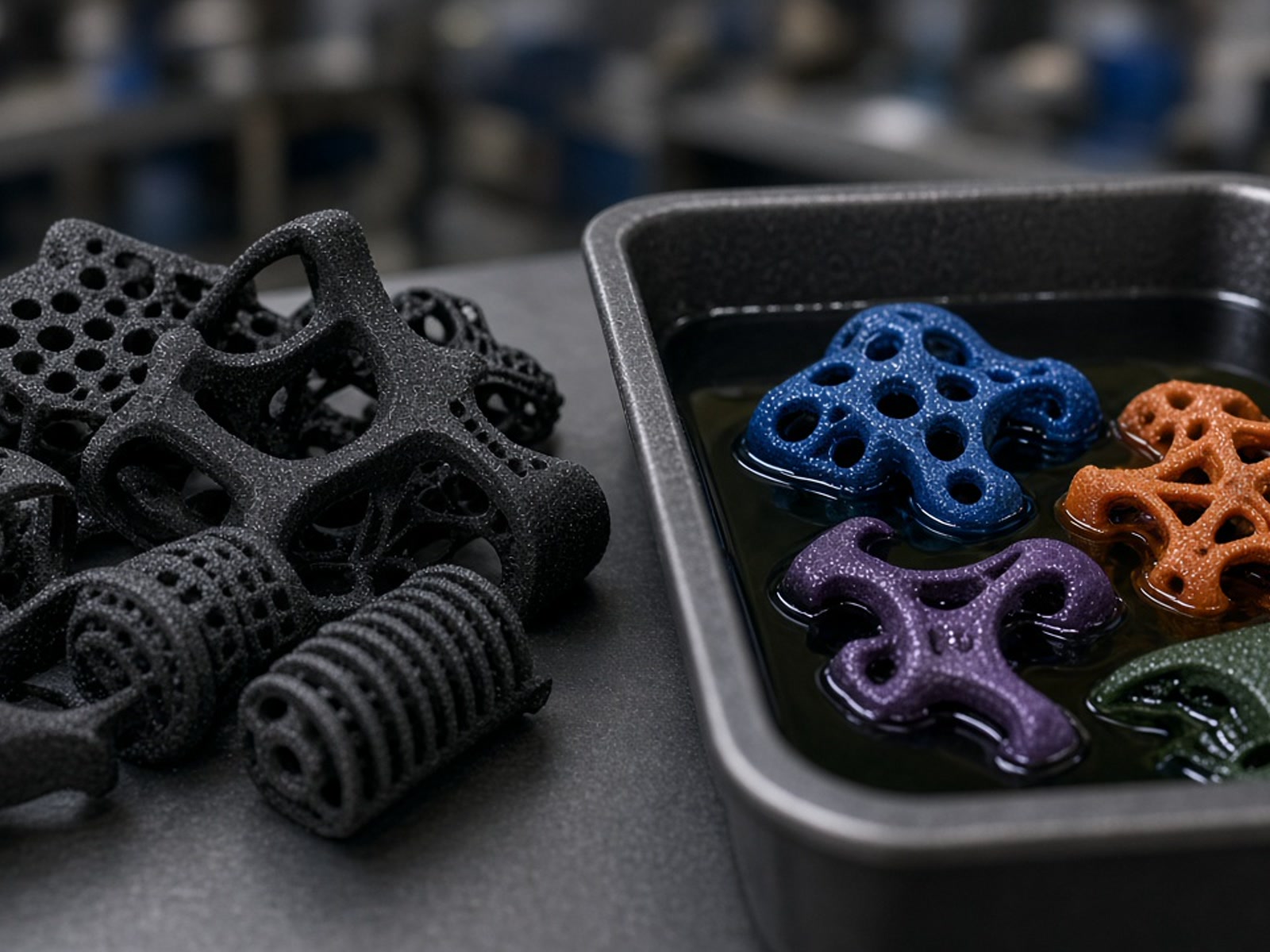
Dyeing is most effectively applied to parts produced via powder-bed fusion processes, such as SLS (Selective Laser Sintering) and MJF (Multi Jet Fusion). Because these processes utilize nylon-based materials (such as PA11 and PA12) with a slightly porous surface structure, the dye is able to penetrate the outer layer of the part during the immersion process.
Unlike painting, which sits on top of the part, dyeing colors the material itself. This makes it an ideal choice for the applications below.
Assembly Aids and Jigs
Color-coding parts to prevent operator error on the factory floor.
Low-Volume End-Use Parts
Achieving a consistent, professional aesthetic for consumer-facing or branded equipment.
Wear Resistance
Because the color is infused into the material, the finish remains consistent even if the part sustains minor surface scratches during operation.
Selection Factors for Dyeing
When considering dyeing for your 3D printed components, review the following technical inputs with our engineering team.
01 — Material
Material Compatibility
Dyeing is best suited for nylon-based powders (PA11, PA12). Materials like PEEK or high-performance engineering resins may not be suitable for standard dyeing processes due to their density and chemical resistance.
02 — Geometry
Dimensional Impact
The dyeing process involves liquid immersion at elevated temperatures. While the effect on tolerances is generally negligible, it requires engineering review if your part features extremely tight fits or delicate internal geometries.
03 — Color
Color Consistency
While we strive for uniformity, the final color may vary slightly based on the base material color, geometry, and surface texture. For critical color-matching requirements, please consult with our engineering team during the project discovery phase.
04 — Environment
Application Environment
Dyeing is a surface-level treatment. If your part will be exposed to specific harsh chemicals or extreme UV environments, please inform our team so we can evaluate if the dye is appropriate for your specific operating requirements.
Engineering Review and Quality Support
At RapidPrintParts, we do not simply print parts; we evaluate the entire lifecycle of your component. Before proceeding with dyeing or any other post-processing finish, we conduct an engineering review to ensure the chosen process aligns with your functional goals.
Our quality support team can provide dimensional inspection reports and material documentation to ensure that your finished parts—dyed or otherwise—meet the specifications required for your application.
Start Your Project with RapidPrintParts
To determine if dyeing is the right finishing solution for your project, our team requires a clear understanding of your application, quantity, and performance needs.
Begin the Engineering ReviewWhat to Provide to Begin
To begin the engineering review process, please provide the following inputs.
-
1
3D CAD Files
STEP or STP format.
-
2
Application Details
Operating environment, load, and temperature requirements.
-
3
Quantity
Whether you require a single prototype or a low-volume production batch.
-
4
Finish Requirements
Specific color needs or functional constraints.
Discuss Your Dyeing Requirements
Contact our engineering team today to discuss your project requirements and receive a professional assessment for your next industrial build.
- [email protected]
- Address
- No. 17-1, Guanlan Avenue, Longhua District, Shenzhen, Guangdong Province, Shenzhen 3D Printing Industrial Park
Contact RapidPrintParts
Get in Touch
We are here to answer your questions about industrial additive manufacturing and functional 3D printed parts. Reach out to us through the following methods:
Email: [email protected]
Address: No. 17-1, Guanlan Avenue, Longhua District, Shenzhen, Guangdong Province, Shenzhen 3D Printing Industrial Park