Industrial Additive Manufacturing
Copper 3D Printing
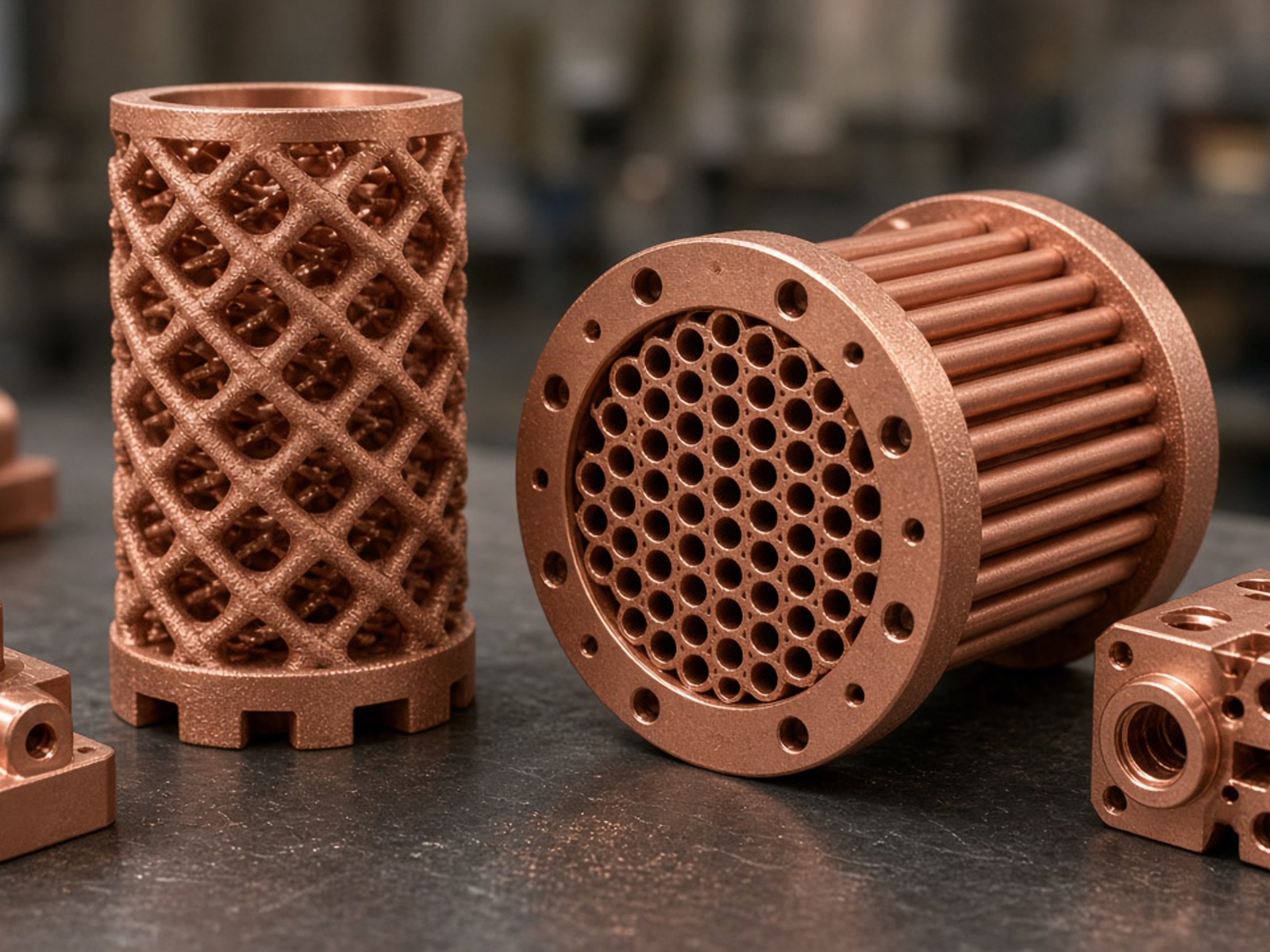
Copper 3D printing refers to additive manufacturing techniques that process pure copper or copper alloys to produce parts with high thermal and electrical conductivity. These methods typically involve laser-based powder bed fusion or binder jetting systems, which differ significantly from polymer processes in equipment, parameters, and post-processing needs.
Material Properties Relevant to Additive Manufacturing
Copper offers excellent conductivity, corrosion resistance in many environments, and good ductility. In printed form, achieved conductivity depends on density, purity, and any alloying elements.
Thermal Conductivity
Typical reference values for printed copper include thermal conductivity above 300 W/m·K when density exceeds 95 %, though actual results vary with process parameters and require verification through testing.
Corrosion Resistance
Copper resists corrosion in many environments, an advantage for components exposed to moisture, coolants, or moderate chemical contact.
Ductility & Purity
Good ductility supports functional parts, while achieved conductivity depends on density, purity, and any alloying elements present in the feedstock.
Common Process Approaches
Both documented routes fall outside standard polymer additive manufacturing capabilities and generally need dedicated metal systems plus controlled environments.
Laser Powder Bed Fusion
Laser powder bed fusion remains the most documented route for copper, yet the metal’s high reflectivity and thermal conductivity demand specialized lasers and atmospheres.
Binder Jetting + Sintering
Binder jetting followed by sintering offers an alternative path but introduces shrinkage and porosity considerations that must be planned for in the design stage.
Practical Selection Factors
Four considerations usually decide whether an additive route is the right fit for a copper component.
Application Requirements
High conductivity for heat transfer or electrical paths must be balanced against mechanical loads, operating temperature, and chemical exposure.
Geometry Complexity
Internal channels or thin walls benefit from additive freedom but increase support removal and surface finishing effort.
Quantity and Economics
Low-volume or highly complex copper parts may justify additive routes; higher volumes often favor traditional forming or machining.
Tolerances and Finish
As-printed surfaces usually require secondary operations such as machining or polishing to meet functional dimensions.
Design Inputs and Limitations
Designs must account for minimum wall thickness, overhang angles, and powder removal paths specific to the chosen metal process. Shrinkage during sintering or residual stresses after laser melting can affect final geometry.
Guaranteed tolerances and material certifications require engineering review on a part-by-part basis. Surface oxidation during or after printing may also necessitate additional cleaning steps.
Review Checklist
- •Minimum wall thickness for the selected process
- •Overhang angles and support strategy
- •Powder removal paths for internal features
- •Shrinkage or residual stress compensation
- •Post-print cleaning and secondary operations
Considering an Alternative Route
Copper 3D printing remains a specialized capability with higher equipment and material costs compared with polymer alternatives.
Load Review
Define the mechanical loads the component must carry in service.
Temperature Review
Establish the operating temperature range the part will see.
Conductivity Review
Confirm the thermal and electrical conductivity actually required.
For many functional industrial components, engineering review of load, temperature, and conductivity needs can identify suitable polymer options that avoid the complexity of metal additive manufacturing.
Request an Engineering Review
Share your part requirements and our team will review load, temperature, and conductivity needs to identify a suitable manufacturing route. Tolerances and material certifications are confirmed on a part-by-part basis after review.
- •Email: [email protected]
- •Address: No. 17-1, Guanlan Avenue, Longhua District, Shenzhen, Guangdong Province, Shenzhen 3D Printing Industrial Park
Contact RapidPrintParts
Get in Touch
We are here to answer your questions about industrial additive manufacturing and functional 3D printed parts. Reach out to us through the following methods:
Email: [email protected]
Address: No. 17-1, Guanlan Avenue, Longhua District, Shenzhen, Guangdong Province, Shenzhen 3D Printing Industrial Park