
3D Printing Sanding
Sanding is one post-processing option that RapidPrintParts may apply to improve surface texture on additive-manufactured components. It is considered when parts must meet specific handling, assembly, or appearance requirements in industrial settings.
- Finishing Steps
- Sanding, blasting, polishing, vapor smoothing, painting
- Typical Parts
- Jigs, fixtures, robot EOAT, housings, brackets
- Review Basis
- Application, load, temperature, quantity
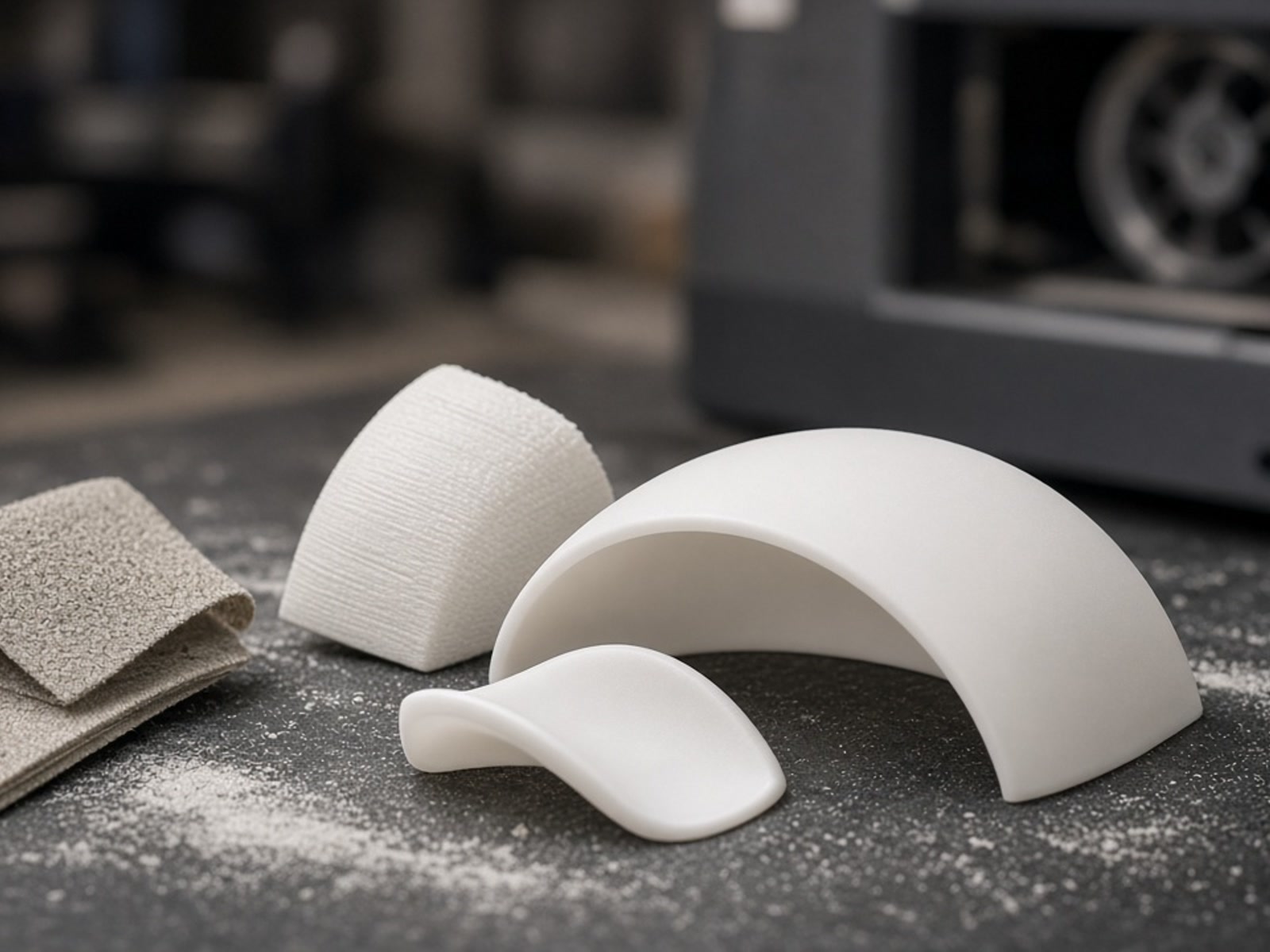
Role of Sanding in Functional Finishing
Sanding removes layer lines or surface irregularities left by the build process. It is listed among available post-processing steps that also include blasting, polishing, vapor smoothing, and painting.
The goal is to produce a surface that supports the part’s operating conditions without altering core mechanical properties.
What Sanding Addresses
- Layer lines left by the build process
- Surface irregularities affecting handling
- Assembly fit and appearance requirements
- Coating or sealing preparation needs
Core mechanical properties remain unchanged by the sanding step.
Compatible In-House Processes
Sanding may be applied to parts produced by the following processes. Build envelopes and typical tolerances remain unchanged by the sanding step. Guaranteed results always require engineering review.
Thermoplastics
Parts in ABS, ASA, PC, PA, PA-CF, PETG, TPU, or PEEK.
Engineering Resins
Parts produced in SLA engineering resins.
Powder-Based Materials
Parts in PA12, PA11, PA12 GF, or TPU.
Practical Selection Factors
When evaluating sanding, consider the inputs below. Each factor is reviewed against the part’s intended function before any finishing step is confirmed.
Most Often Requested For
Jigs, fixtures, robot EOAT, mechanical housings, brackets, and low-volume end-use components.
-
01
Part Geometry
Access to surfaces that need treatment.
-
02
Target Surface Roughness
Required for grip, sealing, or coating adhesion.
-
03
Material Hardness
Its response to abrasive media.
-
04
Quantity & Repeatability
Needs for production batches.
-
05
Finishing Interaction
Interaction with other finishing steps such as dyeing or painting.
Design Inputs and Limitations
Provide a STEP/STP file plus a 2D drawing that clearly marks critical surfaces and any tolerance zones that must remain untouched.
- Sanding is a manual or semi-manual operation; uniform results on deep internal channels or very fine features may be limited.
- Over-sanding can affect dimensional accuracy, so minimum stock allowance and maximum material removal should be defined during review.
- Sanding does not add strength or change material certifications.
- It is not presented as a substitute for tighter build tolerances or secondary machining.
Engineering Review Process
RapidPrintParts evaluates every sanding request against the part’s application, load, temperature, and quantity requirements.
Submit your CAD data, performance specifications, and target lead time for assessment. The engineering team confirms feasibility and documents the agreed finishing steps before production begins.
Start an Engineering ReviewRequest a Sanding Assessment
Share your CAD data, performance specifications, and target lead time. The engineering team confirms feasibility and documents the agreed finishing steps before production begins.
Contact RapidPrintParts
Get in Touch
We are here to answer your questions about industrial additive manufacturing and functional 3D printed parts. Reach out to us through the following methods:
Email: [email protected]
Address: No. 17-1, Guanlan Avenue, Longhua District, Shenzhen, Guangdong Province, Shenzhen 3D Printing Industrial Park