3D Printing Finishing for Industrial Parts
In additive manufacturing, the as-printed surface is only the baseline. RapidPrintParts provides engineered post-processing workflows to enhance surface texture, dimensional accuracy, and mechanical performance tailored to your part's thermal, mechanical, and chemical environment.
Common Industrial Finishing Processes
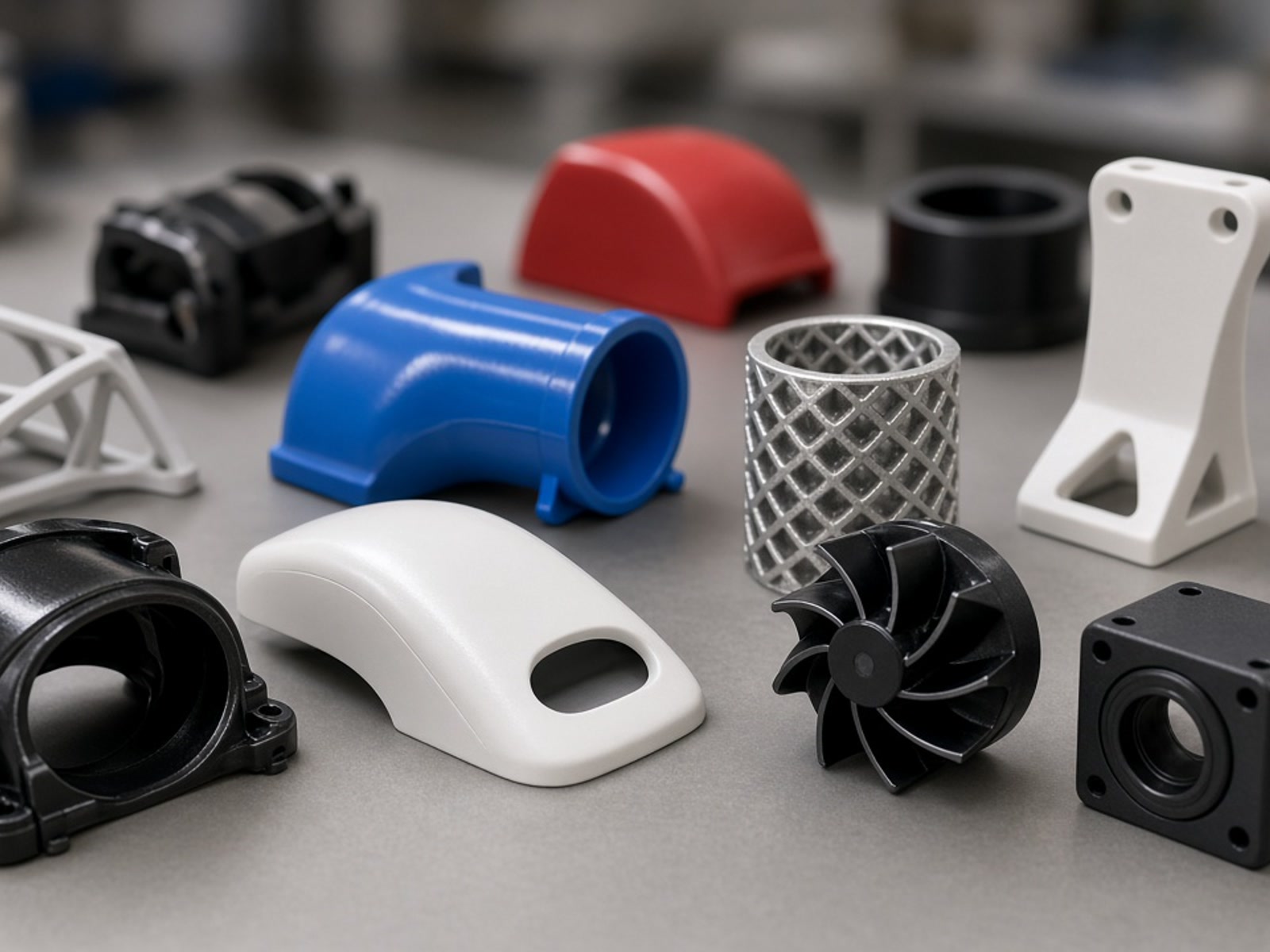
Finishing ranges from basic aesthetic uniforming to mission-critical secondary machining. We tailor operations to baseline technology capabilities across polymer platforms.
Mechanical Finishing
- Media Blasting Removes residual powder from SLS and MJF parts, producing a uniform, matte textured finish.
- Sanding & Polishing Reduces layer lines on SLA resins and FDM thermoplastics for fit-check prototypes and tactile requirements.
- Support Removal Mechanical or chemical release of sacrificial build structures without degrading critical features.
Surface Treatments & Coatings
- Vapor Smoothing Chemical exposure that redistributes the outer layer of PA12 or TPU, sealing micropores to improve fluid containment and cleanability.
- Industrial Dyeing Standardized deep immersion dyeing (typically black) for MJF and SLS nylon components to achieve end-use uniformity.
- Painting & UV Coating Specialized color matching and UV barrier topcoats applied to protect engineering resins in outdoor environments.
Functional Secondary Operations
- Threaded Inserts Heat-set or ultrasonic insertion of brass or stainless steel inserts for strong, reusable assembly threads.
- Secondary CNC Machining Post-print milling or turning for high-precision geometries, such as bearing bores requiring tolerances down to ±0.05 mm.
- Drilling, Tapping & Marking Precision manual or automated tapping, along with laser marking for component serialization and traceability.
Finishing Considerations by Process
Post-processing workflows are selected in accordance with the base additive manufacturing build method to maintain dimensional stability and mechanical integrity.
| Additive Process | Typical Finishing Options | Primary Industrial Benefit |
|---|---|---|
| FDM / FFF | Sanding, Inserts, Painting, CNC Machining | Improved assembly strength, seam concealment, and cosmetic aesthetics |
| SLA | UV Curing, Polishing, Clear Coating | High dimensional accuracy, smooth tactile feel, and visual clarity |
| SLS | Media Blasting, Dyeing, Vapor Smoothing | Batch powder elimination, consistent color, and sealed surface pores |
| MJF | De-powdering, Dyeing, Vapor Smoothing | Enhanced surface durability, deep black finish, and professional appearance |
Engineering Design Inputs for Finishing
Secondary processing alters geometry, material performance, and delivery schedules. Integrate these four design inputs during early CAD preparation.
Dimensional Change
Abrasive sanding and chemical vapor smoothing remove or shift surface polymer. Critical tolerances (typically ±0.1 mm to ±0.3% based on process) require proper pre-build CAD offset allowances.
Material Compatibility
Not all polymers react identically to chemical vapor or thermal installation. High-performance polymers like PEEK and PEI require distinct process parameters compared to commodity PA12 or ABS.
Geometry Limitations
Enclosed channels, deep internal voids, and delicate lattice structures often prevent line-of-sight media blasting or mechanical polishing, dictating localized or chemical-only alternatives.
Lead Time Impact
Standard de-powdering is rapid, but multi-coat painting, secondary CNC milling, and precision insert tapping add sequential verification steps to the total production timeline.
Quality Assurance & Inspection Controls
For functional prototypes and bridge-production runs, RapidPrintParts aligns finishing deliverables with formal quality documentation. We support First Article Inspection (FAI) and dimensional verification reports to ensure secondary CNC operations, bore concentricities, and insert installations comply strictly with your 2D engineering drawings.
Request a Finishing & Manufacturing Quote
Submit your CAD models and 2D drawings. Our engineering team will review material selection, finishing feasibility, and dimensional constraints to provide an actionable manufacturing quote.
Contact RapidPrintParts
Get in Touch
We are here to answer your questions about industrial additive manufacturing and functional 3D printed parts. Reach out to us through the following methods:
Email: [email protected]
Address: No. 17-1, Guanlan Avenue, Longhua District, Shenzhen, Guangdong Province, Shenzhen 3D Printing Industrial Park