
Industrial Additive Manufacturing
Industrial 3D Printed Ducts: Engineering and Production
In industrial machinery, automation, and robotics, ducting is essential for airflow, cooling, material transport, and cable management. Traditional manufacturing of these components often involves complex sheet metal bending, welding, or expensive injection molding.
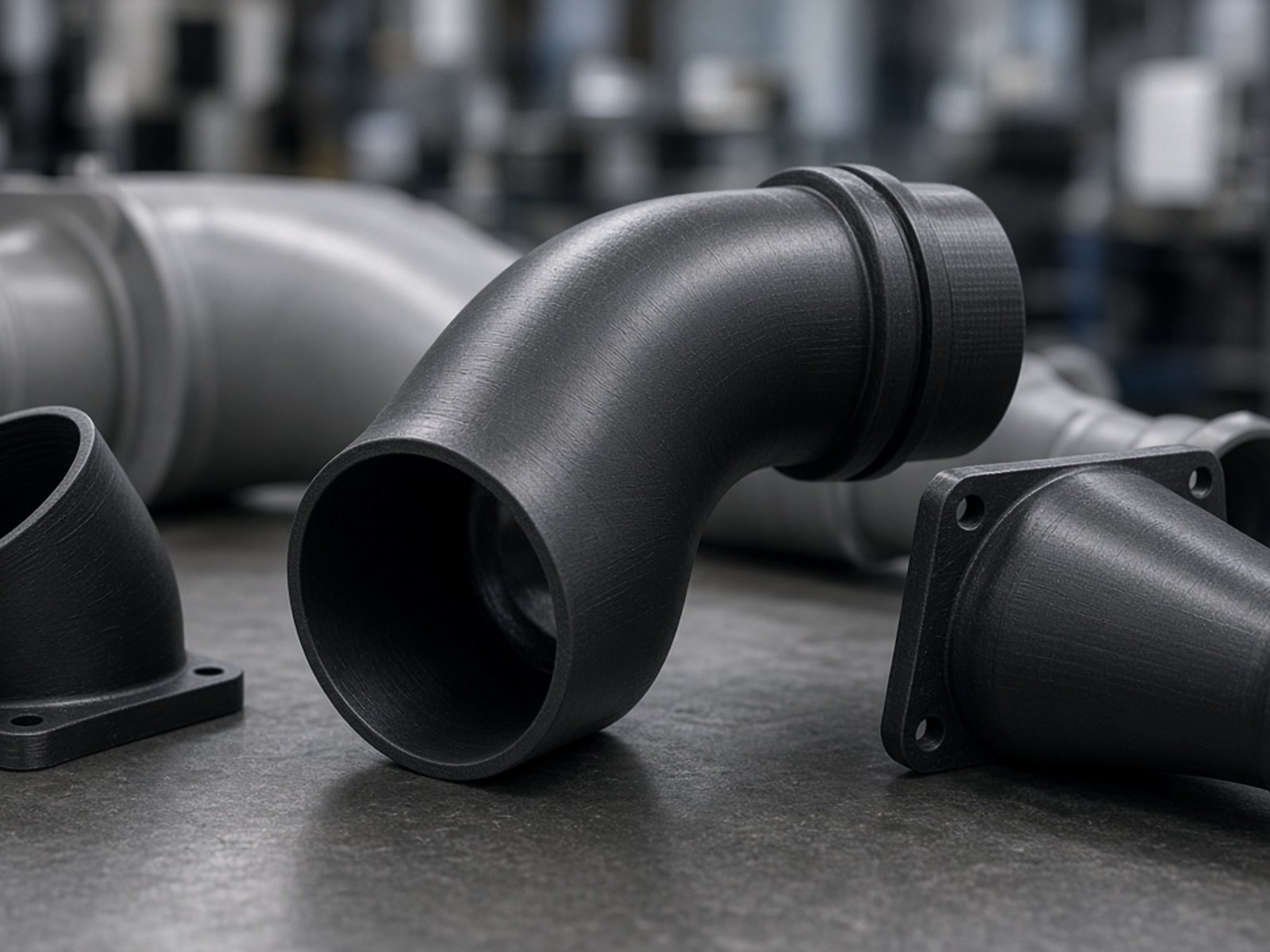
3D printed ducts allow engineers to consolidate multiple components into a single part, optimize internal flow paths, and produce low-volume or custom geometries without the constraints of traditional tooling. At RapidPrintParts, we utilize industrial additive manufacturing to produce functional ducts that meet specific mechanical and environmental requirements.
Core Processes for Duct Manufacturing
Selecting the appropriate 3D printing process for a duct depends on the required airtightness, temperature resistance, and mechanical load.
SLS and MJF
Selective Laser Sintering (SLS) and Multi Jet Fusion (MJF) are often the preferred methods for functional ducts.
- Materials
- Typically Nylon PA12, PA11, or glass-filled variants (PA12 GF).
- Advantages
- Durable, isotropic parts that handle complex internal geometries without internal support structures. Well-suited for airtight or watertight applications, especially when combined with post-processing.
- Typical Tolerance
- ±0.3% or ±0.2 mm, though this requires engineering review for specific geometries.
FDM / FFF
FDM is used for larger ducts or those requiring specialized high-performance polymers.
- Materials
- ABS, ASA (UV resistant), PC, and high-temperature materials like PEEK or PEI (ULTEM).
- Advantages
- Ideal for large-scale ducting (up to 1,000 mm) and environments involving high temperatures or harsh chemicals.
- Considerations
- FDM parts are inherently anisotropic; for pressurized applications, wall thickness and orientation must be carefully managed.
SLA
SLA is primarily utilized for high-detail prototypes and fit-testing.
- Materials
- Engineering resins.
- Advantages
- Provides the smoothest surface finish for airflow validation and clear resins for visual flow analysis.
Material Selection Factors
Industrial ducts must withstand their operating environment. Common selection criteria include:
Thermal Requirements
For cooling ducts near motors or heat sources, materials like PC, PA-CF, or PEEK may be necessary.
Chemical Resistance
Ducts used in chemical processing or those exposed to oils and lubricants require chemically stable polymers like PA12 or PEEK.
UV Exposure
For outdoor equipment, ASA is a typical reference for its resistance to UV degradation.
Mechanical Stress
Fiber-reinforced filaments (PA-CF) provide additional stiffness for ducts that also serve as structural brackets.
Design and Engineering for 3D Printed Ducts
Transitioning from traditional designs to additive manufacturing requires a shift in design philosophy.
-
1
Part Consolidation
Engineers can integrate mounting brackets, sensor ports, and flanges directly into the duct body, reducing assembly time and potential leak points.
-
2
Internal Flow Optimization
3D printing allows for organic, non-standard shapes that can improve laminar flow and reduce pressure drops compared to segmented, welded designs.
-
3
Wall Thickness
Typical functional ducts require a minimum wall thickness to ensure structural integrity and airtightness. Depending on the process, this may range from 1.2 mm to 3.0 mm.
Post-Processing
To achieve specific performance targets, ducts may undergo secondary operations such as:
- Vapor Smoothing: To seal the surface and improve internal airflow.
- Dyeing or Painting: For aesthetic or identification purposes.
- Inserts and Tapping: For secure mechanical fastening to machinery.
Applications in Industrial Sectors
Machinery & Automation OEMs
Custom cooling shrouds for electronics or specialized air-delivery nozzles for packaging lines.
Robotics & Integrators
Lightweight End-of-Arm Tooling (EOAT) ducts for vacuum grippers or cable management.
MRO and Spare Parts
Replacement of obsolete or discontinued ducting for older industrial equipment.
Industrial Hardware
Functional prototypes for EVT/DVT/PVT stages of product development.
Engineering Review and Quality Support
The success of a 3D printed duct depends on the alignment of design and process capabilities. RapidPrintParts provides engineering reviews to evaluate material compatibility, load requirements, and tolerances before production begins.
For projects requiring specific documentation, we may provide first article inspections (FAI), dimensional inspection reports, and certificates of conformity when agreed upon during the quoting phase.
Contact Our Engineering TeamWhat we review before production
- Material compatibility
- Load requirements
- Tolerances
- Documentation needs agreed at quoting
Review your CAD data and application requirements
Contact our engineering team to review your CAD data and application requirements for custom 3D printed ducting.
Share your drawings, operating environment, and target quantities. Our team will follow up with process and material guidance.
Start Your InquiryRequest a Quote for 3D Printed Ducts
Send us your application details and CAD data. Our engineering team will review material compatibility, load requirements, and tolerances before production begins.
Contact RapidPrintParts
Get in Touch
We are here to answer your questions about industrial additive manufacturing and functional 3D printed parts. Reach out to us through the following methods:
Email: [email protected]
Address: No. 17-1, Guanlan Avenue, Longhua District, Shenzhen, Guangdong Province, Shenzhen 3D Printing Industrial Park