Metal 3D Printing: Industrial Applications & Technology Overview
Metal additive manufacturing builds intricate components layer-by-layer directly from digital CAD models. Understand core processes, industrial alloys, critical design constraints, and how high-performance polymers compare for tooling, jigs, and functional hardware.
Common Metal Additive Manufacturing Technologies
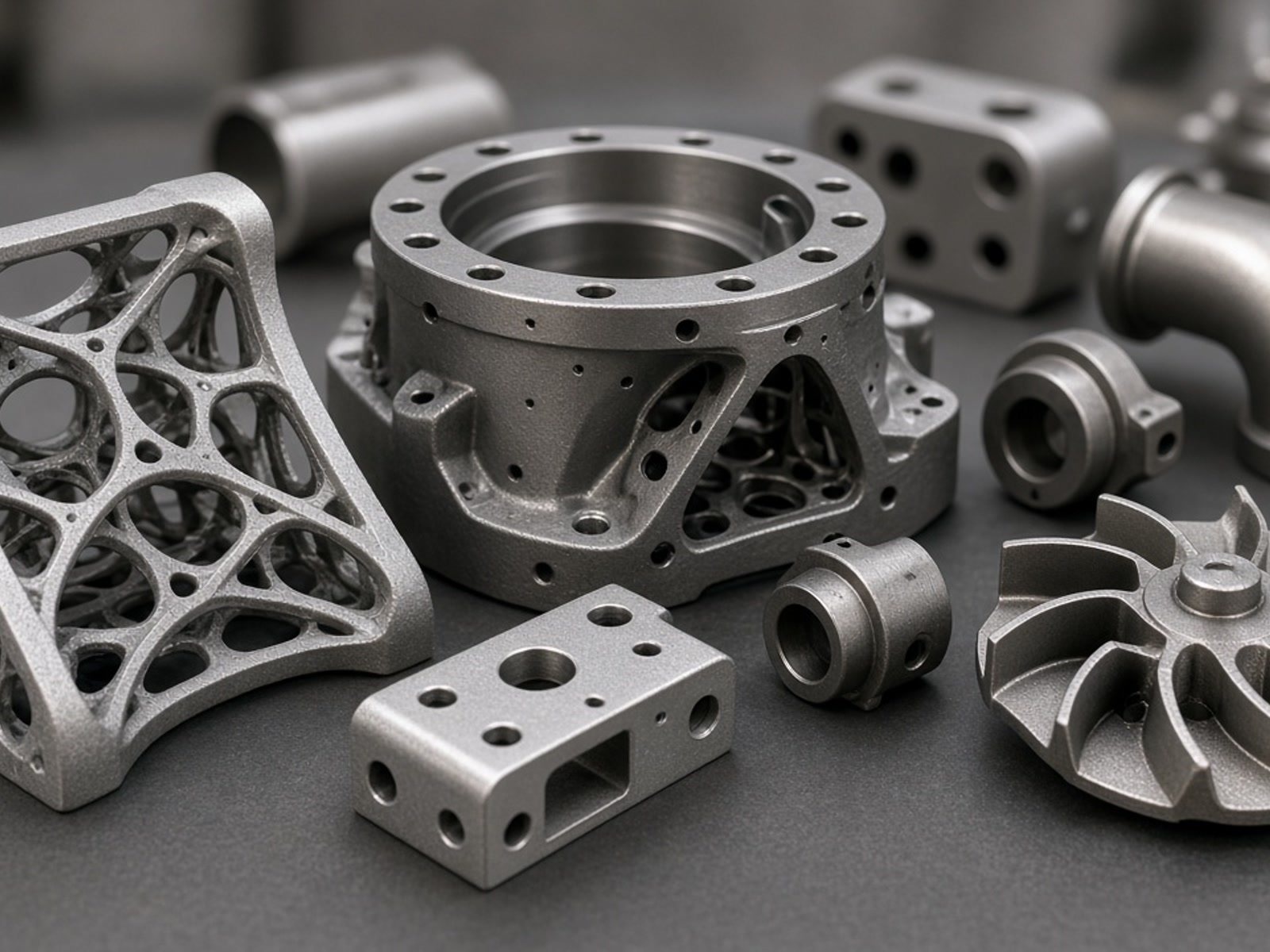
While all metal additive processes construct parts layer-by-layer, the physical mechanism used to fuse metallic materials differs significantly across platforms.
Powder Bed Fusion (PBF)
Includes Direct Metal Laser Sintering (DMLS) and Selective Laser Melting (SLM). A high-powered laser selectively fuses microscopic metal powder layers to form fully dense, high-strength industrial structures.
Binder Jetting
Liquid binder is selectively deposited across a bed of metal powder. The printed green body is later sintered in a high-temperature furnace to burn off binder and achieve material consolidation.
Directed Energy Deposition (DED)
Thermal energy (laser or electron beam) melts powder or wire feedstocks simultaneously as they are expelled through an integrated nozzle system.
Typical Industrial Metal Materials
Industrial metal additive manufacturing relies on standardized alloys formulated specifically for powder and wire processing environments.
Stainless Steel (316L, 17-4 PH)
Offers high mechanical strength and exceptional corrosion resistance. Widely deployed across chemical processing, marine, and food-grade machinery.
Aluminum (AlSi10Mg)
Combines low mass with solid thermal conductivity. Commonly chosen for thermal management heat exchangers and structural airframe brackets.
Titanium (Ti6Al4V)
Renowned for superior strength-to-weight metrics and biological compatibility, suited for mission-critical mechanical systems and specialized fixtures.
Nickel Superalloys (Inconel 625/718)
Maintains yield strength, tensile stability, and oxidation resistance under high thermal and corrosive stresses.
Tool Steels (Maraging Steel)
High hardness and wear resistance characteristics tailored for injection mold inserts featuring conformal cooling passages and heavy-duty tooling.
Evaluating Properties?
Compare these metallic mechanical limits against high-strength industrial polymers.
See Polymer Comparison →Design & Production Considerations
Designing for metal additive processes requires accounting for metallurgical dynamics, support structures, and mandatory post-build operations.
Support Structures
Metal PBF mandates rigid anchors to manage rapid heat transfer and secure the part to the build plate. These require mechanical removal via CNC machining or wire EDM.
Internal Stresses
Steep thermal gradients introduce residual stresses during solidification. Secondary thermal stress-relief cycles are generally required prior to cutting parts off the plate.
Surface Finish
Raw sintered surfaces exhibit a characteristic matte texture. Mating interfaces, bearing journals, and O-ring grooves demand post-machining to satisfy tight operational tolerances.
Build Orientation
Layer orientation dictates directional mechanical properties (anisotropy), support footprint size, and surface finish uniformity across downward-facing geometric angles.
Metal vs. High-Performance Polymers
While metal 3D printing is irreplaceable for extreme thermal zones and strict electrical conduction, modern industrial polymers often fulfill mechanical tooling and functional component requirements at a fraction of the cost and weight.
RapidPrintParts Polymer Focus
Specializing in industrial FDM/FFF, SLA, SLS, and MJF manufacturing.
Strength-to-Weight Optimization
Carbon Fiber Reinforced Nylon (PA-CF) and high-temp PEEK via industrial FDM provide the rigidity, dimensional stability, and wear resistance needed to substitute for aluminum brackets and housings.
Unconstrained Complex Geometries
Powder-bed polymer technologies like SLS and MJF (Nylon 11 / 12) require no sacrificial anchors. Internal fluid channels, baffles, and lattice geometries produce cleanly without post-machining.
Turnaround & Production Cost
By avoiding wire EDM cut-off, hot isostatic pressing (HIP), and complex CNC cleanup, engineering polymer components provide rapid delivery and reduced part costs for bridge production.
Engineering Review for Functional Parts
Determining whether an application genuinely requires metal or can leverage high-performance additive polymers involves rigorous evaluation of operating constraints:
Request an Engineering Feasibility Assessment
Unsure if your part requires metal additive manufacturing or if an industrial polymer can deliver equal performance at lower weight and cost?
RapidPrintParts reviews your 3D CAD models and operational requirements to evaluate compatibility with our in-house industrial polymer capabilities, including SLS, MJF, and engineering-grade FDM.
Contact RapidPrintParts
Get in Touch
We are here to answer your questions about industrial additive manufacturing and functional 3D printed parts. Reach out to us through the following methods:
Email: [email protected]
Address: No. 17-1, Guanlan Avenue, Longhua District, Shenzhen, Guangdong Province, Shenzhen 3D Printing Industrial Park