Manufacturing 3D Printing for Functional Industrial Parts
Direct digital production of functional prototypes, jigs, fixtures, mechanical components, and low-volume end-use parts. RapidPrintParts evaluates each geometry against actual mechanical, thermal, and dimensional criteria before selecting the optimal manufacturing path.
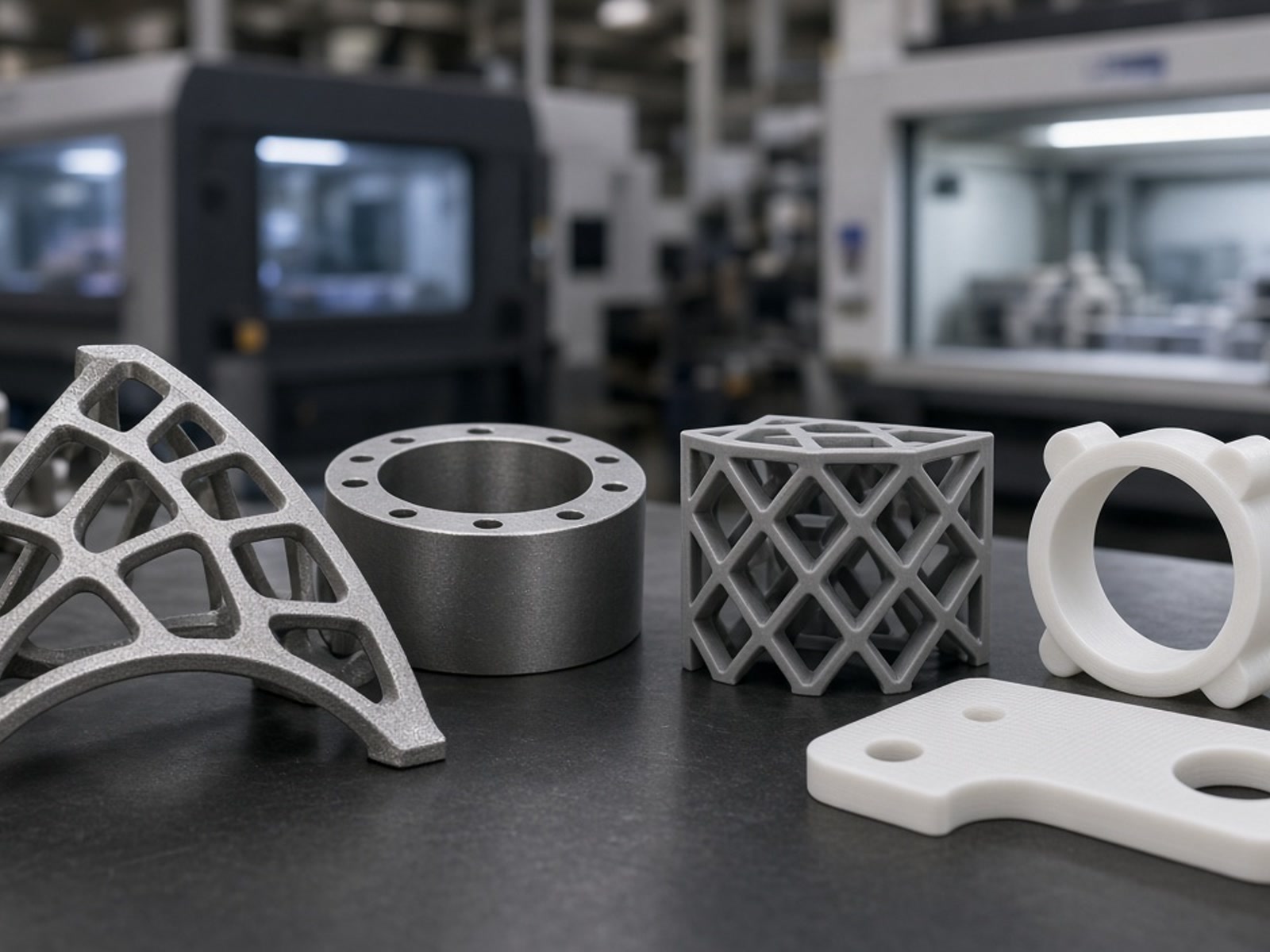
In-house additive production across 2,600 m² of specialized polymer processing equipment.
Core In-House Polymer Additive Processes
RapidPrintParts deploys four dedicated industrial polymer technologies configured for mechanical integrity, dimensional repeatability, and production predictability.
FDM / FFF
Filament ExtrusionEngineered for durable assembly jigs, robust fixtures, large enclosures, and functional equipment parts requiring structural plastics.
- Materials
- ABS, ASA, PC, PA, PA-CF, PETG, TPU, PEEK
- Typical Build Envelope
- Up to ~1,000 × 600 × 600 mm
- Standard Tolerance Baseline
- ±0.2 mm or ±0.3%
SLA
PhotopolymerizationOptimal for fine-feature prototypes, ergonomic master patterns, and assembly validation demanding smooth cosmetic surfaces.
- Materials
- Engineering Resins (Standard, Rigid, Tough, Clear)
- Typical Build Envelope
- Up to ~600 × 600 × 400 mm
- Standard Tolerance Baseline
- ±0.1 mm or ±0.2%
SLS
Selective Laser SinteringPowder-bed fusion yielding durable, support-free geometries suitable for complex ducting, snap fits, and low-volume production batches.
- Materials
- PA12, PA11, TPU
- Typical Build Envelope
- Up to ~380 × 380 × 600 mm
- Standard Tolerance Baseline
- ±0.3 mm or ±0.3%
MJF
Multi Jet FusionHigh-density functional nylon components with balanced isotropic properties, ideal for end-use industrial parts and batch replacements.
- Materials
- PA12, PA11, PA12 GF, TPU
- Typical Build Envelope
- Up to ~380 × 284 × 380 mm
- Standard Tolerance Baseline
- ±0.2 mm or ±0.3%
Practical Selection Factors
Additive manufacturing provides rapid agility, but successful deployment hinges on matching physical demands to the correct polymer matrix and thermal envelope.
Volume & Demand Profile
Cost-effective for low-to-mid unit volumes, bridge tooling, and recurring spare part requirements without hard tooling capital.
Environmental Demands
Material compatibility verified for continuous operating temperature, UV exposure, chemical contact, flame retardance, or ESD limits.
Mechanical Loads
Selection adjusted for tensile strength, elongation at break, impact resistance, and anisotropic shear planes along Z-axes.
Finish & Schedule
Alignment of required post-processing steps with required turnaround speed, lead times, and downstream assembly schedules.
Engineering Inputs, Secondary Operations & Quality
From native 3D geometry to final dimension inspection, manufacturing 3D printing integrates controlled post-processing workflows for demanding industrial use.
Data & File Readiness
Projects require solid model files in STEP / STP format. Accompanying 2D engineering drawings with defined datum planes, critical callouts, and thread callouts ensure thorough evaluation.
Secondary Operations
Post-processing options are scoped per component and may include bead blasting, manual sanding, mechanical polishing, chemical vapor smoothing, dyeing, industrial painting, marking, threaded brass inserts, drilling, tapping, and secondary CNC machining.
Quality Support
Project-specific verification paths can include First Article Inspection (FAI), calibrated dimensional measurement reports, material certificates, and Certificates of Conformity (CoC) when formally agreed prior to production.
Industrial Collaboration & Application Fit
RapidPrintParts partners directly with machinery OEMs, robotics systems integrators, automation designers, specialized MRO facilities, and contract manufacturers requiring recurring, reliable functional components without excessive tooling lead times.
Initiate a Technical Assessment
Submit your CAD files alongside functional requirements. Our engineering team reviews build orientation, technology selection, material suitability, and post-processing feasibility to deliver a clear production quote.
✓ STEP / STP native CAD format accepted
✓ Industrial polymer additive technologies (FDM, SLA, SLS, MJF)
✓ Engineering-driven review for functional and production parts
Contact RapidPrintParts
Get in Touch
We are here to answer your questions about industrial additive manufacturing and functional 3D printed parts. Reach out to us through the following methods:
Email: [email protected]
Address: No. 17-1, Guanlan Avenue, Longhua District, Shenzhen, Guangdong Province, Shenzhen 3D Printing Industrial Park