3D Printed Robot Grippers: Engineering Custom EOAT Solutions
In modern automation, the ability to rapidly iterate and customize End-of-Arm Tooling (EOAT) is critical to maintaining line efficiency. Additive manufacturing offers a versatile alternative to traditional machined metal grippers, allowing for complex geometries, weight reduction, and faster deployment cycles.
At RapidPrintParts, we support robotics integrators and automation OEMs by producing functional, durable robot grippers designed to withstand real-world industrial environments.
Benefits of Additive Manufacturing for Grippers
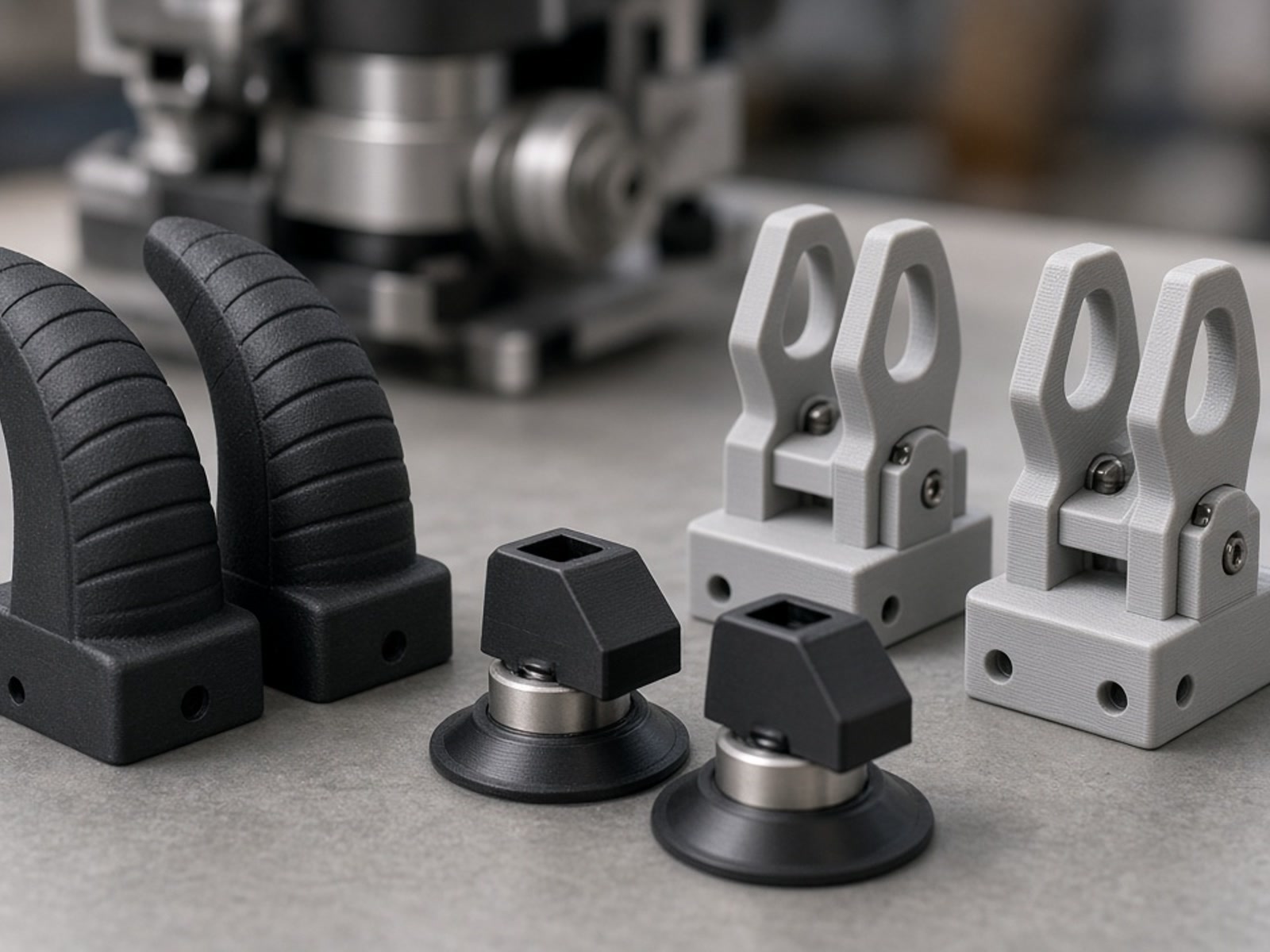
Transitioning from traditional manufacturing to 3D printing for robot grippers provides several functional advantages.
Weight Reduction
By utilizing additive design, grippers can be optimized to reduce mass. This minimizes the moment of inertia on the robot arm, potentially increasing cycle speeds or allowing for the use of smaller, more cost-effective robots.
Complex Geometries
3D printing allows for internal channels, conformal shapes that match irregular workpieces, and integrated mounting features that are difficult or impossible to achieve with subtractive machining.
Rapid Iteration
When a new product enters the production line, custom grippers can be manufactured in days rather than weeks, keeping project timelines on track.
Tooling Avoidance
For low-volume production or unique, one-off assembly tasks, 3D printing eliminates the need for expensive CNC fixtures or casting molds.
Selecting the Right Process and Material
The operating environment and mechanical requirements dictate the optimal additive process. Our team evaluates the following factors to ensure the gripper performs under load.
| Process | Recommended Materials | Best-Fit Characteristics |
|---|---|---|
| FDM / FFF | PA-CF, PEEK, PC, ABS | Excellent for large, rigid structures and custom mounting brackets. |
| SLS | PA12, PA11 | Ideal for complex, durable parts that require high dimensional accuracy. |
| MJF | PA12, PA12 GF, TPU | High-throughput production of functional parts with isotropic mechanical properties. |
Note: TPU is frequently utilized for gripper fingers or contact surfaces where high friction and compliance are required to prevent damage to the handled object.
Design and Engineering Considerations
To ensure the reliability of 3D printed grippers, every design requires engineering review. When submitting your CAD files, please consider the following.
Typical Tolerances
FDM: ±0.2 mm or ±0.3%. SLS / MJF: ±0.2–0.3 mm.
Critical mating surfaces may require secondary CNC machining or the integration of metal inserts for increased durability.
-
1
Operating Environment
Does the gripper encounter chemicals, high temperatures, or specific ESD requirements?
-
2
Load Requirements
Define the weight of the objects being handled and the expected acceleration forces.
-
3
Tolerances
While our processes achieve typical tolerances (FDM ±0.2 mm or ±0.3%; SLS / MJF ±0.2–0.3 mm), critical mating surfaces may require secondary CNC machining or the integration of metal inserts for increased durability.
-
4
Interface Geometry
Ensure mounting patterns for your robot flange are clearly defined in your STEP or STP files.
Quality and Post-Processing
Industrial grippers often require more than just the raw print. RapidPrintParts provides secondary services to improve functionality and longevity.
Mechanical Integration
We offer tapping, drilling, and the installation of threaded inserts to ensure secure mounting to your robot arm.
Surface Finishing
Blasting or polishing can be used to improve the surface finish or friction characteristics of the contact points.
Quality Documentation
For projects requiring strict repeatability, we can provide first article inspection, dimensional reports, and certificates of conformity upon request.
Request an Engineering Review
RapidPrintParts specializes in functional components for robotics and automation. We do not provide metal 3D printing services; however, our polymer-based solutions are engineered to replace, augment, or optimize your mechanical components.
To get started, provide us with:
- •A 3D model (STEP/STP format) and 2D drawing.
- •The application environment and load requirements.
- •Quantity and delivery timeline.
Discuss Your Robot Gripper Requirements
Send us your project details and receive a professional engineering review for your next project.
Contact RapidPrintParts
Get in Touch
We are here to answer your questions about industrial additive manufacturing and functional 3D printed parts. Reach out to us through the following methods:
Email: [email protected]
Address: No. 17-1, Guanlan Avenue, Longhua District, Shenzhen, Guangdong Province, Shenzhen 3D Printing Industrial Park