
3D Printed Parts Quality for Functional Industrial Applications
RapidPrintParts delivers functional prototypes, jigs and fixtures, mechanical components, and low-volume end-use parts. In-house polymer capabilities span FDM/FFF, SLA, SLS, and MJF technologies, ensuring process parameters, material properties, and finishing match the exact operating environment.
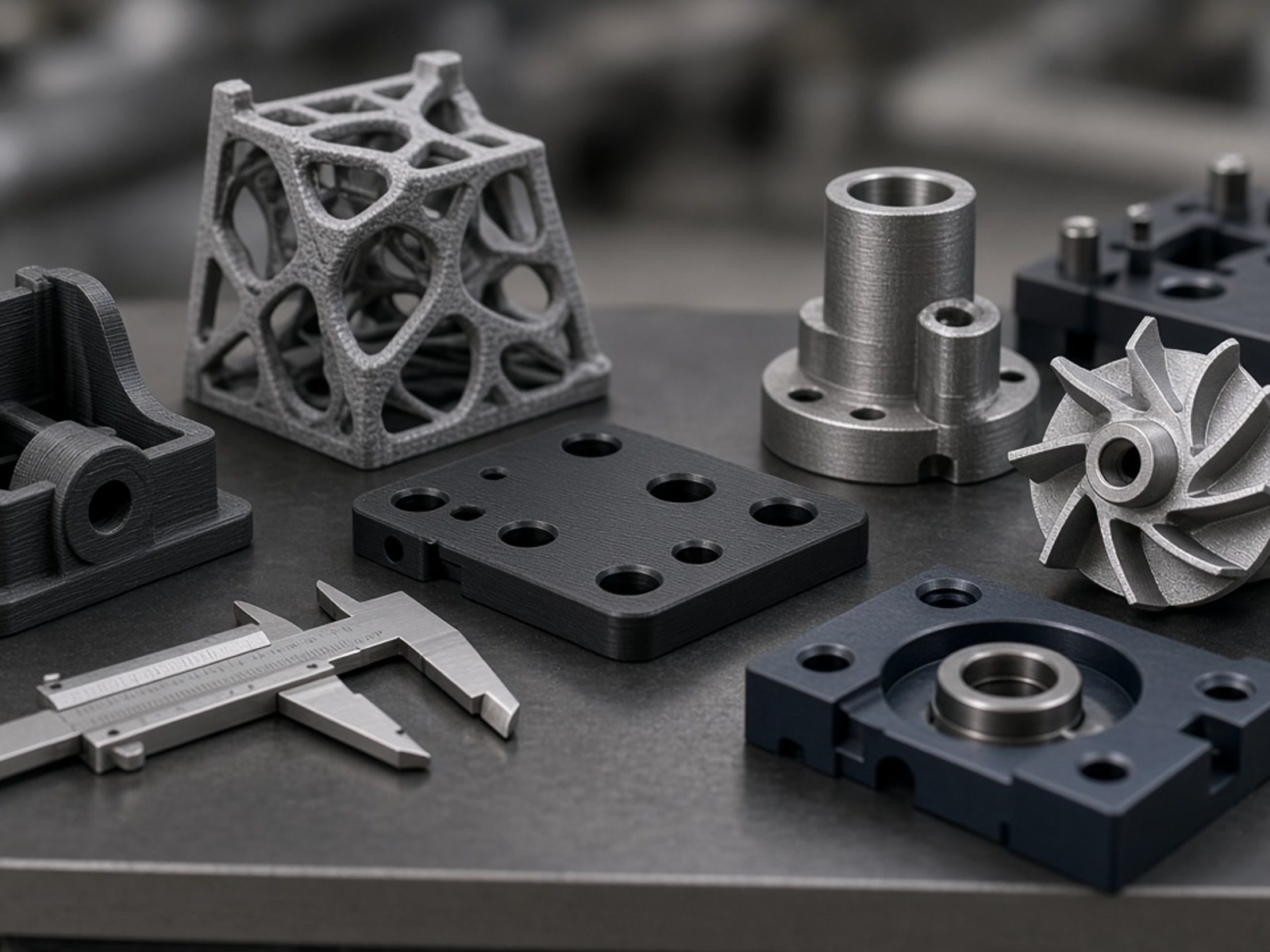
Typical Tolerance References by In-House Process
Tolerances are stated as typical references and vary based on component geometry, material grade, and build orientation. Parts that require tighter control are assessed individually during engineering review before quoting.
FDM / FFF
Functional prototypes, durable fixtures, large-scale industrial assemblies.
SLA
Smooth surface finishes, high visual fidelity, fine detail verification.
SLS
Complex geometries, support-free printing, robust mechanical parts.
MJF
Balanced isotropic properties, production-grade functional enclosures.
Quality Verification & Project Documentation
Quality assurance at RapidPrintParts relies on structured verification steps agreed upon prior to manufacturing. Documentation is aligned to functional industrial criteria, verifying compliance from raw material to dimensional sign-off.
First Article Inspection (FAI)
Verification of initial production units against critical CAD parameters before progressing full run batches.
Dimensional Inspection Reports
Measured data sets verifying key tolerances, fit surfaces, and specified reference planes.
Material & Compliance Records
Material verification sheets, certificates of conformity, and shipment reports confirming verified lots.
Post-Processing & Functional Finishing
Raw print surfaces are refined to meet operational requirements. Secondary operations provide required surface smoothness, visual aesthetics, or mechanical interfaces.
Surface Conditioning
- Media Blasting
- Hand Sanding & Polishing
- Vapor Smoothing
Color & Aesthetics
- Dyeing (SLS/MJF)
- Industrial Painting
- Component Marking
Hardware Integration
- Threaded Heat-Set Inserts
- Press-Fit Bushings
- Hole Tapping & Drilling
Machining Operations
- CNC Secondary Machining
- Precision Bore Reaming
- Critical Face Milling
Engineering Evaluation & Design Inputs
Achieving required part quality depends on identifying operational constraints during CAD assessment. RapidPrintParts reviews essential technical inputs to balance manufacturing performance and functional lifetime.
Required Application Inputs
- • Operating Environment: Ambient temperatures, mechanical loads, exposure to chemicals, flame retardancy, or ESD conditions.
- • Dimensional Controls: Critical fits, locating surfaces, and 2D engineering drawings showing exact tolerances.
- • Volume & Timing: One-off prototyping versus repeated batch requirements and milestone deadlines.
- • CAD Geometry: Standard STEP/STP formats alongside 2D documentation for engineering validation.
Geometry & Process Constraints
- • Wall Thickness & Features: Thin ribs and minimal feature sizes evaluated to prevent warpage and incomplete fills.
- • Build Orientation: Calculated layer-adhesion characteristics that balance strength along critical stress axes.
- • Thermal Shrinkage: Accounting for polymer contraction variations across SLA, SLS, and MJF thermal cycles.
- • Assembly Interfaces: Reviewing interface clearances for press-fits, threaded inserts, and mating components.
Request an Engineering Quality Review
Submit your part specifications for an in-depth review by our technical team. Providing complete details ensures process verification, achievable tolerance confirmation, and correct documentation scope.
Recommended Information
- • Application description & mechanical loads
- • Material preferences & thermal criteria
- • Critical tolerances and 2D inspection drawings
- • Part quantity & target milestone delivery
Contact RapidPrintParts
Get in Touch
We are here to answer your questions about industrial additive manufacturing and functional 3D printed parts. Reach out to us through the following methods:
Email: [email protected]
Address: No. 17-1, Guanlan Avenue, Longhua District, Shenzhen, Guangdong Province, Shenzhen 3D Printing Industrial Park