
Electronics 3D Printing
RapidPrintParts produces functional polymer parts for electronics-related industrial applications using FDM/FFF, SLA, SLS, and MJF processes. These parts serve machinery, automation, robotics, and hardware customers who require low-volume components that meet specific operating requirements.
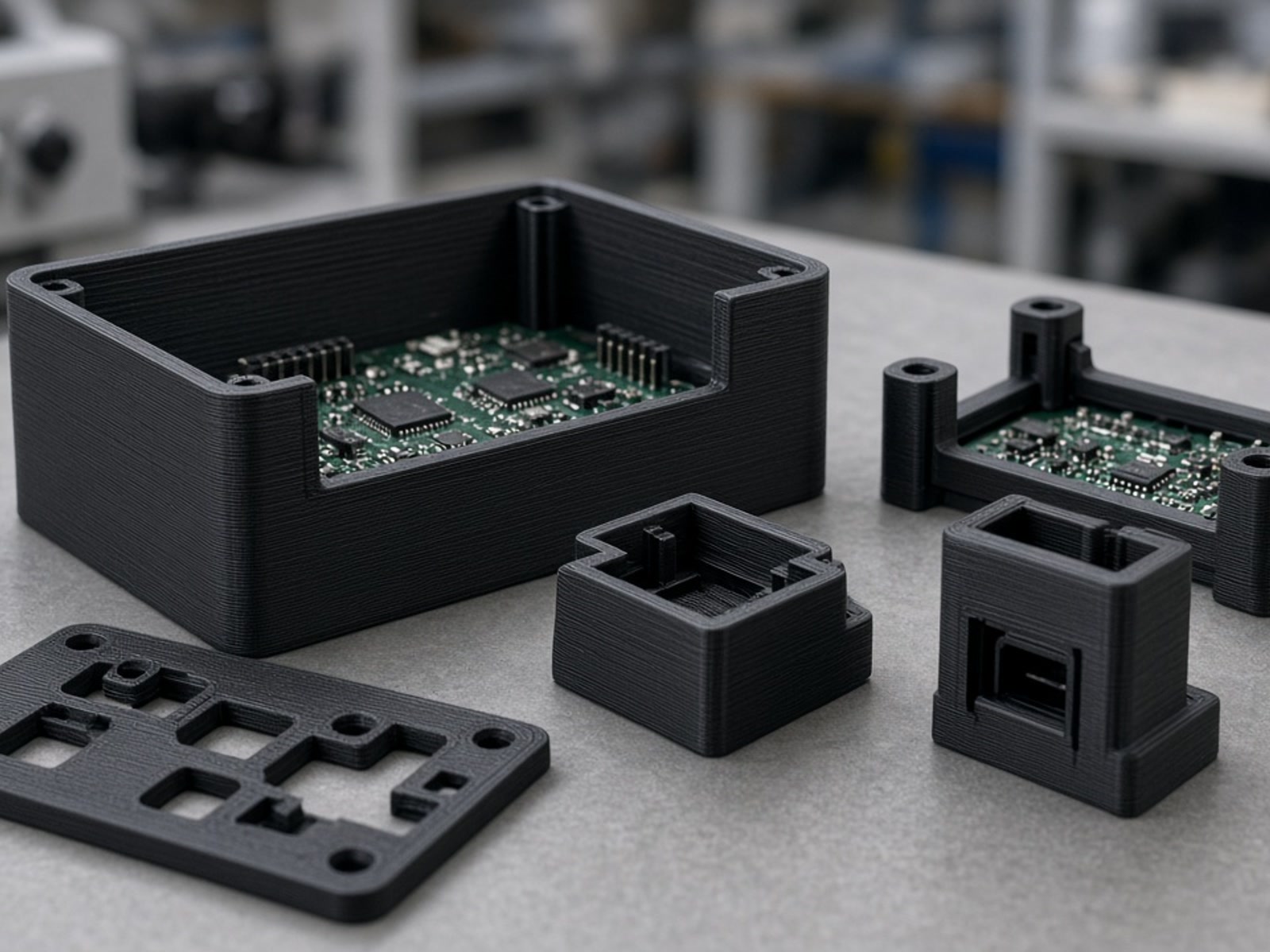
Typical Applications
Electronics 3D printing at RapidPrintParts focuses on parts that perform in real environments rather than appearance models. These applications align with the needs of automation OEMs, robotics integrators, and industrial hardware developers who require parts before or instead of traditional tooling.
Enclosures & Housings
Protection for internal electronic components.
Brackets & Mounts
For sensors, PCBs, or cable routing.
Ducts & Airflow Management
Components that direct and manage airflow.
Jigs, Fixtures & Assembly Aids
Used during electronics production.
Custom Replacement Parts
For legacy equipment no longer supported by original tooling.
Process and Material Selection Factors
Selection begins with the part’s operating conditions. The following table summarizes the in-house processes and typical materials suitable for electronics-related functional parts. Material choice depends on load, temperature, chemical exposure, and quantity. Guaranteed tolerance requires engineering review.
| Process | Typical Materials | Common Electronics Uses |
|---|---|---|
| FDM / FFF | ABS, ASA, PC, PA, PA-CF, PETG, PEEK | Large housings, structural brackets, ducts |
| SLA | Engineering resins | High-detail fit-check prototypes and small enclosures |
| SLS | PA12, PA11, TPU | Complex internal geometries and durable nylon parts |
| MJF | PA12, PA11, PA12 GF, TPU | Low-volume end-use brackets and functional nylon components |
Design Inputs Required for Review
To evaluate suitability, the following information is needed:
- 1 Application and operating environment
- 2 Quantity and repeat demand
- 3 Material requirement
- 4 Critical dimensions and tolerances
- 5 Load, temperature, or other performance needs
- 6 Finish and post-processing requirements
- 7 Target lead time
Build Envelopes & Post-Processing
Typical build envelopes and tolerance references vary by process. Post-processing options such as blasting, sanding, inserts, tapping, or CNC secondary machining may be applied when specified.
Provide the seven inputs alongside your files so the engineering team can assess material performance, tolerance feasibility, and process fit.
Limitations
- RapidPrintParts does not offer metal additive manufacturing. All production uses polymer processes listed above.
- Parts must be evaluated against actual mechanical and environmental demands before a process is recommended.
- Consumer, decorative, or very high-volume applications fall outside the typical scope.
Request an Engineering Review
Provide STEP/STP files, a 2D drawing, and the eight discovery inputs listed above for a technical assessment. The engineering team evaluates material performance, tolerance feasibility, and process fit before quoting.
Email: [email protected]
Address: No. 17-1, Guanlan Avenue, Longhua District, Shenzhen, Guangdong Province, Shenzhen 3D Printing Industrial Park
Contact RapidPrintParts
Get in Touch
We are here to answer your questions about industrial additive manufacturing and functional 3D printed parts. Reach out to us through the following methods:
Email: [email protected]
Address: No. 17-1, Guanlan Avenue, Longhua District, Shenzhen, Guangdong Province, Shenzhen 3D Printing Industrial Park