Robotics 3D Printing for Industrial Automation and EOAT
In the robotics and automation sector, the ability to rapidly iterate on End-of-Arm Tooling (EOAT), sensor mounts, and custom housings is critical to meeting project timelines. RapidPrintParts provides industrial-grade additive manufacturing solutions designed to meet the rigorous demands of robotic integrators and machinery OEMs.
Engineering-Grade Solutions for Robotics
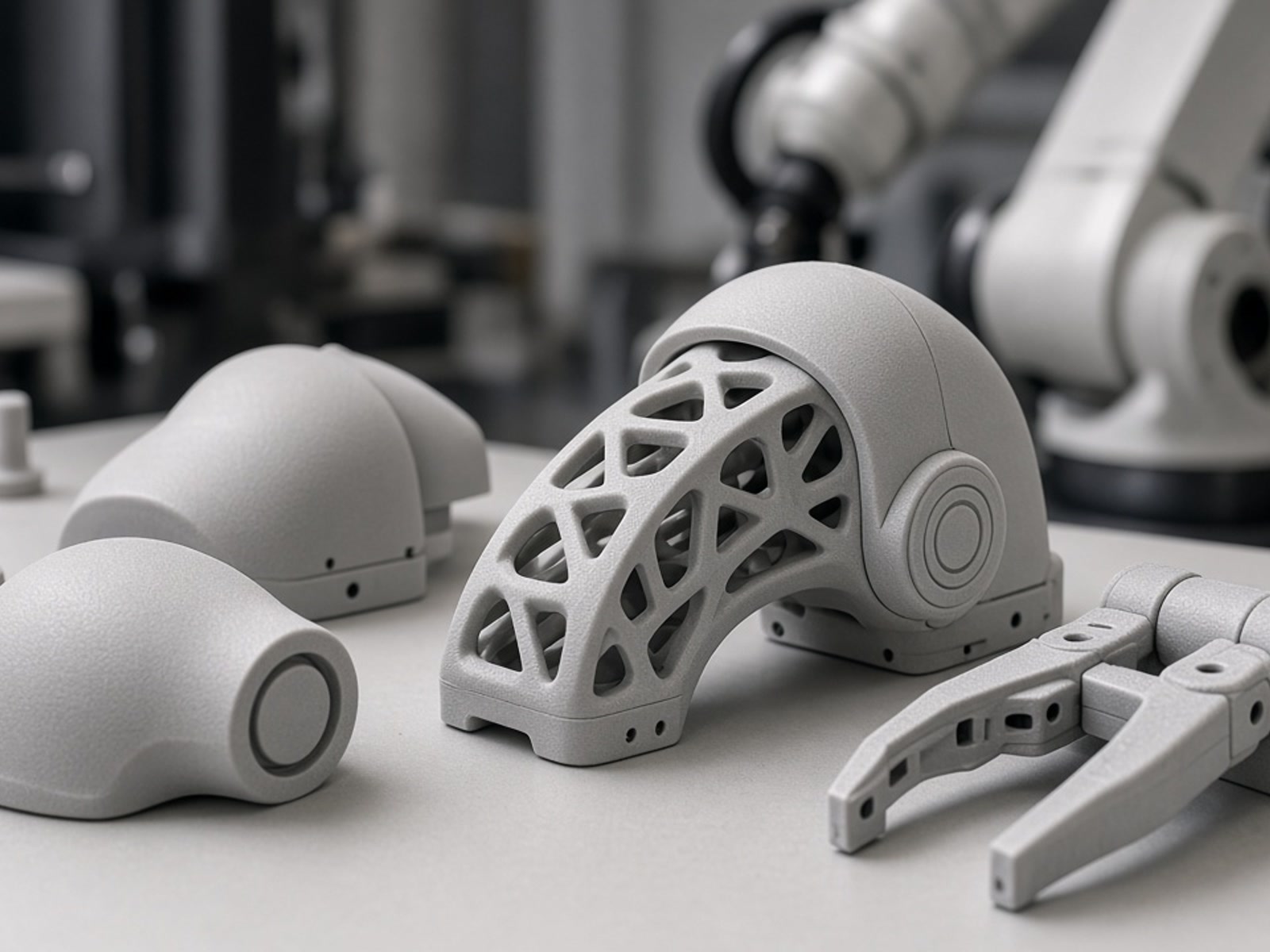
Robotic applications often require a balance of low weight, high strength, and geometric complexity that traditional manufacturing methods cannot provide on short notice. Our additive manufacturing processes—FDM, SLS, and MJF—are utilized to produce functional components that perform in real-world industrial environments.
EOAT & Grippers
Lightweight, customized end-effectors that reduce robot payload and improve cycle times across high-speed pick-and-place lines.
Sensor Brackets & Housings
Complex mounting solutions designed to integrate optical sensors, vision cameras, and cable routing into tight machine envelopes.
Assembly Aids & Jigs
Custom manufacturing tooling designed to accurately locate and secure components during automated assembly or welding processes.
Low-Volume Replacement Parts
Rapid on-demand fabrication of discontinued or specialized mechanical components to minimize costly industrial production downtime.
Selection Factors for Robotic Components
When selecting an additive manufacturing process for automation assemblies, our engineering team evaluates the specific operating environment of the part to balance mechanical performance and build efficiency.
Material Selection
Applications may require materials with specific properties, such as the high heat resistance of PEEK or ULTEM for FDM, or the durability, balance of rigidity, and chemical resistance of PA12 (Nylon) in SLS and MJF platforms.
Mechanical Load
Assessing the mechanical stress, acceleration forces, and recurring strain the part will endure during continuous robotic operation is essential for determining optimal print orientation and infill density.
Tolerance Requirements
While typical tolerances for processes like MJF and SLS range from ±0.2 mm to ±0.3 mm, critical fitment interfaces, dowel pin locations, and bearing pockets may require secondary CNC machining or specific geometry offsets.
Environmental Factors
Operating temperature ranges, industrial lubricant and chemical exposure, and ESD requirements are evaluated to ensure the specified material formulation and post-processing methods remain stable during continuous production.
Core Processes for Industrial Robotics
We match the additive manufacturing technology directly to your automation functional requirements, part scale, and batch size.
Large Structural Enclosures
Ideal for large structures, equipment guards, protective cowlings, and high-performance polymers such as PEEK or carbon-fiber-reinforced composites.
Complex Functional Tooling
Best suited for complex, durable nylon parts that require high geometric freedom without the design constraints or surface marks of support structures.
Low-Volume Production
An efficient choice for low-volume end-use parts, offering balanced density, isotropic mechanical behavior, and consistent properties in nylon materials.
High-Detail Fit Prototypes
Recommended for high-detail prototypes and verification models where precise spatial fit and surface cosmetics are evaluated before serial deployment.
Design for Additive Manufacturing (DFM)
To ensure optimal performance for your robotic components, we recommend a collaborative approach to design. Our engineering team reviews native and neutral CAD files (STEP/STP) to optimize wall thickness, lightweight internal lattice structures, and build orientations.
We provide full quality support for your robotic projects, including first article inspection, dimensional inspection reports, and certificates of conformity upon request.
Engineering Review Checklist
- • CAD Verification: Detailed evaluation of STEP/STP models for structural wall thickness and overhangs.
- • Orientation Strategy: Print axis alignment tailored to functional shear, tension, and moment loads.
- • Quality Documentation: First article inspection (FAI), dimensional reports, and conformity records.
Start Your Engineering Review
The performance of a 3D printed component depends on the application, material, and geometry. Submit your CAD files, production volume, and intended operating conditions to begin an engineering review of your robotic components.
Contact RapidPrintParts
Get in Touch
We are here to answer your questions about industrial additive manufacturing and functional 3D printed parts. Reach out to us through the following methods:
Email: [email protected]
Address: No. 17-1, Guanlan Avenue, Longhua District, Shenzhen, Guangdong Province, Shenzhen 3D Printing Industrial Park