
3D Printed Housings for Industrial Applications
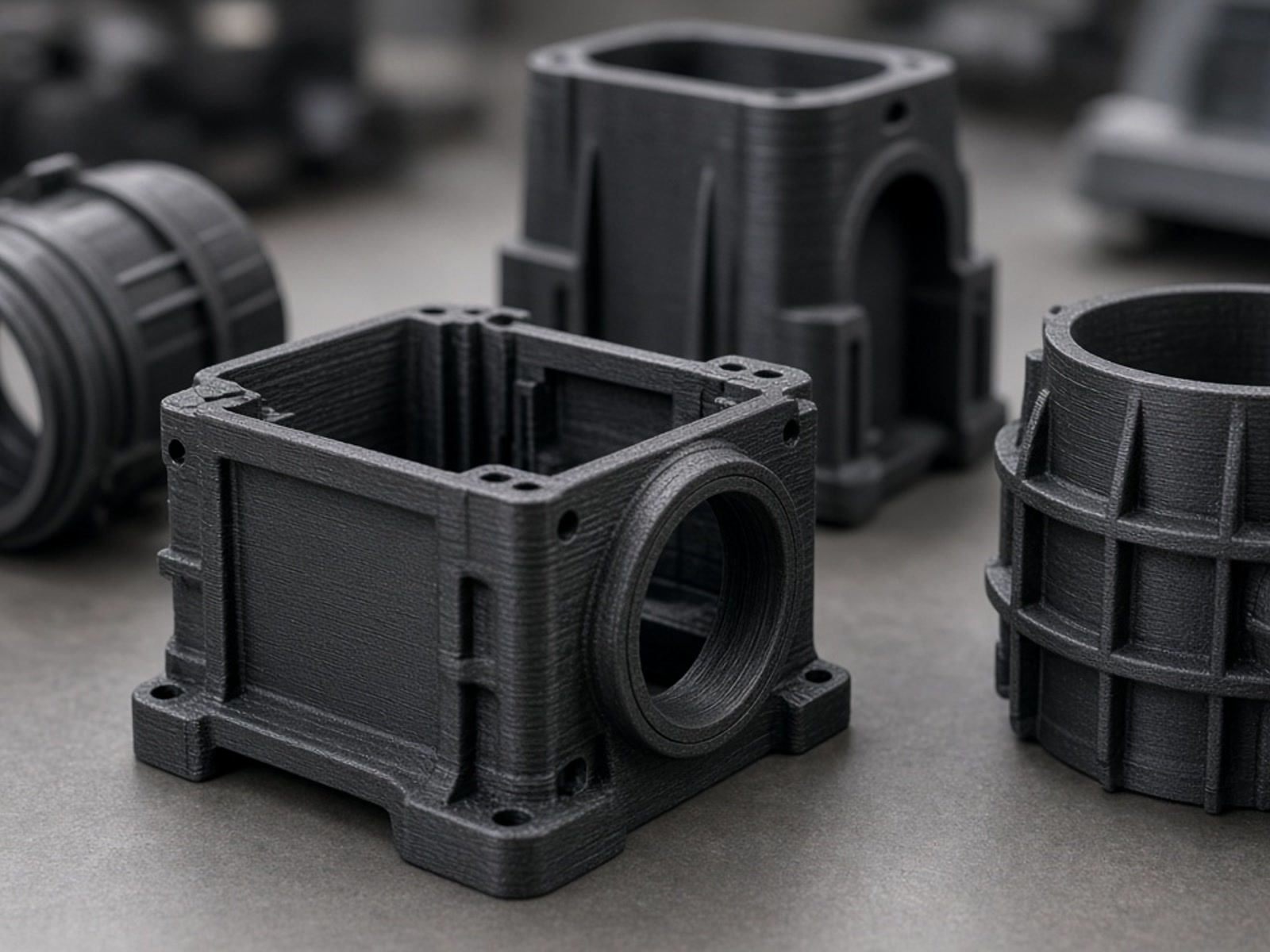
In demanding industrial environments, housings serve as the critical interface between sensitive internal components and external operating conditions. Protect electronics, shield mechanical assemblies, and secure sensor modules with rapid development and production-grade performance without the lead times of conventional tooling.
At RapidPrintParts, we deliver functional housings for machinery OEMs, robotics integrators, and industrial hardware developers. We evaluate your specific operating environment—including thermal, chemical, and mechanical loads—to recommend the ideal additive manufacturing process.
Selecting the Right Process for Your Housing
The choice of manufacturing process is dictated by functional loads, environmental factors, and assembly requirements. We utilize four industrial additive processes to align with your mechanical specifications.
FDM / FFF
Ideal for large-scale housings or structural enclosures requiring high-performance polymers like PC, PEEK, or carbon-fiber-reinforced composites. Offers expansive build envelopes suitable for bulky machinery protective covers.
MJF (Multi Jet Fusion)
Best for low-volume end-use housings demanding high isotropic strength and durability. Excels in complex geometries requiring consistent wall thickness, pressure-tight sealing, and balanced mechanical performance.
SLS (Laser Sintering)
A proven choice for complex, durable nylon housings where structural integrity is paramount. Highly suited for functional components subjected to repeat assembly, mechanical vibration, or snap-fit actuation.
SLA (Stereolithography)
Recommended for housings requiring superior surface cosmetics, tight micro-features, or optical clarity. Preferred for fit-and-appearance verification, functional sensor bezels, and presentation-grade prototypes.
Engineering Considerations for 3D Printed Enclosures
A successful housing balance requires careful evaluation of material capabilities, dimensional tolerances, and post-build integration.
Material Performance
The operating environment dictates polymer selection. We supply an extensive range of industrial polymers engineered for structural and thermal resilience:
- PA12: Balanced mechanical properties, chemical resistance, and wear stability.
- PA-CF: Carbon fiber-reinforced matrix offering elevated stiffness and dimensional rigidity.
- PEEK: High thermal thresholds, chemical inertness, and structural strength under continuous load.
- ASA: UV resistance and weatherability for external or outdoor enclosures.
Specify exact thermal ranges, chemical exposures, or ESD requirements in your inquiry for an engineering assessment.
Dimensional Accuracy
Understanding process-specific capabilities ensures mating features interface properly with internal hardware and electronic boards:
Note: Guaranteed tolerances for critical mating interfaces or snap-fit assemblies require a formal engineering review.
Integration & Post-Processing
To ensure complete mechanical functionality, we integrate secondary operations directly into production workflows:
-
Mechanical Fastening
Installation of brass threaded heat-set or ultrasonic inserts, drilling, and tapping for reliable re-usable assembly.
-
Secondary CNC Machining
Precision CNC post-machining on critical bearing bores, seal grooves, and planar mounting surfaces requiring tight tolerances.
-
Surface Treatment
Bead blasting, technical painting, and chemical vapor smoothing to achieve smooth aesthetics and improved fluid resistance.
Partnering with RapidPrintParts
We support engineering and procurement teams by providing functional, production-grade components that bridge the gap between initial design and final assembly.
Whether you are developing prototype iterations for rigorous engineering validation or require bridge-production quantities to circumvent upfront tooling investments, our engineering staff is prepared to assist.
Required Details for Technical Assessment
Please supply the following technical inputs to accelerate your quotation and manufacturability review:
Intended deployment context, ambient temperature exposures, chemical contact, and ingress needs.
Prototype quantities, initial delivery lots, and projected repeat-order requirements.
3D CAD files in neutral STEP/STP format alongside 2D technical drawings for critical tolerances.
Target impact resistance, tensile loads, flame ratings (e.g., UL94), or electrical conductivity constraints.
Discuss Your Housing Project
Submit your project details and CAD files below. Our engineering team will review your specifications, verify process compatibility, and return a detailed manufacturing proposal.
Contact RapidPrintParts
Get in Touch
We are here to answer your questions about industrial additive manufacturing and functional 3D printed parts. Reach out to us through the following methods:
Email: [email protected]
Address: No. 17-1, Guanlan Avenue, Longhua District, Shenzhen, Guangdong Province, Shenzhen 3D Printing Industrial Park