
Flexible Resin 3D Printing: Engineering Considerations & Applications
Flexible resin 3D printing—often utilizing stereolithography (SLA) technology—is a specialized manufacturing process engineered for elasticity, elongation, and impact resistance. RapidPrintParts evaluates your functional demands to determine whether resin elastomers or alternative thermoplastic processes like TPU via SLS/MJF deliver optimal mechanical performance.
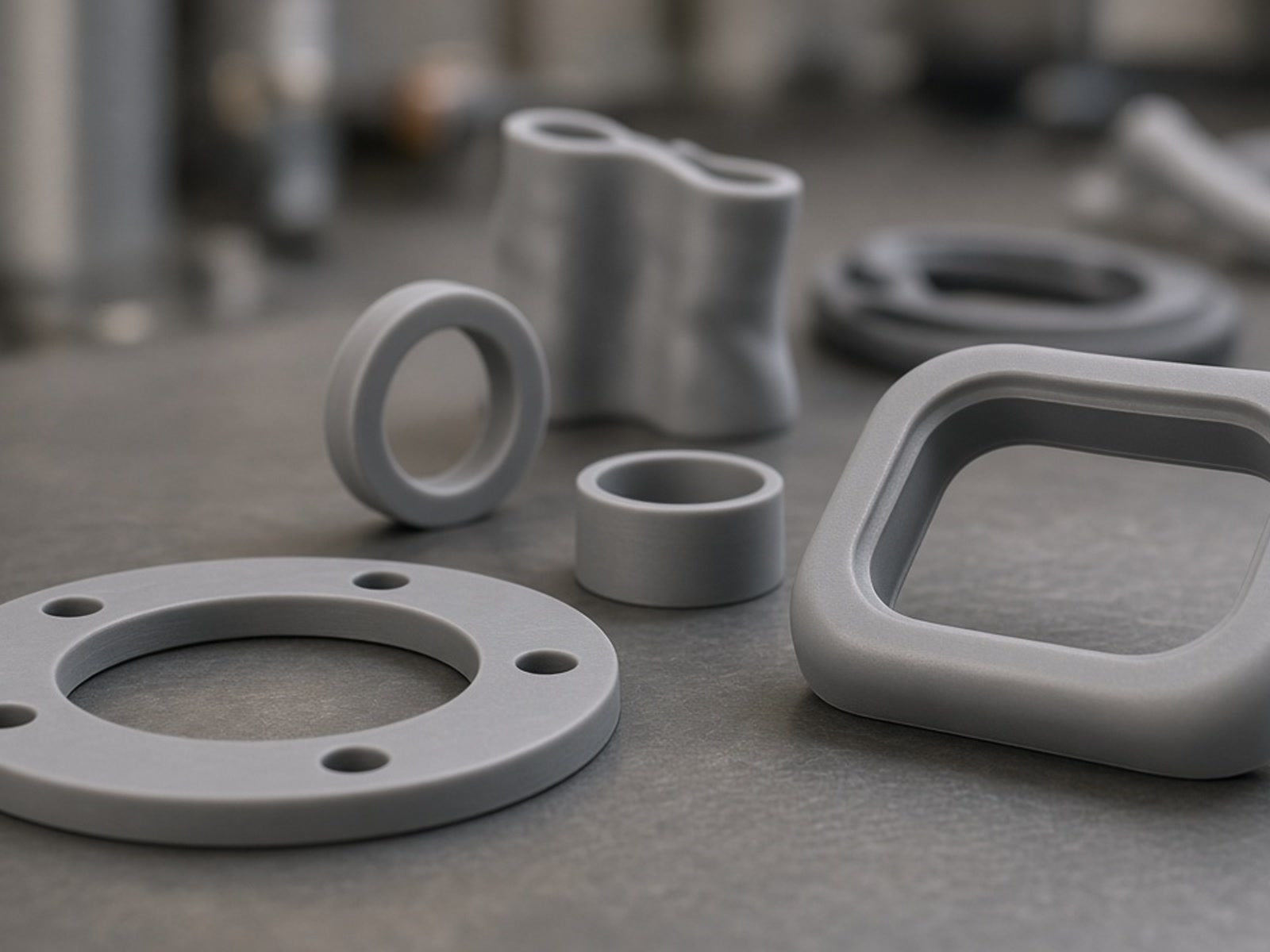
Understanding Flexible Resin Properties
Flexible resins deform under load and return to their original shape, simulating elastomeric properties. Unlike standard rigid photopolymers, each formulation exhibits distinct mechanical characteristics that dictate long-term durability and functionality.
Shore Hardness
Measures the polymer's resistance to surface indentation, establishing relative rigidity, compliance, and component tactile feel under direct force.
Elongation at Break
Specifies the maximum strain percentage the elastomeric part can absorb under tension before mechanical failure or tearing occurs.
Tear Strength
Quantifies resistance against the initiation and propagation of fissures, critical for thin walls, hinge geometries, and slit profiles.
Rebound Resilience
Defines the material's capability to snap back to original dimensions after sustained or cyclic compressive loading is released.
Environmental Notice: Photopolymer flexible resins possess different aging characteristics compared to traditional vulcanized or injection-molded elastomers. Operating temperatures, chemical contact, and ultraviolet exposure must be evaluated during material selection.
Industrial & Mechanical Applications
Flexible resin components are deployed throughout automation, tooling, and functional mechanical assemblies where compliance, dampening, or ergonomic grip is required.
Gaskets & Low-Pressure Seals
Custom profiles tailored for test fixtures, functional prototypes, and experimental enclosures. Provides conformal sealing along mating flanges without custom tooling dies.
Key Focus: Compression recovery & surface finishVibration Dampers & Isolators
Specialized elastomeric bushings engineered to decouple sensitive electronic sensors, precision instrumentation, or optical systems from high-frequency structural vibration.
Key Focus: Rebound resilience & shock absorptionErgonomic Grips & EOAT Compliant Pads
Tactile contact surfaces for manual assembly devices or robotic end-of-arm tooling. Enables secure gripping of delicate workpieces without surface marking or slippage.
Key Focus: Shore hardness selection & frictionProtective Boots & Shrouds
Movable bellows, protective sleeves, and flex boots designed to shield mechanical linkages, ball screws, and wiring harnesses from particle accumulation and ambient debris.
Key Focus: Tear strength & cyclic deflectionDesign Inputs & Production Parameters
Elastomeric resins behave distinctly during additive manufacturing. Due to their low green-state modulus, geometric stability must be considered during CAD design to ensure feature fidelity and surface quality.
Wall Thickness Management
Very thin walls risk buckling or tearing under self-weight and peel forces. Excessively heavy sections reduce compliance and cause uneven curing dynamics.
Feature Complexity & Support Cleansing
While SLA produces intricate undercut structures, supports must be positioned where extraction does not compromise critical sealing faces or thin functional membranes.
Reference Tolerances
Standard reference tolerances for SLA additive processes are approximately ±0.1 mm or ±0.2%. Final achievable tolerance depends on specific geometry, orientation, and shore hardness.
Design for Additive Manufacturing (DFM) Review
Prior to manufacturing, our team analyzes native CAD geometry (STEP/STP) and 2D engineering drawings to validate part mechanics across three core criteria:
-
1
Environmental Exposure Assessment Verification against expected operating temperatures, UV exposure, and lubricant/fluid contact.
-
2
Mechanical Load & Duty Cycle Evaluation of dynamic fatigue, maximum expected elongation, and compression cycling.
-
3
Geometry & Stress Concentration Identification of sharp inner corners, unradiused steps, or inadequate cross-sections prone to tear propagation.
Selecting the Optimal Flexible Technology
While flexible stereolithography (SLA) resin yields exceptionally smooth surfaces and high feature detail, it is part of a broader additive spectrum. RapidPrintParts supports both liquid resin and powder-bed fusion platforms.
Flexible Resin via SLA
Best suited for concept validation, fine cosmetic prototypes, non-abrasive gaskets, and parts requiring smooth surface textures without post-processing bead blasting.
- • Superior surface smoothness and edge definition
- • Strict adherence to fine geometric tolerances
- • Requires post-print support removal and UV curing
TPU via SLS / MJF
Recommended when your application demands higher structural durability, superior chemical resistance, dynamic flex life, and support-free complex internal passages.
- • True thermoplastic elastomer performance (TPU)
- • Self-supporting powder bed eliminates support marks
- • Superior resistance to oil, grease, and abrasion
Our engineering team balances your material, mechanical load, volume, and schedule requirements to direct your project to the ideal platform.
Submit Your CAD Files for Engineering Review
Provide your component specifications, operational parameters, and 3D CAD files (STEP/STP). Our engineering team will review your flexible component design for manufacturability and mechanical alignment.
Contact RapidPrintParts
Get in Touch
We are here to answer your questions about industrial additive manufacturing and functional 3D printed parts. Reach out to us through the following methods:
Email: [email protected]
Address: No. 17-1, Guanlan Avenue, Longhua District, Shenzhen, Guangdong Province, Shenzhen 3D Printing Industrial Park