
3D Printed Electronic Parts: Engineering Considerations for Enclosures and Mounts
In modern industrial design, 3D printing has become a standard method for producing custom housings, sensor mounts, and protective covers for electronics. Rather than relying on costly tooling for low-volume production or initial prototypes, engineers can utilize additive manufacturing to create functional, durable electronic components that meet specific environmental and mechanical requirements.
At RapidPrintParts, we support industrial clients by evaluating the operating environment, material properties, and assembly requirements necessary to ensure electronic components are protected and functional.
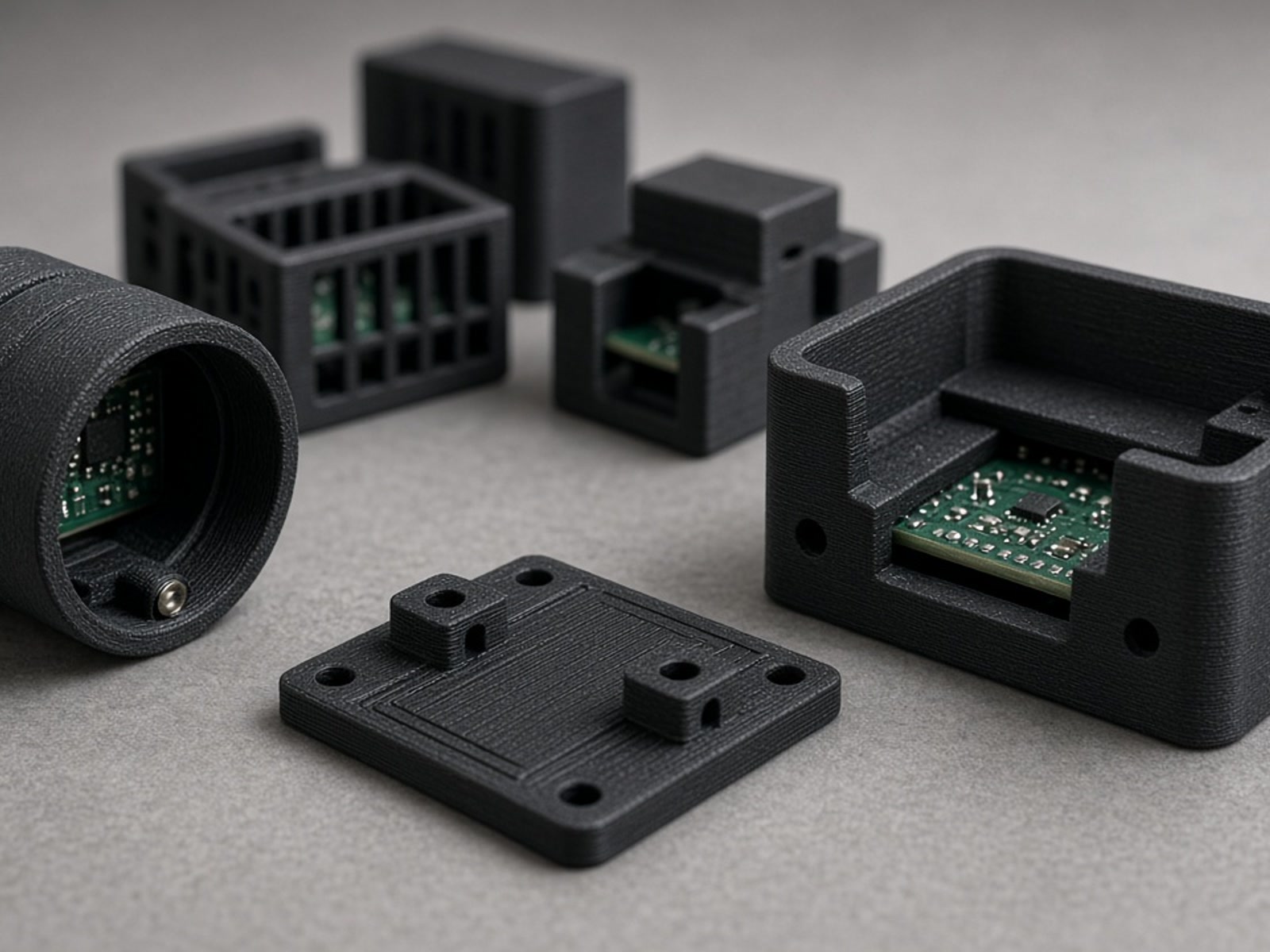
Common Applications for 3D Printed Electronic Components
Industrial 3D printing is frequently used to solve specific challenges in the assembly and integration of electronic systems across demanding industrial setups.
Custom Enclosures
Housing PCBs, controllers, and instrumentation in protective shells specifically designed to accommodate non-standard form factors and space limitations.
Sensor Mounts & Brackets
Securing sensors in automation lines or robotic End-of-Arm Tooling (EOAT) to ensure precise mechanical alignment and stable operating positions.
Cable Management & Ducting
Integrating custom conduits, brackets, and routing geometries to shield delicate wiring assemblies within an industrial machine chassis.
Bridge Production
Utilizing additive manufacturing to fulfill production requirements while permanent tooling is being prepared, or when unit volumes do not justify traditional molding costs.
Material Selection and Performance Factors
The success of a 3D printed electronic part depends heavily on the selection of material and the manufacturing process. Because electronics generate heat and operate in demanding industrial environments, we evaluate key operating criteria during technical assessment.
Thermal Management
If the enclosure houses components that generate heat, materials with higher heat deflection temperatures (HDT) are critical. High-performance polymers such as Polycarbonate (PC), PEEK, or PEI/ULTEM provide elevated thermal resistance to maintain dimensional stability under steady operating temperatures.
Mechanical Load & Vibration
Components subjected to constant vibration, mechanical stress, or direct impact require durable engineering polymers. Selective Laser Sintering (SLS) with PA12 delivers high isotropic strength, while FDM-printed PA-CF (carbon fiber reinforced nylon) yields superior structural rigidity.
Environmental Protection
Industrial operational conditions dictate custom material formulations. Depending on the installation environment, components can be evaluated for chemical resistance against oils and solvents, moisture sealing compatibility, or specialized flame-retardant characteristics.
Tolerance and Fit
Precise dimensions are critical for sealing enclosures or mounting sensitive PCB hardware. Typical process baselines vary, such as FDM at ±0.2 mm (or ±0.3%) and SLS at ±0.3 mm (or ±0.3%). Tighter design specifications require an upfront engineering review to verify manufacturing feasibility.
Design for Additive Manufacturing (DfAM) for Electronics
Ensuring an electronic component performs reliably in production requires designing with additive constraints and assembly workflows in mind.
Assembly Features
Incorporate heat-set threaded inserts, snap-fits, or structural bosses directly into the CAD model. Secondary machining can be factored in when tighter interface seating is needed.
Wall Thickness
Maintain an optimal balance between weight reduction and the physical rigidity necessary to support internal electronics, heavy connectors, and external operational impacts.
Access & Maintenance
Design service interfaces for ease of assembly and ongoing maintenance, ensuring enclosures can be inspected or upgraded without risking stress damage to internal hardware.
Post-Processing
Depending on ingress or cosmetic needs, parts can undergo targeted post-processing including mechanical sanding, technical painting, or vapor smoothing for refined sealing.
Engineering Review and Quality Support
Not every electronic application is suited for 3D printing. We prioritize projects where functional performance is the primary driver. Our team assesses your CAD files (STEP/STP format) against your operational parameters to determine the most effective process—whether FDM, SLA, SLS, or MJF.
We provide quality support tailored to your project’s needs, which may include first article inspection, dimensional inspection reports, and certificates of conformity.
Rapid validation & composite filaments
High-strength isotropic PA12 parts
First article & dimensional reports
Ready to Discuss Your Electronic Enclosure or Mount Project?
Provide us with your application details, expected quantities, material requirements, and critical tolerances. Our engineering team will review your specifications to ensure the chosen additive process meets your mechanical and thermal expectations.
Preferred Submission Format:
- 3D CAD files in STEP (.step / .stp) format
- Operational temperature & load requirements
- Specific tolerance callouts or fit interfaces
Contact RapidPrintParts
Get in Touch
We are here to answer your questions about industrial additive manufacturing and functional 3D printed parts. Reach out to us through the following methods:
Email: [email protected]
Address: No. 17-1, Guanlan Avenue, Longhua District, Shenzhen, Guangdong Province, Shenzhen 3D Printing Industrial Park