Understanding AlSi10Mg 3D Printing for Industrial Components
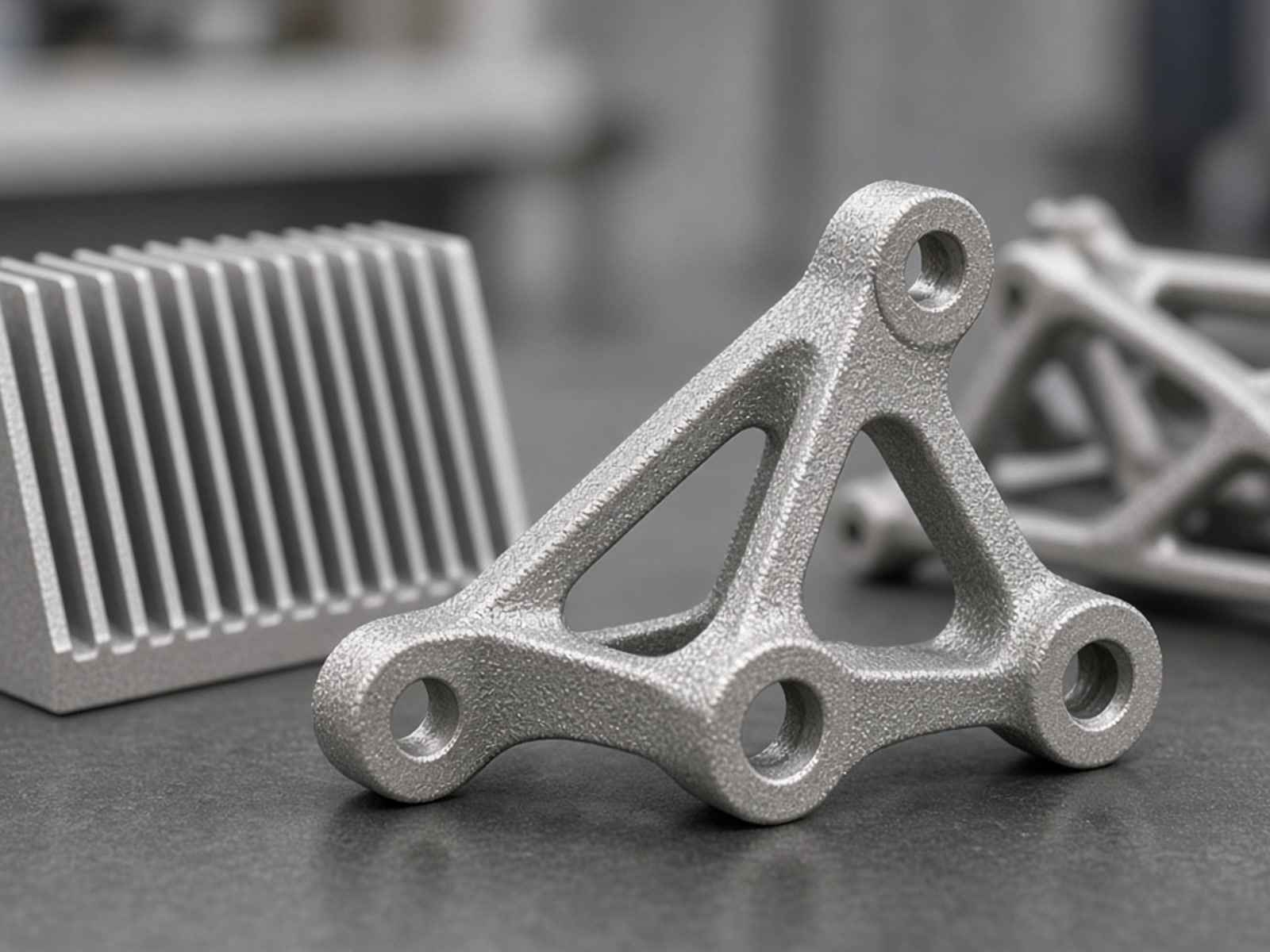
AlSi10Mg is one of the most widely used aluminum alloys in the additive manufacturing industry. Known for its excellent strength-to-weight ratio and thermal properties, it is frequently selected by engineers for functional prototypes and low-volume production parts that require the characteristics of traditional cast aluminum.
In industrial settings, AlSi10Mg is typically processed via Laser Powder Bed Fusion (LPBF). While this material offers significant advantages for specific mechanical requirements, selecting it requires a thorough understanding of its material behavior, design constraints, and how it compares to high-performance polymer alternatives.
Key Material Properties of AlSi10Mg
AlSi10Mg is an aluminum alloy containing silicon and magnesium, which contributes to its hardness and strength. It is often chosen for applications where weight reduction is critical without sacrificing structural integrity.
Thermal Conductivity
This alloy maintains high thermal conductivity, making it suitable for heat exchangers and components subjected to thermal loading.
Weight Efficiency
With a density significantly lower than stainless steel, it is a primary choice for lightweighting in robotics and automation.
Corrosion Resistance
Like many aluminum alloys, AlSi10Mg offers good resistance to atmospheric corrosion, which is beneficial for industrial housings and brackets.
Mechanical Strength
Parts printed in AlSi10Mg often exhibit mechanical properties comparable to or exceeding those of traditional T6-treated gravity die-cast parts.
Industrial Applications for Aluminum 3D Printing
Engineers utilize AlSi10Mg for parts that require more durability or thermal stability than standard polymers can provide. Typical reference applications include:
Robotics and End-of-Arm Tooling (EOAT)
Lightweight grippers and brackets that reduce the payload on robotic arms, allowing for faster cycle times.
Machinery Components
Custom manifolds, internal cooling channels, and complex housings that are difficult or impossible to manufacture via CNC machining.
Heat Sinks
Custom-geometry thermal management components designed to maximize surface area within a confined footprint.
Functional Prototypes
Engineering validation parts that must undergo rigorous mechanical testing before moving to high-volume die casting.
Design Considerations and Limitations
Designing for AlSi10Mg 3D printing requires a different approach than traditional subtractive manufacturing. Because the process involves melting metal powder with a laser, several factors must be considered.
-
1
Support Structures
Metal 3D printing requires extensive support structures to anchor the part to the build plate and dissipate heat. This may affect surface finish on supported faces.
-
2
Surface Roughness
As-printed parts typically have a matte, slightly grainy texture. While post-processing such as bead blasting or CNC machining can improve the finish, these steps add to the lead time and cost.
-
3
Dimensional Accuracy
Typical tolerances for metal additive processes may vary, and achieving precision fits for bearings or threaded interfaces usually requires secondary CNC machining.
-
4
Wall Thickness
Minimum wall thicknesses must be maintained to prevent warping or failure during the build process; these requirements are subject to engineering review based on part geometry.
Selecting the Right Process: Metal vs. Polymer
While AlSi10Mg is a robust choice for metal components, many industrial applications—such as jigs, fixtures, and equipment guards—can be effectively served by high-performance polymers. At RapidPrintParts, we focus on industrial polymer processes including FDM/FFF, SLA, SLS, and MJF.
Before committing to a metal 3D printing process, it is essential to evaluate the actual operating requirements:
Load and Stress
Does the part require the fatigue resistance of aluminum, or can a carbon-fiber-reinforced nylon (PA-CF) via FDM provide sufficient rigidity?
Operating Temperature
If the environment exceeds 150°C, AlSi10Mg or high-performance polymers like PEEK or PEI (ULTEM) may be required.
Weight vs. Cost
Polymer processes like MJF or SLS using PA12 often provide a more cost-effective solution for complex geometries where metal is not strictly necessary for thermal or electrical conductivity.
Engineering Review for Functional Parts
Every industrial 3D printing project begins with a clear understanding of the application. For components requiring specific tolerances or mechanical performance, an engineering review is necessary to determine the optimal material and process.
At RapidPrintParts, our team evaluates factors such as load, temperature, chemical exposure, and quantity to recommend the best-fit manufacturing route. Whether you are developing functional prototypes, assembly aids, or low-volume end-use parts, choosing the right material is critical to the success of the component in the field.
Request a Quote or Engineering Review
Share your part requirements and application details. Our team will evaluate load, temperature, chemical exposure, and quantity to recommend the best-fit manufacturing route for your project.
- Functional prototypes and engineering validation parts
- Jigs, fixtures, assembly aids, and equipment guards
- Low-volume end-use parts in industrial polymer processes
Contact RapidPrintParts
Get in Touch
We are here to answer your questions about industrial additive manufacturing and functional 3D printed parts. Reach out to us through the following methods:
Email: [email protected]
Address: No. 17-1, Guanlan Avenue, Longhua District, Shenzhen, Guangdong Province, Shenzhen 3D Printing Industrial Park