Industrial 3D Printed Spare Parts for Maintenance and Repair
In industrial environments, equipment downtime is often dictated by the availability of replacement components. Traditional supply chains for spare parts frequently face high minimum order quantities, long lead times for out-of-stock items, and the total obsolescence of parts for older machinery.
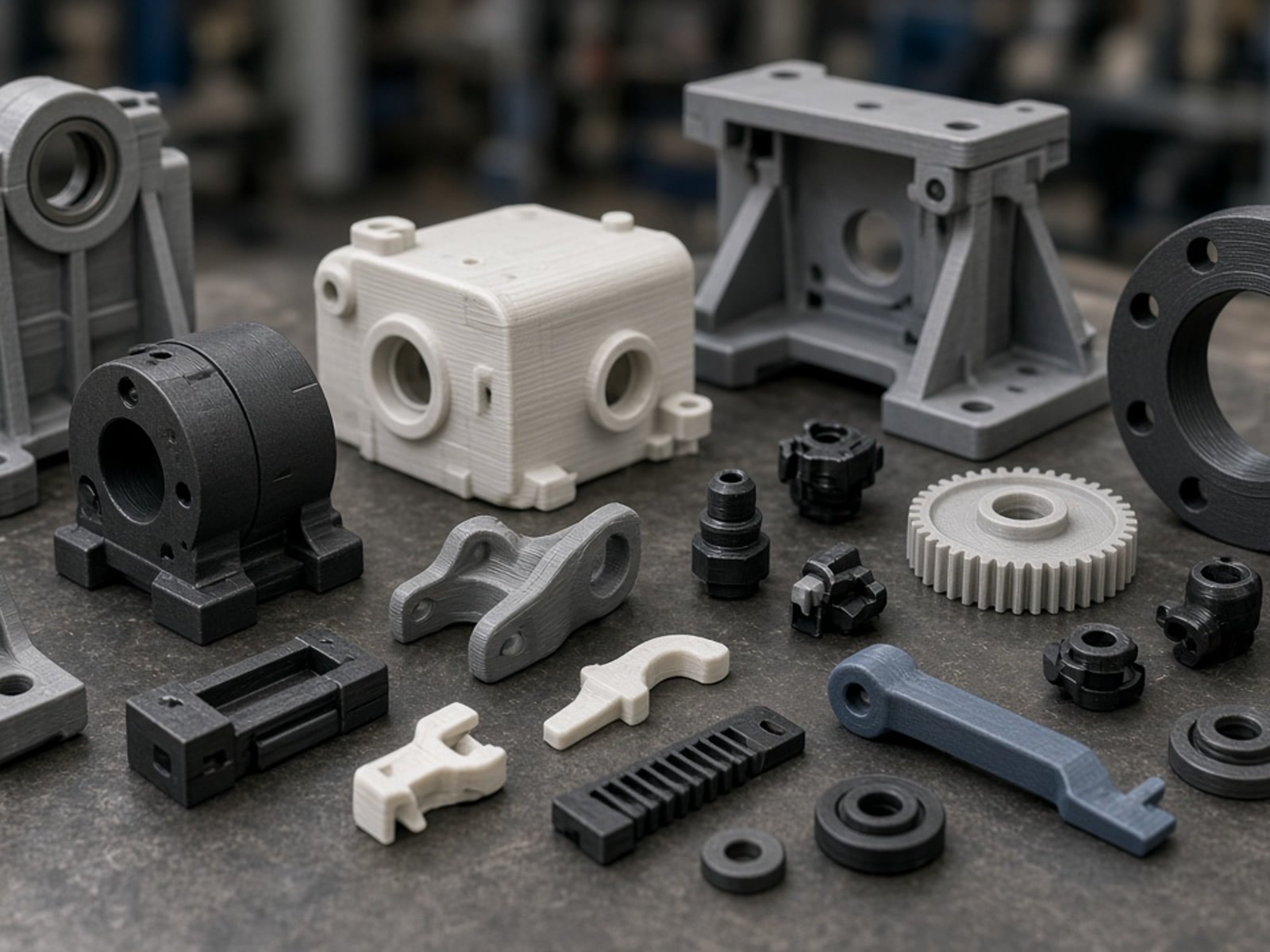
3D printed spare parts offer a localized, on-demand solution for Maintenance, Repair, and Operations (MRO). Facilities can produce functional replacements for jigs, fixtures, brackets, and mechanical components without expensive tooling or extensive inventory.
The Role of Additive Manufacturing in MRO
Additive manufacturing (AM) allows for the production of complex geometries that may be difficult or uneconomical to produce via traditional machining in low volumes. For spare parts, this technology is primarily used in three scenarios.
Legacy Support
Producing parts for machines where the original equipment manufacturer (OEM) no longer supports the model or has gone out of business.
Lead Time Mitigation
Creating temporary or bridge components to keep a production line running while waiting for a long-lead-time OEM part.
Customization
Modifying a standard spare part to better suit a specific operating environment or to improve its wear characteristics.
Industrial Processes for Functional Replacements
RapidPrintParts utilizes four core in-house polymer processes to manufacture industrial-grade replacement parts. The selection of the process depends on the mechanical requirements and the operating environment of the equipment.
FDM (Fused Deposition Modeling)
Often selected for large-scale structures, internal equipment components, and durable guards. With materials like PEEK, PA-CF (Carbon Fiber Reinforced Nylon), and PC (Polycarbonate), FDM can produce parts capable of withstanding significant mechanical stress and higher operating temperatures.
SLS and MJF (Powder Bed Fusion)
Ideal for complex, durable nylon parts. These processes use PA12, PA11, and Glass-Filled (GF) Nylon to create isotropic components well-suited for functional mechanical assemblies, housings, and ducts. These parts typically do not require support structures, allowing for highly complex internal geometries.
SLA (Stereolithography)
Utilized when high detail and smooth surface finishes are required for fit and appearance validation. While engineering resins are available, SLA is typically reserved for parts where dimensional accuracy and surface finish are prioritized over high-impact strength.
Material Selection Factors
When replacing a traditionally manufactured part with a 3D printed version, an engineering review is essential to ensure the new material meets the application's demands. Key factors include:
-
Mechanical Load: Does the part require the stiffness of a carbon-filled nylon or the flexibility of a TPU?
-
Thermal Requirements: Will the part be exposed to high heat? High-performance polymers like PEEK or PEI (ULTEM) may be required.
-
Chemical Exposure: Will the part come into contact with oils, solvents, or cleaning agents?
-
Tolerances: Typical industrial 3D printing tolerances range from ±0.1 mm to ±0.3%, depending on the process and geometry. Critical fitments may require secondary CNC machining or the use of threaded inserts.
Design Inputs for Spare Part Production
To initiate the manufacturing of a replacement part, the following technical inputs are typically required:
CAD Data
A 3D model in STEP or STP format. If a CAD file is not available, the original part may require reverse engineering or 3D scanning.
2D Drawings
Essential for identifying critical tolerances, surface finish requirements, and locations for post-processing like drilling or tapping.
Application Context
Information regarding the part's function, including load, temperature, and any chemical exposure, allows for an accurate material recommendation.
Metal 3D Printing for Spare Parts
While RapidPrintParts focuses on high-performance polymers and resins, metal 3D printing (such as DMLS or SLM) is an alternative for spare parts requiring high thermal conductivity or extreme tensile strength. Metal additive manufacturing typically involves alloys like 316L stainless steel, Ti6Al4V titanium, or Inconel. For parts where polymer alternatives are not suitable, metal 3D printing provides a path to produce obsolete metal components without casting or complex multi-axis milling.
A common alloy referenced for metal additive manufacturing.
A common alloy referenced for metal additive manufacturing.
A common alloy referenced for metal additive manufacturing.
Limitations and Engineering Review
3D printing is a powerful tool for MRO, but it is not a universal replacement for all manufacturing methods. Some geometries may require redesign to be compatible with additive processes (DfAM), and certain high-tolerance assemblies may require secondary operations.
All functional spare parts require an engineering review to confirm that the selected process and material are appropriate for the intended operating conditions.
For a technical evaluation of your spare part requirements, provide your CAD data and application specifications for a comprehensive engineering review.
Request a Technical Evaluation
Share your CAD data and application specifications. Our team will review your spare part requirements and recommend a suitable process and material based on the intended operating conditions.
- [email protected]
- Address
- No. 17-1, Guanlan Avenue, Longhua District, Shenzhen, Guangdong Province, Shenzhen 3D Printing Industrial Park
Contact RapidPrintParts
Get in Touch
We are here to answer your questions about industrial additive manufacturing and functional 3D printed parts. Reach out to us through the following methods:
Email: [email protected]
Address: No. 17-1, Guanlan Avenue, Longhua District, Shenzhen, Guangdong Province, Shenzhen 3D Printing Industrial Park