Industrial Additive Manufacturing
3D Printed Functional Parts
RapidPrintParts produces 3D printed functional parts for engineering and production environments. These components are evaluated against operating requirements such as material performance, load, temperature, tolerance, finish, quantity, and lead time before any process is recommended.
Suitable Applications
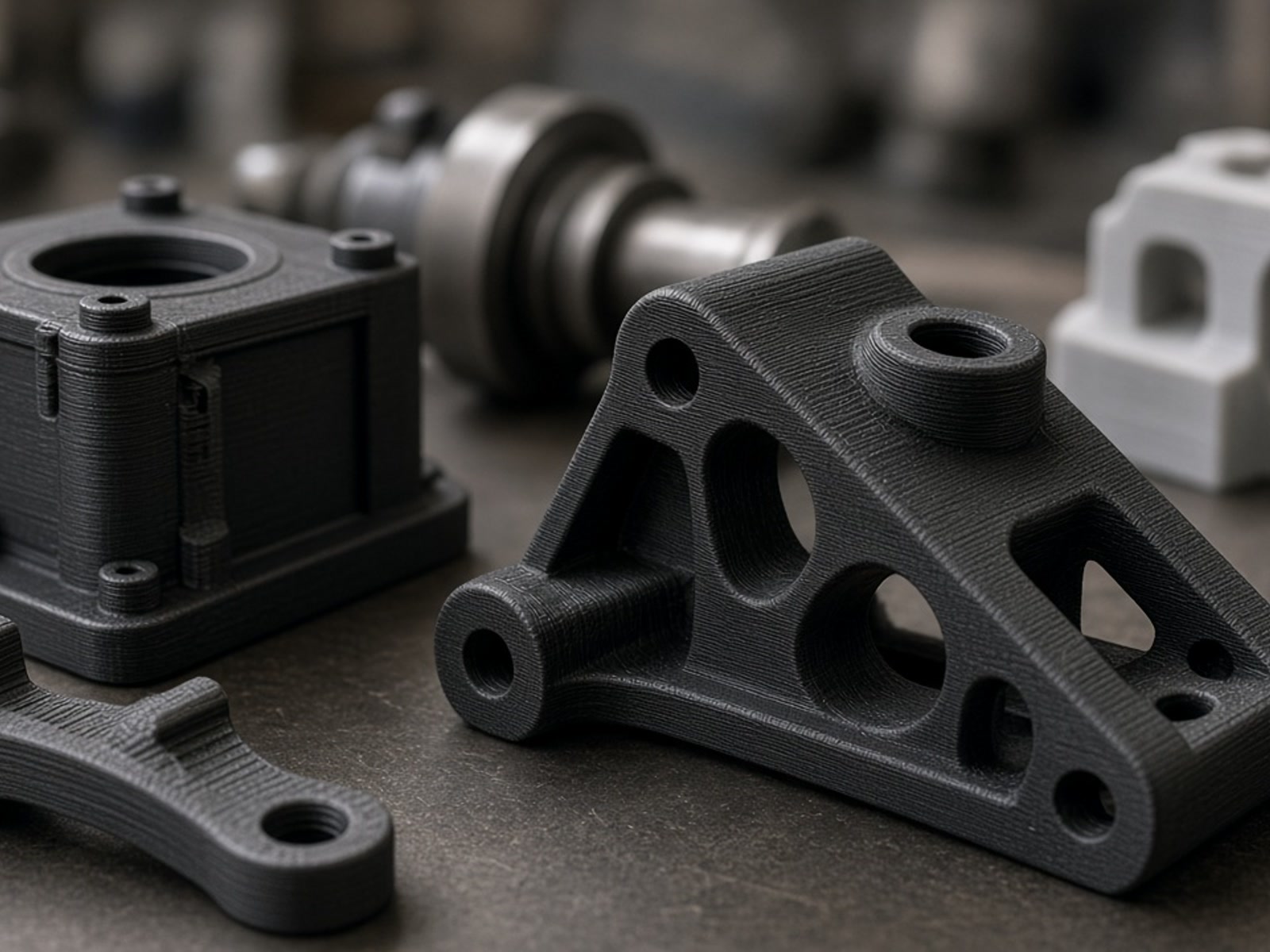
Functional parts address real mechanical demands rather than appearance alone. Typical uses include functional prototypes for engineering validation, jigs and fixtures, robot end-of-arm tooling, assembly aids, mechanical components, housings, ducts, brackets, and custom replacement parts. Low-volume end-use parts and bridge-production components are also supported when traditional tooling is uneconomical or too slow.
Engineering Validation
Functional prototypes built to test fit, form, and real mechanical behavior before commitment to tooling.
Jigs, Fixtures & Tooling
Jigs and fixtures, robot end-of-arm tooling, and assembly aids for shop-floor and production use.
Mechanical Components
Housings, ducts, brackets, and custom replacement parts designed around actual operating demands.
Low-Volume End-Use
End-use parts produced at low volume when conventional tooling is uneconomical or too slow.
Bridge Production
Bridge-production components that keep programs moving while longer-term manufacturing is arranged.
In-House Polymer Processes
RapidPrintParts operates four additive processes in its Shenzhen facility.
FDM / FFF
For fixtures, large structures, and equipment parts. Materials include ABS, ASA, PC, PA, PA-CF, PETG, TPU, and PEEK.
SLA
For high-detail prototypes and fit or appearance validation using engineering resins.
SLS
For complex durable nylon parts and low-volume production using PA12, PA11, and TPU.
MJF
For low-volume end-use and functional nylon parts using PA12, PA11, PA12 GF, and TPU.
Build envelopes, typical tolerance references, and post-processing options vary by process. Guaranteed tolerances require engineering review for each project.
Material and Process Selection Factors
Selection begins with the part’s operating environment. Key considerations include required mechanical properties, thermal and chemical exposure, quantity, target lead time, and any need for secondary operations such as inserts, tapping, or CNC machining.
Post-Processing Options
Steps that may be applied include blasting, sanding, vapor smoothing, dyeing, painting, and marking.
Design and Specification Inputs
Clear technical information enables accurate process and material recommendations. Required inputs typically include:
- Application details
- Quantity and repeat demand
- Material requirements
- Critical dimensions and tolerances
- Load or environmental conditions
- Finish expectations and target lead time
- STEP / STP files with any accompanying 2D drawings
Practical Limitations
Additive processes carry inherent constraints on achievable tolerances, surface finish, and mechanical consistency compared with machined or molded parts. Not all geometries or performance targets are suitable for every process. Projects involving regulated industries or medical applications fall outside the current scope.
Engineering Review
RapidPrintParts evaluates each inquiry against actual part requirements before confirming feasibility. Submit application details, CAD files, and performance criteria for a technical assessment.
What to Submit
Application details, CAD files, and performance criteria.
What Happens Next
Each inquiry is evaluated against actual part requirements before feasibility is confirmed.
Request an Engineering Review
Submit your application details, CAD files, and performance criteria. RapidPrintParts evaluates each inquiry against actual part requirements before confirming feasibility.
Contact RapidPrintParts
Get in Touch
We are here to answer your questions about industrial additive manufacturing and functional 3D printed parts. Reach out to us through the following methods:
Email: [email protected]
Address: No. 17-1, Guanlan Avenue, Longhua District, Shenzhen, Guangdong Province, Shenzhen 3D Printing Industrial Park