3D Printing Vapor Smoothing: Enhancing Industrial Part Performance
Vapor smoothing is a secondary finishing process engineered to improve the surface quality of additive manufactured parts. By exposing components to a controlled vaporized solvent, the outer polymer layer is momentarily liquefied, allowing it to flow and seal microscopic gaps and layer lines.
At RapidPrintParts, we integrate vapor smoothing to enhance the structural performance, fluid resistance, and aesthetics of parts produced via our core in-house SLS and MJF production lines.
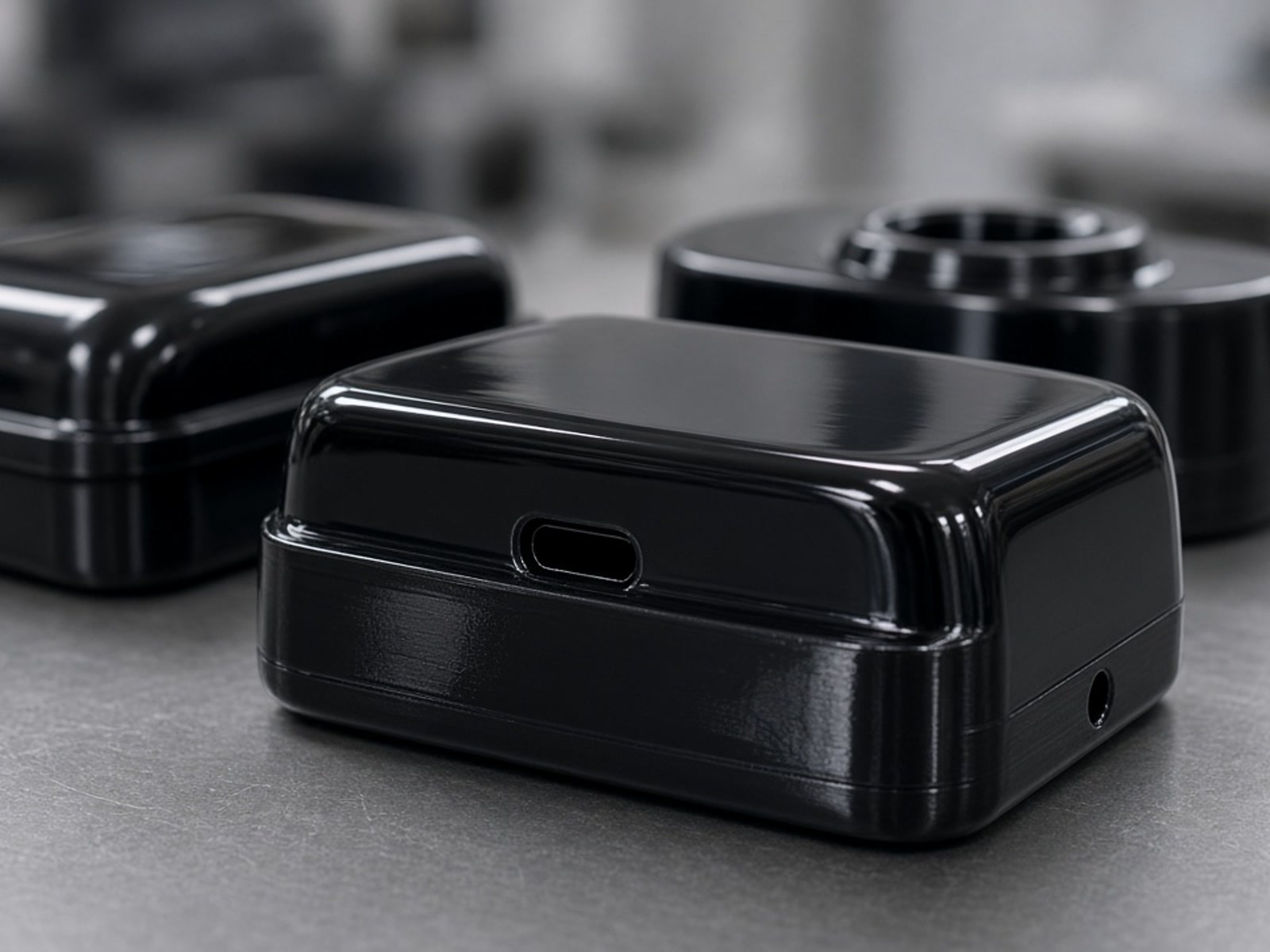
Surface Treatment
Sealed, semi-gloss finish for functional polymer prototypes and production runs.
Functional Advantages
How Vapor Smoothing Improves Functional Parts
While additive manufacturing excels in delivering complex geometry, layer-based construction inherently introduces surface roughness. Vapor smoothing modifies these surface characteristics to unlock critical mechanical and chemical advantages.
Improved Surface Finish
Significantly reduces Ra surface roughness values, transforming textured layer stepping into a uniform, semi-gloss appearance suitable for customer-facing assemblies.
Sealing & Porosity Reduction
Seals microscopic microporosities on the boundary layer, making housings, fluid ducts, and manifolds resistant to moisture, oils, and chemical absorption.
Enhanced Fatigue Life
By melting away micro-notches along layer transitions, the process eliminates critical stress concentration points to help increase mechanical cyclic durability.
Simplified Cleanability
Yields a completely non-porous exterior that prevents particulate buildup, facilitating fast decontamination in robotics end-effectors and clean manufacturing aids.
Material Compatibility
Compatible Polymer Technologies
Vapor smoothing responds specifically to chemical-solvent interactions with engineering thermoplastic powders. At RapidPrintParts, we systematically test and validate smoothing parameters across our industrial powder-bed fusion systems.
SLS (Selective Laser Sintering)
Commonly specified for PA12 and PA11 components. Ideal for end-use functional assemblies, enclosures, and structural mounts where liquid-tight barriers and improved cleanability are mandatory.
MJF (Multi Jet Fusion)
Highly effective for PA12 and PA12 Glass Bead (GF) components. Removes the standard granular finish while maintaining black-body color stability across complex geometries.
Process Constraints
Engineering Considerations for Vapor Smoothing
Because chemical vapor smoothing temporarily liquefies the outer thermoplastic layer, design parameters must account for localized material redistribution before manufacturing.
1. Dimensional Tolerances
The process consumes a controlled microscopic layer of material to produce the continuous skin. Tightly toleranced press-fits, bearing seats, or precision threads require pre-compensation in the initial CAD model.
2. Feature Integrity & Edge Radii
Extremely fine details, knife-edges, and razor-sharp external corners can soften and round out during solvent exposure. Thin walls must maintain structural stiffness to prevent distortion during drying.
3. Internal Passages & Cavities
Vapor action is dictated by vapor circulation. Deep, narrow channels or blind cavities may not encounter full solvent concentration, meaning inaccessible interior areas will likely retain their as-printed roughness.
4. Application & Environmental Factors
Operating demands—including thermal load, continuous chemical contact, and dynamic mechanical stress—are reviewed before processing to ensure surface modification preserves bulk structural properties.
Quality Assurance
Engineering Review & Documentation
At RapidPrintParts, finishing is not an afterthought—it is a calibrated phase of industrial manufacturing. Whether you are engineering robotics end-of-arm tooling, liquid-tight enclosures, or low-volume functional assemblies, our technical staff verifies tolerances and material behaviors prior to batch smoothing.
Design for Additive Manufacturing (DFM)
Comprehensive geometry evaluations that cross-check print orientation, wall thickness, and post-process vapor exposure risks before hardware build begins.
Project Quality Documentation
Dimensional inspection reports and certificates of conformity provided when specified and agreed upon in the project scope.
Start Your Build
Request an Engineering Review
Evaluating vapor smoothing for your production parts? Submit your CAD models, material specifications, and operating conditions. Our team will review the mechanical fit and post-processing parameters.
Review Checklist
- • 3D CAD files (STEP, STP, or STL format)
- • Material choice (SLS PA11/PA12, MJF PA12/PA12 GF)
- • Critical sealing, fluid-contact, or aesthetic areas
- • Dimensional tolerance constraints
Contact RapidPrintParts
Get in Touch
We are here to answer your questions about industrial additive manufacturing and functional 3D printed parts. Reach out to us through the following methods:
Email: [email protected]
Address: No. 17-1, Guanlan Avenue, Longhua District, Shenzhen, Guangdong Province, Shenzhen 3D Printing Industrial Park