3D Printing Polishing and Surface Finishing
In industrial additive manufacturing, the as-printed surface finish directly reflects the process parameters, layer thickness, and build orientation. While functional parts such as jigs, fixtures, and internal mounts perform reliably with standard textured finishes, critical end-use parts demand controlled surface treatments.
At RapidPrintParts, we deliver tailored post-processing solutions engineered around your part geometry, mechanical demands, and target operating environments for both validation prototypes and low-volume production.
Understanding Finishing Processes
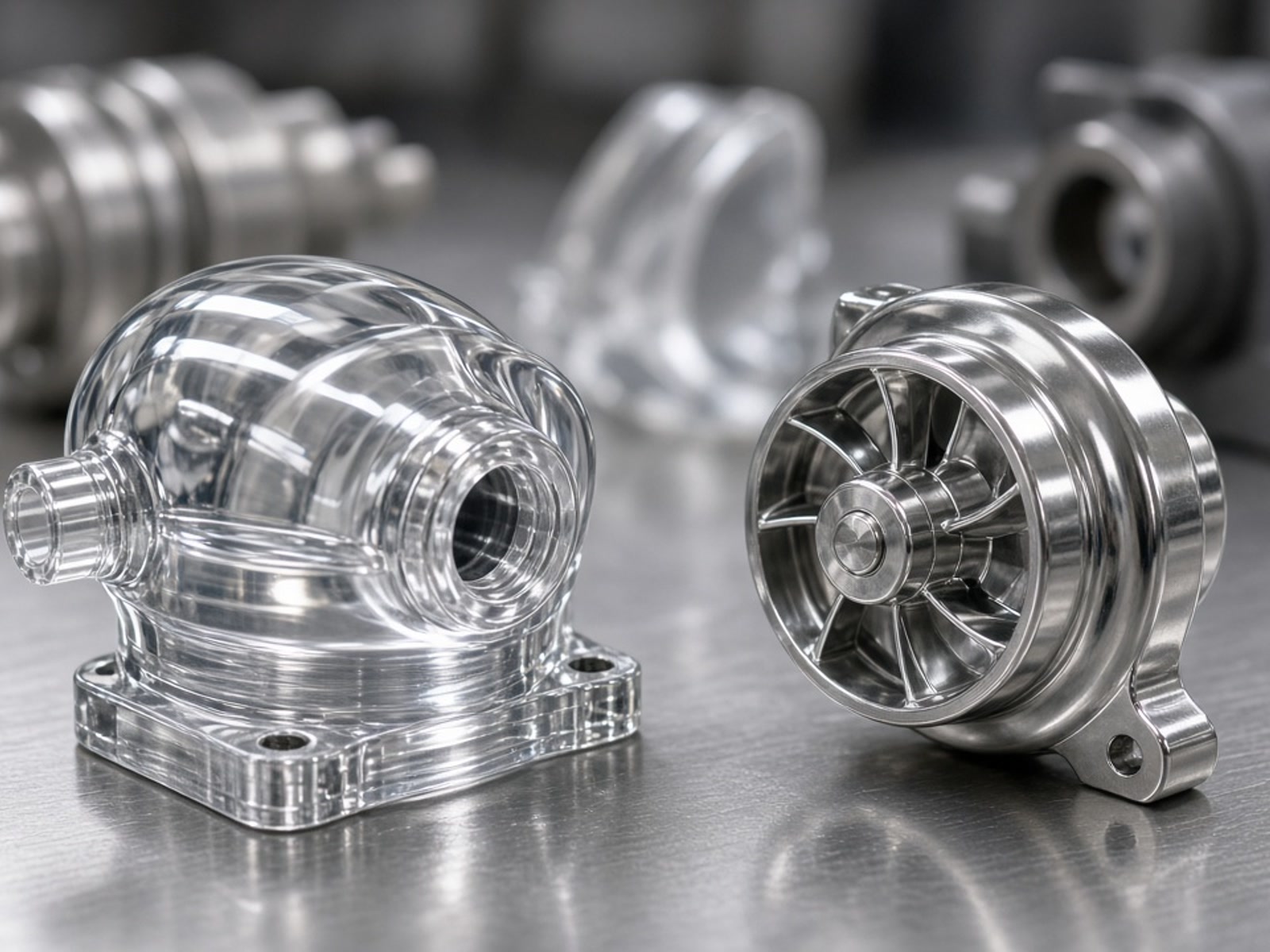
Surface finishing directly impacts friction, sealing capabilities, cosmetic appearance, and chemical resistance. Depending on your material and additive technology, we implement targeted secondary treatments to achieve targeted surface characteristics.
Polishing & Sanding
Manual and mechanical abrasion applied incrementally to eradicate visible layer lines and reduce roughness. Essential for tight mating interfaces, low-friction sliding surfaces, and high-visibility aesthetic prototypes.
Vapor Smoothing
Controlled chemical vapor exposure liquefies the microscopic surface layer to homogenize peaks and valleys. Creates a fully sealed, semi-gloss exterior that improves pressure-tightness and fluid containment.
Bead Blasting
Fine media blasting deployed on SLS and MJF components to clear sintered powder residue. Delivers a clean, uniform, and non-directional matte grain across complex geometric exteriors.
Painting & Dyeing
Application of industrial coatings or deep-penetration dye baths. Supports custom color identification, UV resistance, and heightened environmental barriers for functional end-use parts.
Selecting the Right Finish
Surface treatment specification involves balancing functional demands against dimensional tolerances and production timelines. Evaluate these core technical variables prior to final finish sign-off:
Functional Sealing & Friction
Determine whether the component operates under pressurized air, fluid flow, or continuous dynamic contact. Vapor smoothing eliminates internal porosity to prevent gas leakage, while targeted hand polishing addresses high-friction contact points without excessive stock removal.
Geometric Accessibility
Intricate lattice designs, enclosed manifolds, and internal flow channels resist physical abrasive tools. Our engineering team reviews the 3D CAD model to confirm whether mechanical polishing, media tumbling, or vapor immersion is feasible for inaccessible internal profiles.
Dimensional Stock Allowance
Subtractive techniques such as hand sanding remove microns of material, while aggressive smoothing can soften crisp edges. Critical tolerance features (e.g., ±0.1 mm press-fit bores) require offset modeling or masking during finishing execution.
Polymer & Material Compatibility
Reactivity differs significantly across engineering polymers. High-performance materials like PEEK or ULTEM exhibit superior chemical inertness requiring specific parameters, distinct from common aliphatic polyamides (PA12) or ABS formulations.
Engineering Review & Quality Support
At RapidPrintParts, parts are engineered for functional deployment. Because secondary surface modification can alter dimensional conformity or thin-wall stiffness, our engineering team audits your operating demands—such as mechanical load, operating temperature, and chemical exposure—before initiating finishing cycles.
Quality validation documentation, including dimensional inspection reports and certificates of conformity (CoC), is available to verify that your polished and finished parts align with technical drawing specifications.
- CAD Geometry & Wall Review
- Surface Tolerance Evaluation
- Dimensional Inspection Records
- Certificate of Conformity (CoC)
Ready to Discuss Your Finishing Project?
If your functional part demands defined surface parameters, smooth tactile qualities, or media-tight integrity, submit your 3D CAD files (STEP/STP format) alongside application criteria.
- Optimal additive platform (FDM, SLA, SLS, MJF)
- Mechanical finishing limits vs. critical tolerances
- Cost-effective vapor, blasting, or polishing paths
Contact RapidPrintParts
Get in Touch
We are here to answer your questions about industrial additive manufacturing and functional 3D printed parts. Reach out to us through the following methods:
Email: [email protected]
Address: No. 17-1, Guanlan Avenue, Longhua District, Shenzhen, Guangdong Province, Shenzhen 3D Printing Industrial Park