3D Printing Post Processing for Industrial Applications
At RapidPrintParts, the additive manufacturing process does not end when a part is removed from the build chamber. Post processing is a critical stage in the manufacturing workflow, essential for refining functional prototypes, jigs, fixtures, and low-volume end-use parts to meet specific engineering requirements.
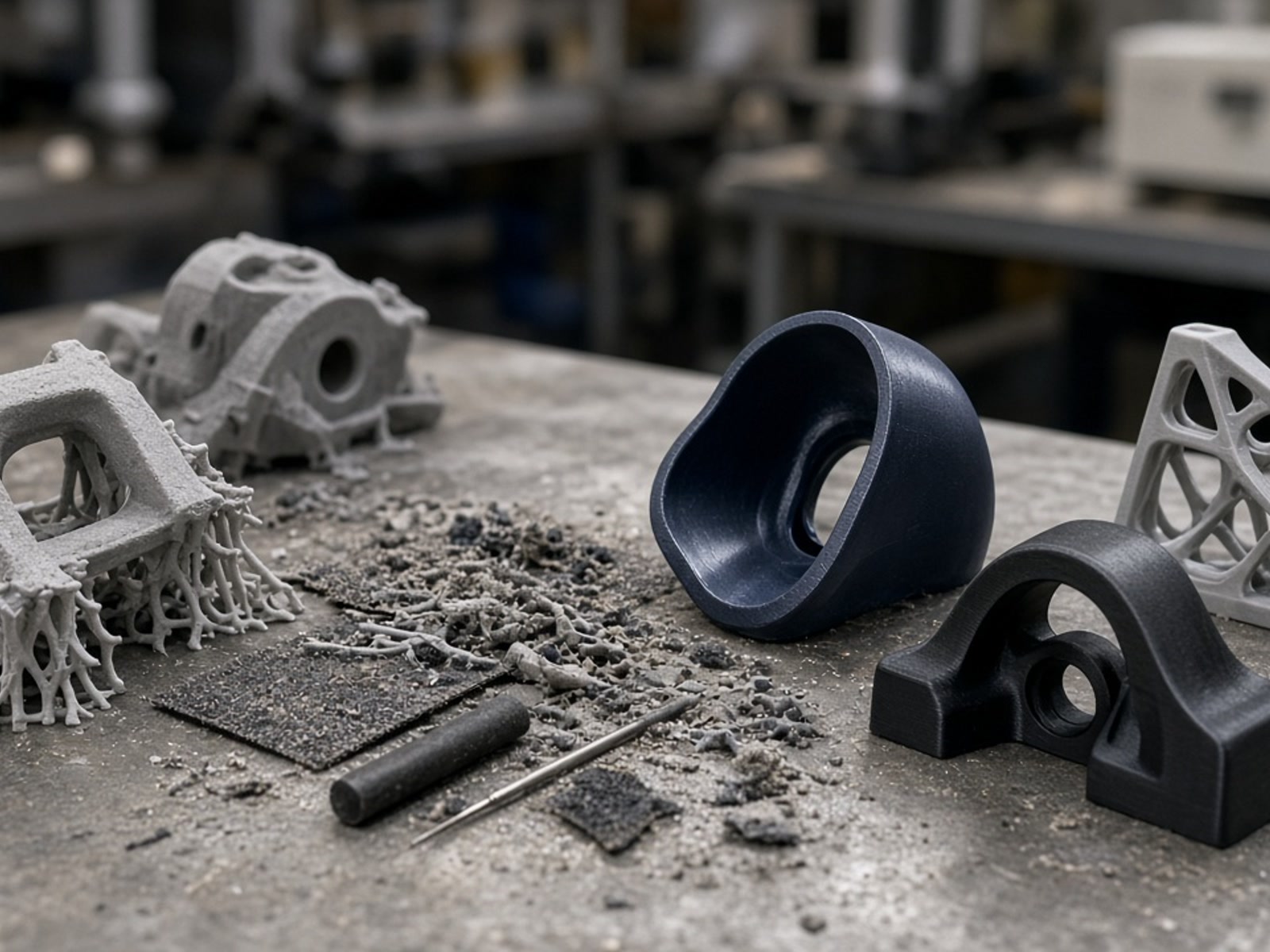
Refining prototypes, tooling, and low-volume production parts.
Why Post Processing Matters for Functional Parts
While 3D printing excels at producing complex geometries without expensive tooling, raw additive outputs often require controlled secondary steps to attain required surface finishes, precise interfaces, or operational durability. For industrial components—such as robotic end-of-arm tooling (EOAT), machinery housings, or assembly aids—post processing serves critical functions:
Surface Refinement
Improving aesthetics and reducing surface roughness (Ra) to minimize operational friction or prepare components for specialized coatings.
Dimensional Accuracy
Achieving tighter dimensional targets across critical locating faces through secondary CNC machining, precision drilling, or tapping.
Mechanical Integrity
Enhancing structural performance, sealing porosity, and protecting the polymer substrate against environmental degradation.
Assembly Readiness
Equipping parts for immediate integration into equipment through threaded inserts, accurate clearance holes, or tailored surface treatments.
Common Post-Processing Techniques
Depending on the chosen additive process—FDM, SLA, SLS, or MJF—and the specified polymer, we provide a selection of finishing operations aligned with project technical requirements.
Surface Finishing
- Blasting: Bead or sandblasting creates a uniform matte appearance and efficiently removes residual unsintered powder from SLS and MJF builds.
- Sanding & Polishing: Manual and mechanical smoothing diminishes visible layer striations, providing lower roughness for visual or functional evaluation parts.
- Vapor Smoothing: Controlled chemical exposure smooths specific polymer surfaces, effectively sealing microscopic porosity for a more uniform and washable finish.
Secondary Machining & Assembly
- CNC Secondary Machining: Where print processes cannot directly hold tight tolerances on mating faces, post-build CNC operations bring features into compliance.
- Tapping & Drilling: Threaded features and precision-sized clearance holes are cut directly into printed bosses to prepare components for fast mechanical assembly.
- Inserts: Heat-set or ultrasonic metal threaded inserts provide enhanced pull-out resistance and thread durability under repeated cyclic assembly.
Coatings & Marking
- Painting & Dyeing: Applied for visual coding across multi-part assemblies, factory-floor identification, or baseline resistance to operating environments.
- Marking: Laser marking and direct labeling enable clear tracking, part numbering, serial sequences, and revision control directly on industrial parts.
Selection Factors & Engineering Review
The viability and efficiency of any finishing operation are dictated by early geometric choices and material selection. Factor the following technical criteria into your initial specification:
Material Compatibility
Each additive polymer formulation responds uniquely to media blasting, chemical vapor smoothing, or heat exposure. Chemistry dictates allowable finishing paths.
Tolerance Requirements
Subtractive processes (sanding, secondary machining) or additive processes (coatings) modify dimensions. Compensating stock must be accounted for in CAD.
Application Environment
Exposure to cyclic stress, chemicals, elevated temperatures, or sliding friction defines whether sealed vapor smoothing, dye, or inserts are mandatory.
Production Quantity
Many post-processing methods involve manual or semi-automated intervention. Batch size directly impacts process repeatability, unit economics, and schedules.
Partnering for Industrial Success
RapidPrintParts supports your development cycle with a focus on functional reliability. Whether you need a single prototype for engineering validation or a batch of replacement parts for MRO applications, our engineering team is ready to discuss the best finishing strategy for your unique operating environment.
Required Submission Details
- 3D CAD files in STEP/STP format
- 2D engineering drawings indicating critical fits and threads
- Operational context (loads, exposure, mating components)
- Target batch quantity and baseline timeline goals
Submit Part Data for Engineering Review
Provide design files and functional parameters for post-processing evaluation.
Contact RapidPrintParts
Get in Touch
We are here to answer your questions about industrial additive manufacturing and functional 3D printed parts. Reach out to us through the following methods:
Email: [email protected]
Address: No. 17-1, Guanlan Avenue, Longhua District, Shenzhen, Guangdong Province, Shenzhen 3D Printing Industrial Park