Tool Steel 3D Printing: Industrial Applications and Considerations
Tool steel 3D printing is a specialized segment of additive manufacturing for producing high-strength, wear-resistant components used in demanding industrial environments. It is primarily applied to injection mold inserts, cutting tools, and high-wear mechanical parts, enabling geometries that are often impossible to achieve through traditional subtractive machining or EDM (Electrical Discharge Machining).
This page is an educational resource outlining the characteristics of tool steel in an additive context, and how it compares with high-performance polymer alternatives used in industrial prototyping and bridge production.
Request an Engineering Review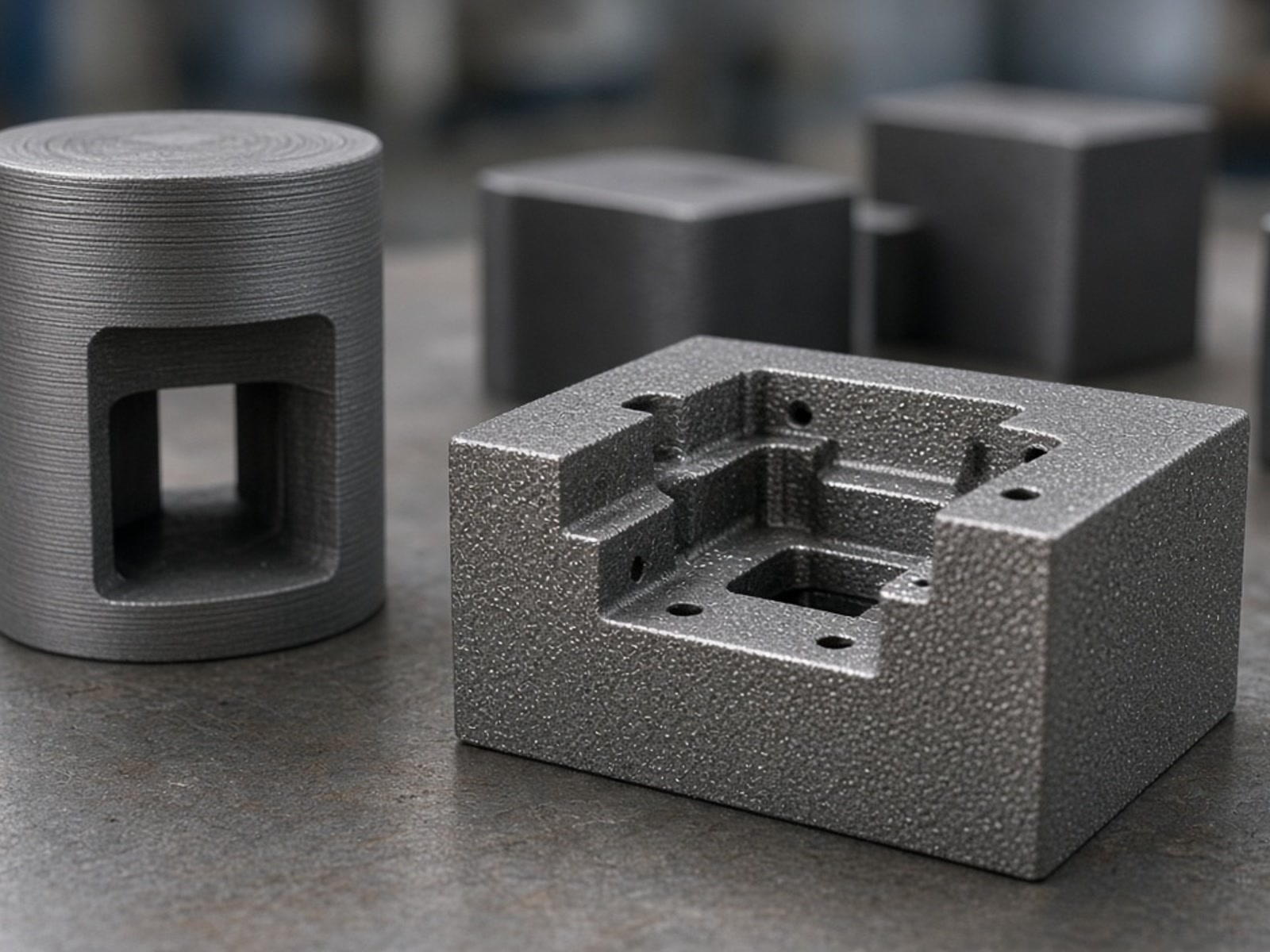
H13
Hot-work tool steel grade
1.2709
Maraging steel grade
M2
High-speed steel grade
Common Tool Steel Alloys in Additive Manufacturing
Industrial 3D printing typically utilizes specific grades of tool steel that respond well to the rapid heating and cooling cycles of metal additive processes.
H13 Tool Steel
Known for excellent temper resistance and thermal fatigue cracking resistance. A frequent choice for hot-work applications such as die-casting inserts and extrusion tools.
Maraging Steel (1.2709)
Favored for high strength, toughness, and dimensional stability during heat treatment. Widely used for high-pressure die casting and high-performance engineering components.
M2 High-Speed Steel
Used for cutting tools and industrial blades due to its high wear resistance and hardness.
Key Advantages of Additive Tooling
The primary driver for selecting tool steel 3D printing over traditional manufacturing is the ability to optimize part function through geometric complexity.
Conformal Cooling Channels
In injection molding, cooling time often accounts for a significant portion of total cycle time. 3D printing allows internal paths that follow the contour of the mold cavity, ensuring uniform heat dissipation, reducing cycle times, and minimizing part warping.
Weight Reduction and Topology Optimization
For end-of-arm tooling (EOAT) or high-speed machinery components, 3D printing can reduce the mass of tool steel parts. By placing material only where it is required to handle mechanical loads, engineers can reduce the inertia of moving assemblies without sacrificing structural integrity.
Consolidating Assemblies
Complex tool assemblies that traditionally require multiple machined components, fasteners, and seals can often be printed as a single monolithic part. This reduces the risk of leaks in cooling lines and simplifies inventory management.
Engineering and Design Considerations
Tool steel 3D printing requires rigorous engineering review to ensure the final part meets the necessary mechanical specifications. Four factors commonly shape the design and post-processing plan.
Heat Treatment
Parts printed in tool steel typically require post-process heat treatment, such as quenching and tempering, to achieve their target hardness and toughness.
Surface Finish
The "as-printed" surface of metal additive parts is generally matte and slightly textured. For mating surfaces, seal grooves, or mold cavities, secondary CNC machining or polishing is required to achieve high-precision tolerances and mirror finishes.
Stress Management
High thermal gradients during the printing process can induce internal stresses. Design features such as generous radii and consistent wall thicknesses help mitigate the risk of cracking or distortion.
Support Structures
Metal printing requires sacrificial support structures to anchor the part and dissipate heat. Support placement must be considered during the design phase to ensure they can be removed during post-processing.
Selecting Between Metal and High-Performance Polymers
While tool steel is essential for high-temperature and high-wear tooling, many industrial applications such as jigs, fixtures, and functional prototypes may be better served by high-performance polymers.
At RapidPrintParts, we focus on industrial polymer processes including FDM (Fused Deposition Modeling), SLS (Selective Laser Sintering), and MJF (Multi Jet Fusion). For applications where tool steel might be over-engineered, materials such as PA-CF (Carbon Fiber Reinforced Nylon) or PEEK can offer significant strength and chemical resistance with faster lead times and lower costs.
Jigs and Fixtures
If the tool does not encounter extreme heat or abrasive wear, SLS or MJF Nylon 12 provides sufficient durability for assembly aids.
Functional Prototypes
Before committing to expensive tool steel production, FDM with PC (Polycarbonate) or ASA can validate fit and function.
Bridge Production
For low-volume end-use parts, MJF and SLS offer isotropic properties that can replace metal components in non-structural or medium-load applications.
Engineering Review for Industrial Parts
Successful implementation of additive manufacturing—whether in metal or polymer—depends on a clear understanding of the operating environment. When evaluating a project, our engineering team reviews several critical factors.
Mechanical Load
The direction and magnitude of forces acting on the part.
Thermal Requirements
Continuous and peak operating temperatures.
Chemical Exposure
Contact with oils, solvents, or industrial cleaning agents.
Dimensional Tolerances
Identifying which features require "as-printed" tolerances and which require secondary machining.
Request a Technical Review
For assistance in selecting the appropriate process and material for your functional industrial components, contact the RapidPrintParts engineering team for a technical review of your STEP/STP files and application requirements.
- Share your STEP/STP files and application requirements.
- Review mechanical, thermal, chemical, and tolerance factors.
- Receive guidance on whether a polymer process suits your part.
No. 17-1, Guanlan Avenue, Longhua District, Shenzhen, Guangdong Province, Shenzhen 3D Printing Industrial Park
Contact RapidPrintParts
Get in Touch
We are here to answer your questions about industrial additive manufacturing and functional 3D printed parts. Reach out to us through the following methods:
Email: [email protected]
Address: No. 17-1, Guanlan Avenue, Longhua District, Shenzhen, Guangdong Province, Shenzhen 3D Printing Industrial Park