3D Printed Automotive Parts
In the automotive sector, the transition from design to physical component requires solutions that balance speed, material performance, and geometric complexity. At RapidPrintParts, we support automotive engineers and manufacturers by producing functional industrial parts that move projects from validation to assembly.
- Processes
- FDM / FFF, SLA, SLS, MJF
- Focus
- Functional & end-use parts
- Inputs
- CAD / STEP / STP & 2D drawings
Applications in Automotive Engineering
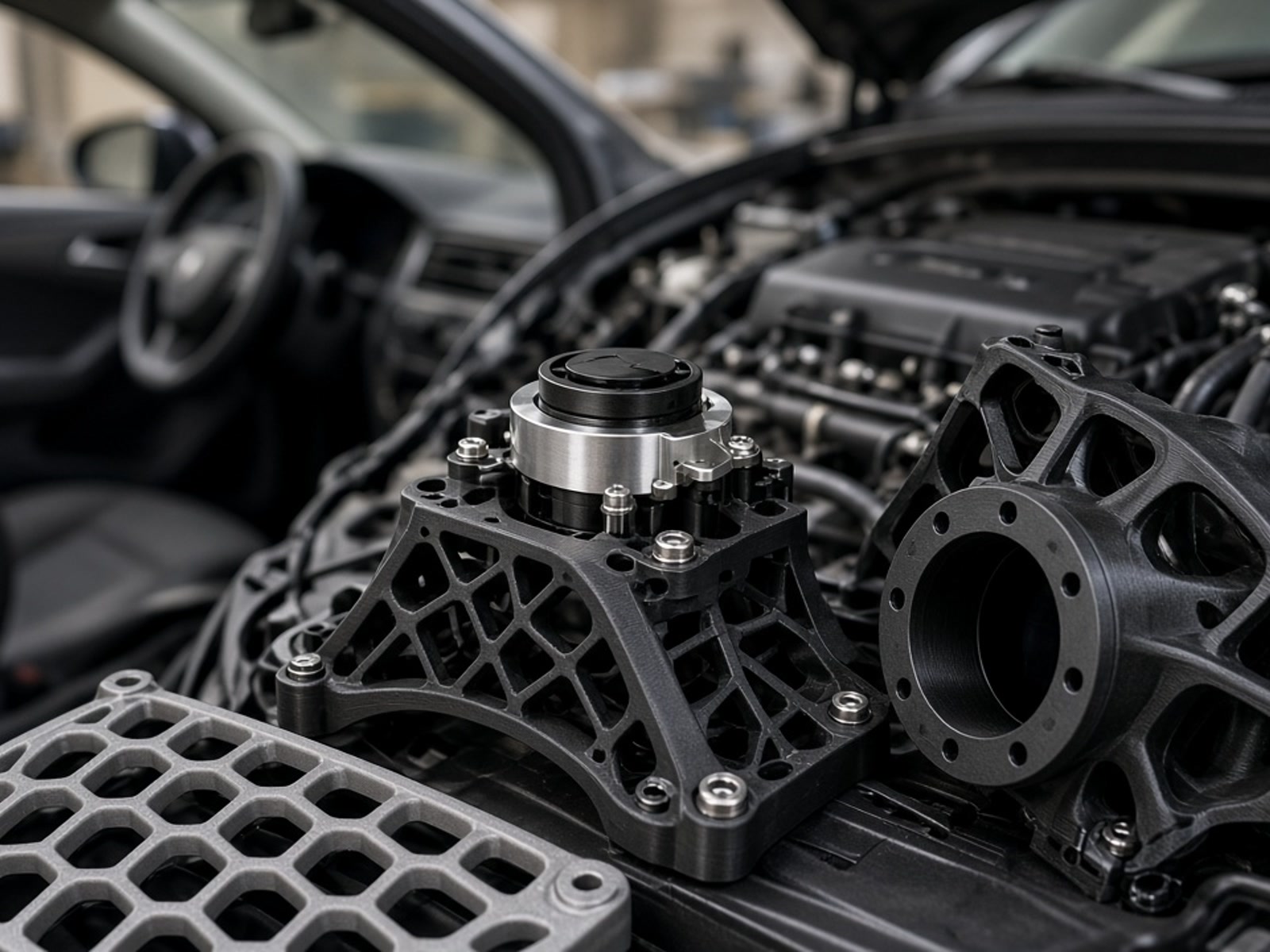
Additive manufacturing is widely utilized in the automotive industry to reduce lead times and avoid the high costs associated with traditional tooling for low-volume requirements. Our in-house processes are suited for the following areas.
Functional Prototypes
Validation parts for design verification (DV) and production verification (PV) testing.
Jigs and Fixtures
Custom assembly aids, drilling templates, and check fixtures designed to improve production line efficiency.
Mechanical Components
Housings, ducts, brackets, and interior components that require specific mechanical or thermal properties.
Replacement Parts
Low-volume production or custom replacements for legacy vehicles or obsolete OEM components.
Bridge Production
Manufacturing end-use parts while waiting for permanent tooling or to support low-volume production runs.
From Validation to Assembly
One partner for prototypes, tooling aids, and low-volume end-use parts across the automotive workflow.
Selecting the Right Process
Choosing the correct additive technology depends on the operating environment, load, and thermal requirements of the automotive application.
FDM / FFF
Rigid & LargeIdeal for large structures and durable equipment parts. With 18 machines and materials including ABS, ASA, PC, and high-performance options like PEEK, this process is well-suited for rigid brackets, large housings, and custom fixtures.
- •Rigid brackets and large housings
- •Custom fixtures and durable equipment
SLA
Detail & FinishBest for parts requiring high detail and smooth surface finishes. SLA is typically used for fit-and-appearance validation and complex prototypes where dimensional accuracy is critical.
- •Fit-and-appearance validation
- •Complex prototypes and smooth surfaces
SLS and MJF
Functional NylonThese powder-bed fusion processes are the standard for functional, durable nylon parts. Using materials like PA12, PA11, and glass-filled variants, these processes provide the isotropic strength needed for automotive components that must withstand mechanical stress.
- •PA12, PA11, and glass-filled variants
- •Isotropic strength for mechanical stress
Engineering Considerations
To ensure that 3D printed parts meet the requirements of an automotive application, we evaluate several key inputs during our engineering review.
Every project starts with an engineering review.
Share your application details so we can help determine the optimal material and process.
Start a Review-
Operating Environment
Does the part require chemical resistance, thermal stability, or flame-retardant properties?
-
Mechanical Load
Will the part be subject to vibration, impact, or continuous stress?
-
Tolerance Requirements
Standard tolerances vary by process (e.g., ±0.2 mm or ±0.3% for FDM; ±0.3 mm or ±0.3% for SLS). Guaranteed tolerances require engineering review.
-
Post-Processing
Depending on the application, parts may require blasting, sanding, vapor smoothing, or secondary machining such as tapping and drilling for inserts.
Quality and Documentation
For automotive projects requiring traceability, we provide quality support that may include first article inspection, dimensional inspection reports, material documents, and certificates of conformity. We work with CAD/STEP/STP files and 2D drawings to align our manufacturing process with your specific technical documentation standards.
- First article inspection
- Dimensional inspection reports
- Material documents
- Certificates of conformity
Accepted Input Formats
Aligned to your specific technical documentation standards.
Request an Engineering Review
Because automotive applications often involve specific performance criteria, we recommend an engineering review for every project. By providing your application details—such as the intended use, load requirements, and expected environment—we can help determine the optimal material and process for your needs.
Are you ready to discuss your automotive part requirements?
Please provide your STEP/STP files, 2D drawings, and a summary of your performance requirements to begin the evaluation process.
Email: [email protected]
Address: No. 17-1, Guanlan Avenue, Longhua District, Shenzhen, Guangdong Province, Shenzhen 3D Printing Industrial Park
Contact RapidPrintParts
Get in Touch
We are here to answer your questions about industrial additive manufacturing and functional 3D printed parts. Reach out to us through the following methods:
Email: [email protected]
Address: No. 17-1, Guanlan Avenue, Longhua District, Shenzhen, Guangdong Province, Shenzhen 3D Printing Industrial Park